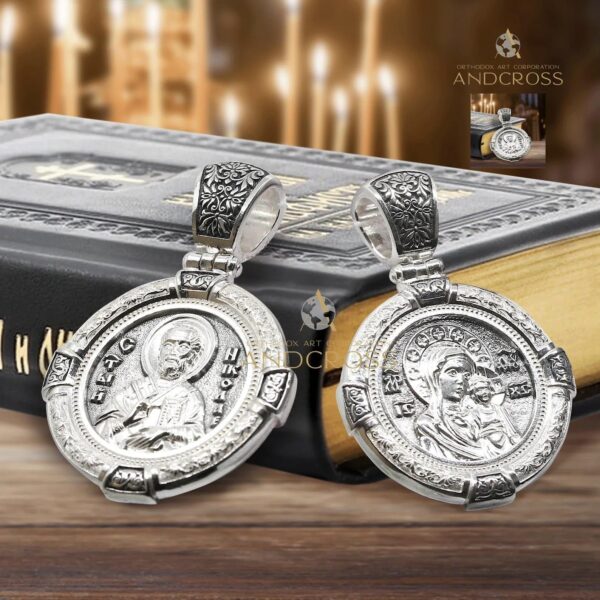
Andcross Orthodox online store offers a wide range of Orthodox products - gift sets, icons, icon cases, books, monastery candles, jewelry and much more. Some of the products of our own production, as well as from other suppliers - monasteries, temples, masters of the entire Orthodox world.
Andcross Orthodox Online Store - Established in 1999

A cross worn at baptism, placed above an icon corner, or given for a feast day is never merely an ornament. Understanding cross crucifix differences helps an Orthodox Christian or thoughtful gift buyer choose an item whose form speaks faithfully about Christ’s sacrifice, victory, and abiding protection.
A cross is the sacred sign of the Lord’s saving Passion. It may be plain, engraved, decorated with vines or prayer inscriptions, or shaped according to a particular Orthodox tradition. A cross can be worn as a pendant, held in prayer, placed on a wall, or kept with an icon and prayer book.
A crucifix is a cross that includes an image of the crucified Christ. The figure of Christ upon the Cross is often called the corpus in Western Christian art. In Orthodox usage, one may also speak of a Crucifixion cross or a cross with the Crucifixion image. The distinction is useful, but it should not suggest that one form honors the Cross more deeply than the other. Both direct the faithful toward the same saving mystery.
The plain cross presents the Cross itself as the weapon of peace, the sign of Christ’s triumph over death. A crucifix brings the viewer directly before the holy Passion, inviting repentance, gratitude, and contemplation of the love shown at Golgotha. Which is more suitable depends on the purpose, the tradition of the recipient, and the iconographic form.
For Orthodox Christians, the Cross cannot be separated from the Resurrection. Christ truly suffered and died, yet His voluntary Passion is already a victory. This theological vision shapes Orthodox sacred art, including crosses with the image of the Savior.
An Orthodox Crucifixion image usually portrays Christ with dignity and peace, not as a figure overcome by despair. His head is bowed in voluntary surrender. The halo commonly bears the words meaning “He Who Is,” a confession of His divine identity. Traditional inscriptions may use Greek, Church Slavonic, or another liturgical language, depending on the origin of the piece.
Many Orthodox crucifixes also include the title above Christ’s head, angels mourning, the Mother of God and Saint John the Theologian standing nearby, or the skull of Adam beneath the Cross. These details are not decorative additions. They proclaim the fullness of salvation: through Christ’s Cross, death is defeated and fallen humanity is restored.
By contrast, a plain Orthodox cross may bear the initials IC XC, the traditional inscription “Save and Protect,” a prayer, or a floral and vine pattern. It may be intentionally simple, especially for a baptismal cross worn daily and close to the body. The absence of the crucified figure does not make it less devotional. It allows the sign of the Cross to stand with great clarity.
Not every cross has the same outline. The familiar Latin form has one long vertical beam and a shorter horizontal bar. It is widely recognized and is used by Christians across many traditions.
The Russian Orthodox cross often has three crossbars: a small upper bar for the inscription above Christ’s head, the principal horizontal bar for His hands, and a slanted lower footrest. The raised end of the footrest points toward the repentant thief who entered Paradise, while the lowered end recalls the thief who rejected Christ. This is a meaningful symbol, although individual Russian and Slavic crosses vary in proportion and detail.
Greek Orthodox crosses are frequently more balanced in shape, with four arms of equal or nearly equal length. Byzantine-style crosses may be richly ornamented, sometimes with expanding ends, intricate openwork, or engraved prayer texts. Celtic, Jerusalem, Ethiopian, and other historic Christian forms also appear in devotional art. Their use requires sensitivity to the recipient’s church background and personal devotion.
A cross’s shape alone does not always determine whether it is Orthodox, Catholic, or Protestant. Craft traditions overlap, and older sacred forms have traveled widely among Christian peoples. The inscriptions, iconography, material, and intended use often provide better guidance than shape alone.
People often describe an Orthodox cross as having Christ shown alive and a Western crucifix as showing Christ suffering. There is truth in the broad observation, but it is too simple to be a rule. Sacred art developed across centuries, and both East and West contain many forms.
Western crucifixes, particularly in later medieval and modern devotional art, may emphasize the physical suffering of Christ with dramatic detail. This can call the believer to profound compassion and repentance. Orthodox iconography tends to preserve a more liturgical stillness. The Savior’s suffering is real, but His divine majesty and willing self-offering remain visible.
Details such as the number of nails, the position of Christ’s feet, the form of the crown, or the wording above the Cross also differ among periods and regions. These are meaningful artistic and theological choices, yet they should not become a reason to judge another Christian’s devotion casually. When selecting an item for Orthodox prayer or as an Orthodox gift, choosing a piece made according to established Orthodox iconographic tradition is the clearest path.
A daily-worn cross should be prayerful, durable, and comfortable. For many Orthodox Christians, especially after baptism, a modest pectoral cross is the natural choice. It may be silver, gold, gold-plated silver, wood, or another suitable material. A simple cross with a clearly formed image and a smooth reverse side is often easier to wear continuously.
If the recipient values traditional Russian Orthodox symbolism, a three-bar cross with the customary slanted footrest may be especially fitting. A small Crucifixion cross can also be appropriate when it follows Orthodox iconographic forms and remains practical for daily wear.
Consider proportion as carefully as material. A large, highly detailed cross can be beautiful for feast-day wear or a formal gift, but a smaller pendant may better serve someone who works, travels, or sleeps while wearing it. Fine engraving is best appreciated on a piece large enough to show the holy inscriptions clearly.
For a baptism, birth, name day, or anniversary, precious metal may express the lasting importance of the occasion. Silver has a long place in Orthodox devotional craftsmanship and can be both refined and accessible. Gold, white gold, rose gold, platinum, and custom-made pieces may be chosen for a family heirloom. The worth of the gift rests first in its sacred purpose, not in its price, yet careful workmanship honors that purpose.
A wall cross has a different calling than a pendant. It becomes part of the prayer life of a home, often placed near icons, a lampada, prayer books, and candles. Here, greater detail can be appropriate. A carved wooden cross, cast metal Crucifixion cross, or cross paired with the Mother of God and Saint John can give an icon corner a strong visual focus.
For a home with a well-established Orthodox icon corner, select a wall cross that harmonizes with the icons rather than competing with them. Bronze-toned metalwork, silver plating, carved wood, and restrained enamel can all be suitable. A large piece with highly polished stones may be meaningful as a commemorative gift, but it should still preserve reverence and legibility.
A crucifixion scene is particularly fitting for a prayer space when the family desires a vivid remembrance of the Passion. A plain cross may be preferable where the icon corner already contains a Crucifixion icon or where simplicity is part of the household’s devotional character. There is no need to force a choice between them. Each can have its rightful place.
An item described as Orthodox should be more than a familiar-looking religious design. Its imagery should respect church tradition, its inscriptions should be accurate, and its craftsmanship should allow the sacred image to be received with reverence. Crosses made by Orthodox artisans, workshops, monasteries, or temple-connected makers often carry the visible care of a living tradition.
Some Christians prefer a cross that has been blessed or consecrated before it reaches them. Others bring a newly purchased cross to their parish priest for blessing. Local pastoral practice differs, so the surest approach is to follow the guidance of one’s priest. A blessing does not turn a fashionable object into a novelty; it sets apart a worthy sacred item for prayerful use.
When giving a cross or crucifix, presentation matters as well. A well-made gift box protects the piece and marks the occasion with dignity. Include a note naming the feast, baptism, wedding, memorial, or name day being remembered. If you are uncertain about the recipient’s tradition, a traditional Orthodox cross in silver or gold-plated silver is often a gracious and enduring choice. Andcross offers forms rooted in Orthodox craftsmanship for those seeking such a gift.
The best choice is not always the most elaborate cross or the most detailed crucifix. It is the one that can be received in faith, worn or displayed with reverence, and returned to in prayer. When uncertainty remains, choose a traditional form with clear Orthodox symbolism, honest materials, and careful workmanship. The Cross then becomes what it is meant to be: a quiet, holy reminder that Christ has conquered death and remains near to those who call upon Him.



Use this form to find things you need on this site