Andcross Orthodox online store offers a wide range of Orthodox products - gift sets, icons, icon cases, books, monastery candles, jewelry and much more. Some of the products of our own production, as well as from other suppliers - monasteries, temples, masters of the entire Orthodox world.
Andcross Orthodox Online Store - Established in 1999

A first icon is often chosen in a moment of need: a small image of Christ for a new home, the Theotokos for a child’s room, or a patron saint given at baptism. Over time, these holy images may become a meaningful collection. Yet icon collecting is not the pursuit of decoration, rarity, or visual variety alone. For an Orthodox Christian, it is the careful gathering of windows into prayer, each one calling the heart toward Christ and the communion of saints.
The best collection does not need to be large. It should be truthful, prayerful, and suited to the life of the household. Whether you are establishing your first icon corner or selecting a gift for a loved one, the central question is not simply, “Which icon is beautiful?” It is, “Which holy image will help us pray faithfully?”
The Orthodox Church honors icons because the Son of God truly became man. In the Incarnation, the invisible God was made visible in Jesus Christ. An icon does not replace worship of God, nor is it a charm. It is venerated with reverence, directing honor to the person depicted: Christ, His Most Pure Mother, the angels, and the saints.
This changes how an Orthodox family approaches icon collecting. A collector may appreciate fine egg tempera, hand-chased silver, gold plating, intricate oklads, or old-world Russian and Greek styles. Such craftsmanship has real value, especially when it preserves traditional forms. But the icon remains a sacred image before it is an object of display.
Begin with a brief prayer and a practical intention. Perhaps you need an icon for daily morning prayers, a named saint for a birthday gift, or an image of a feast day especially beloved by your family. This intention will give your collection coherence and keep purchases from becoming random.
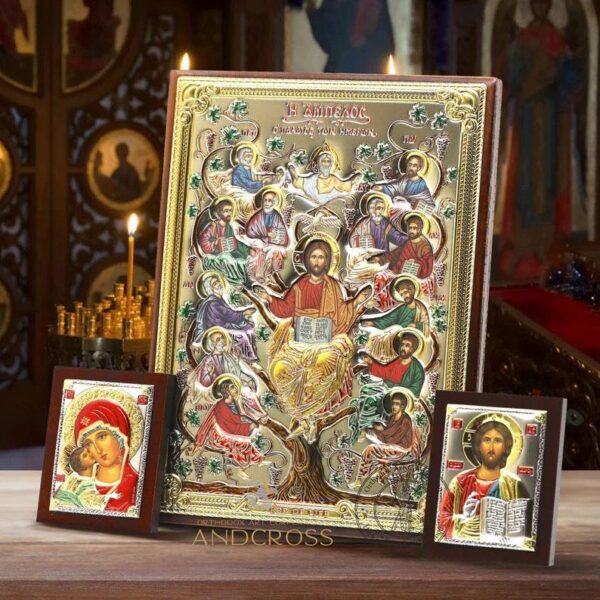
Most home icon corners are centered on Christ and the Mother of God. These are the natural foundation of a prayerful home. An icon of Christ Pantocrator, Christ the Teacher, or the Savior Not Made by Hands may be chosen according to family custom and spiritual connection. For the Theotokos, many Orthodox Christians choose the Kazan, Vladimir, Tenderness, or Hodegetria type.
The precise arrangement differs among households and local traditions. In many homes, the icon of Christ is placed to the right and the icon of the Theotokos to the left when facing the icon corner. A cross, vigil lamp, candleholder, prayer book, and small censer may also have their place. Keep the area clean, dignified, and reserved for prayer rather than ordinary household storage.
After these central images, add icons with a true place in your life. A patron saint is a fitting next choice. So are the saints of spouses and children, a family’s baptismal saint, or a saint whose prayers have become especially dear. An icon of the Holy Trinity, the Guardian Angel, Saint Nicholas, Saint George, Saint Seraphim of Sarov, Saint Xenia of Petersburg, or another beloved saint may be appropriate, depending on your Orthodox tradition and need.
There is no requirement to collect the most famous icons. A modest icon of your heavenly patron, prayed before faithfully, can be more precious to a family than an entire wall of images chosen without connection.
Feast icons also bring the Church calendar into the home. The Nativity of Christ, Theophany, Transfiguration, Crucifixion, Resurrection, Ascension, Pentecost, and Dormition of the Theotokos are especially meaningful choices. They help adults and children contemplate the feasts beyond a single day at church.
For a baptism, name day, wedding, house blessing, memorial, or pastoral gift, select the image with care. The recipient’s patron saint, a wedding icon pair of Christ and the Theotokos, or an icon associated with consolation and protection can carry lasting spiritual significance.
A beautiful religious picture is not always a canonical Orthodox icon. When purchasing, look for imagery that respects the Church’s received tradition. The saint should be correctly identified, the inscriptions should be appropriate, and the composition should reflect Orthodox iconographic forms rather than sentimental fantasy.
Traditional icons may be painted on wood, printed on prepared board, mounted under glass, set in a silver or gold-plated cover, or finished with an ornate metal riza. Each form has its place. A hand-painted icon offers the distinct presence of an artisan’s work and may become a family heirloom. A carefully produced printed icon can be an accessible, worthy choice for daily prayer, travel, or gift giving. Silver and gold-plated icons offer both protection and festal beauty, particularly for baptisms, weddings, and nameday gifts.
Materials matter, but they are not the only measure of worth. If an icon is presented as silver, the purity should be clearly stated, such as 925 sterling silver. Dimensions should be given so that the buyer can judge how the icon will fit in a home prayer corner. A gift box or protective case is valuable when the icon will be presented for a sacrament or sent to family at a distance.
It is also wise to ask whether an icon has been blessed or consecrated according to local practice. Customs differ. Some icons are blessed before sale, while others are brought to a parish priest for blessing after purchase. A clear description helps buyers proceed with reverence and confidence.
Antique icons can carry historical and artistic interest, but age alone does not make an icon spiritually superior. Buyers should be cautious about uncertain provenance, heavily damaged boards, later repainting, and reproductions presented as old works. Restoring an antique icon is specialized work. Aggressive cleaning, household polish, or attempts to remove darkened varnish can cause permanent damage.
If an older icon has been inherited, keep it in a stable place away from direct sunlight, dampness, and strong heat. Consult a qualified conservator for significant cracking, flaking paint, or detached metalwork. Never treat a sacred image as an ordinary antique in need of a quick cosmetic repair.
A growing icon collection benefits from restraint. A home can hold many icons without becoming crowded, but each image should still be visible and treated with honor. If space is limited, rotate smaller feast icons during the liturgical year while keeping Christ, the Theotokos, and patron saints in their established places.
It may help to think in terms of a few related groups: the icon corner, family patron icons, feast icons, travel icons, and gift icons. This is not a rigid system, only a useful way to choose thoughtfully. A small folding triptych or compact metal icon may be ideal for travel. A larger silver-covered icon may be fitting for a wedding or a prominent place in the home. The right choice depends on use, budget, available space, and the customs of the recipient.
Avoid placing icons where they are likely to be knocked over, exposed to cooking grease, or mixed casually with unrelated ornaments. The traditional east-facing placement is meaningful where possible, but it is not always practical in a modern apartment or house. A clean, quiet wall or shelf used consistently for prayer is far better than an ideal direction that cannot be maintained.
Good care is usually simple. Handle icons with clean, dry hands. Dust gently with a soft, dry cloth or a clean soft brush around carved details. Do not use water, sprays, alcohol, furniture polish, abrasives, or chemical cleaners on painted surfaces, gilding, or printed finishes. Metal covers should also be cleaned cautiously, especially when they have enamel, stones, or delicate relief work.
Keep candles and vigil lamps at a safe distance. Their light belongs naturally in the icon corner, but heat, soot, and open flame can damage icons and create a fire hazard. Use stable holders and never leave a burning candle unattended.
When moving or storing an icon, wrap it in clean, acid-free tissue or a soft cloth and place it upright in a protective box. Do not stack heavy items on top. If an icon is cracked, damaged, or no longer suitable for use, ask a priest for guidance rather than discarding it casually.
An icon is among the most personal gifts an Orthodox Christian can offer. It says more than “I remembered the occasion.” It is a prayer that the recipient may know the nearness of Christ and the intercession of His saints.
Choose a gift icon by name, feast, sacrament, or need. A patron saint icon is especially fitting for a name day. Christ and the Theotokos are appropriate for a newly married couple. A Guardian Angel or baptismal saint may be chosen for a child. For someone beginning an Orthodox life, a modest, canonical icon with a prayer book can be more useful than an elaborate piece chosen only for appearance.
Fine workmanship and gift-ready presentation show care, particularly for baptisms and milestone occasions. At the same time, the most meaningful gift is one selected with prayer and offered without display. The holy image should invite the recipient into a living relationship with the Church, not impose an expectation of worldly value.
A collection of icons grows best as a household grows in prayer. Choose patiently, learn the saints’ lives, honor the feasts, and make room before the holy images for stillness. Over the years, the icons in your home may become a quiet record of baptisms, names, sorrows, thanksgiving, and the enduring mercy of God.



Use this form to find things you need on this site