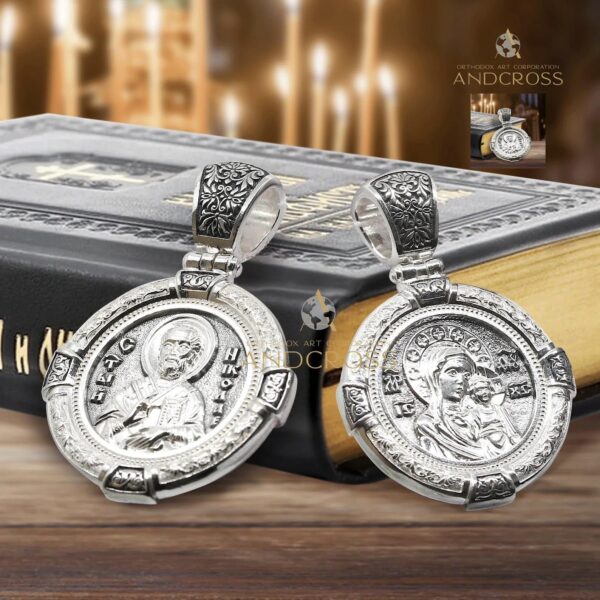
Andcross Orthodox online store offers a wide range of Orthodox products - gift sets, icons, icon cases, books, monastery candles, jewelry and much more. Some of the products of our own production, as well as from other suppliers - monasteries, temples, masters of the entire Orthodox world.
Andcross Orthodox Online Store - Established in 1999
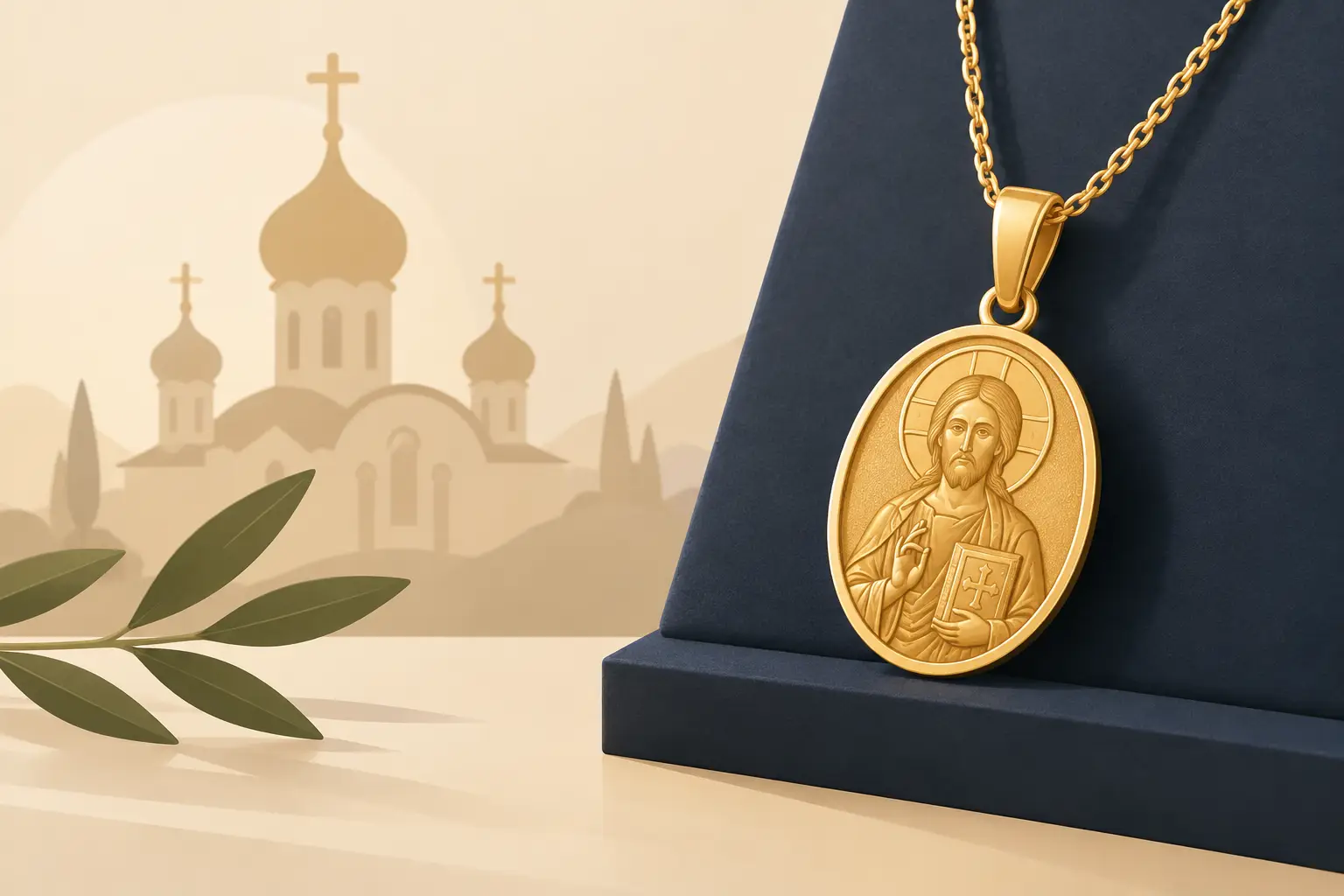
A pendant worn close to the heart can become part of a person’s daily rule of prayer. Gold pendant commissions offer Orthodox Christians a way to order a piece that is personal in its material, scale, and dedication while remaining faithful to the sacred image it bears. Whether the pendant is intended for a baptism, a name day, a wedding, a memorial gift, or quiet personal devotion, the first concern should be reverence for the Cross, the Mother of God, or the saint depicted.
A commissioned pendant is not simply jewelry chosen for its appearance. It is a devotional object made to be worn, kissed, and remembered in prayer. That distinction should guide every decision, from the iconography and inscription to the gold color and the final presentation.
A commission is especially meaningful when a ready-made pendant cannot fully express the occasion or the person receiving it. A family may wish to order a baptismal cross in yellow gold with a child’s patron saint on the reverse. Someone preparing a gift for a godchild may seek a small pendant of the Guardian Angel, sized for daily wear. For a memorial, a client may ask for an image of Christ, the Theotokos, or the saint whose name was carried by the departed.
Gold is valued not only for its beauty and durability, but also for the care it gives to an object meant to remain with its owner for many years. Yet gold is not the only worthy choice. Sterling silver has a quiet traditional character and may suit a larger icon pendant. Platinum is exceptionally durable and restrained in appearance. The best metal depends on the design, budget, intended wearer, and frequency of use.
Commissioning also allows practical choices that ready-made pieces may not offer. A pendant can be adjusted for a child or an adult, made with a larger bail for a preferred chain, or finished in yellow, white, or rose gold. A small change in dimensions matters: an image that is richly detailed at a larger scale may become difficult to read if reduced too far.
For an Orthodox pendant, personal meaning should never replace the Church’s received tradition. A workshop should work from recognizable canonical imagery rather than inventing sentimental religious scenes or altering sacred figures to follow passing fashion. The image must remain clear, dignified, and appropriate to the small format of a pendant.
The Cross is the most common foundation for a commission. Clients may choose an Orthodox eight-pointed cross, a crucifixion cross with traditional inscriptions, or a cross paired with a short prayer on the reverse. The exact arrangement depends on the available surface and the desired level of detail. A cross that is too crowded can lose the strength and clarity that make it suitable for daily devotional use.
Saint pendants require the full and correct name of the saint. This is particularly important where several saints share a name. Saint Nicholas the Wonderworker, Saint George the Victory-Bearer, Saint Xenia of Saint Petersburg, Saint Seraphim of Sarov, and Saint Olga are all distinct sacred images with established iconographic traditions. Providing the baptismal name, feast day if known, and preferred language for the inscription helps the craftsman prepare the design correctly.
For images of the Lord, the Theotokos, and the saints, the request should be made with humility. A pendant may carry an engraved or relief icon, but it should not be treated as a decorative motif. If there is any uncertainty about a particular image, wording, or use, it is wise to seek guidance from one’s priest.
Gold pendant commissions begin with an honest conversation about how the piece will be worn. A highly polished gold surface offers warmth and brightness, while an oxidized or matte background can bring forward the relief of the icon. White gold can give a cooler, more restrained appearance. Yellow gold often suits classical Orthodox imagery beautifully, especially when paired with a traditional engraved border.
The gold purity also affects the result. Higher-karat gold has a richer color, while lower-karat alloys are generally harder for everyday wear. There is no single correct answer. A fine, detailed pendant for special occasions may call for one approach; a cross worn constantly by an active child or adult may call for another. The thickness of the pendant and the strength of the bail deserve as much attention as the front image.
Size should be considered in relation to the image. A small cross can be discreet and deeply meaningful, but fine inscriptions may need to be shortened or enlarged to remain legible. A larger medallion creates more room for a saint’s image, border, and prayer, but it can feel heavier on a chain. A thoughtful workshop will explain these trade-offs before production begins rather than promising detail that cannot be faithfully executed.
An inscription can make a commissioned pendant uniquely personal, but restraint is usually best. Traditional words often carry more spiritual weight than a long personal message. Depending on the pendant, suitable inscriptions may include the saint’s name, “Save and Protect,” the Jesus Prayer in abbreviated form, or a short scriptural phrase. Church Slavonic, Greek, English, and other languages may be appropriate when the spelling and liturgical form are confirmed.
On a baptismal gift, a name and date may be added where space allows. For a memorial piece, the name of the departed may be placed discreetly on the reverse. Avoid filling every open area. The sacred image should remain the center, and text should support prayer rather than compete with it.
Before the pendant enters production, the client should review the spelling, placement, and preferred alphabet carefully. This is a small but essential step. Precious metalwork is lasting, and a correct inscription honors both the recipient and the saint invoked.
A good custom order begins with clear details rather than vague inspiration. The workshop needs to know the preferred sacred image, metal, approximate dimensions, chain or bail requirements, inscription, and occasion. Reference images can help identify a traditional icon type, but the final design must be adapted responsibly for the pendant’s shape and size.
Once the concept is established, the client should receive a clear description of the proposed work. This may include the metal, purity, dimensions, finish, relief or engraving method, inscription, and estimated production time. Because precious-metal prices and handcrafted labor vary, commissions are typically priced individually. A complex double-sided pendant with detailed engraving will require a different investment than a simple small cross.
Handmade work also requires patience. Casting, engraving, polishing, stone setting when requested, and final inspection each take time. If the pendant is needed for a baptism or feast day, it is best to begin early. Rushing sacred craftsmanship can lead to compromises in detail, finish, or communication.
At Andcross, custom work may be created in silver, platinum, and several gold colors, allowing a commission to be matched to both the spiritual purpose and the practical needs of the wearer. A gift-ready case is also worth considering, particularly when the pendant will be presented at a baptism, wedding, or significant family gathering.
A gold pendant should be cared for as both a precious object and a holy reminder. Store it carefully when it is not worn, protect it from harsh chemicals, and inspect the chain and bail from time to time. If the pendant is blessed, treat it with the reverence given to a sacred article. Blessing is ordinarily received from a priest; it is not replaced by the beauty of the design or the value of the metal.
The finest commission is not necessarily the largest, most elaborate, or most expensive one. It is the pendant whose image is true to Orthodox tradition, whose workmanship will endure, and whose presence gently calls its wearer back to Christ in the ordinary hours of life.



Use this form to find things you need on this site