Andcross Orthodox online store offers a wide range of Orthodox products - gift sets, icons, icon cases, books, monastery candles, jewelry and much more. Some of the products of our own production, as well as from other suppliers - monasteries, temples, masters of the entire Orthodox world.
Andcross Orthodox Online Store - Established in 1999
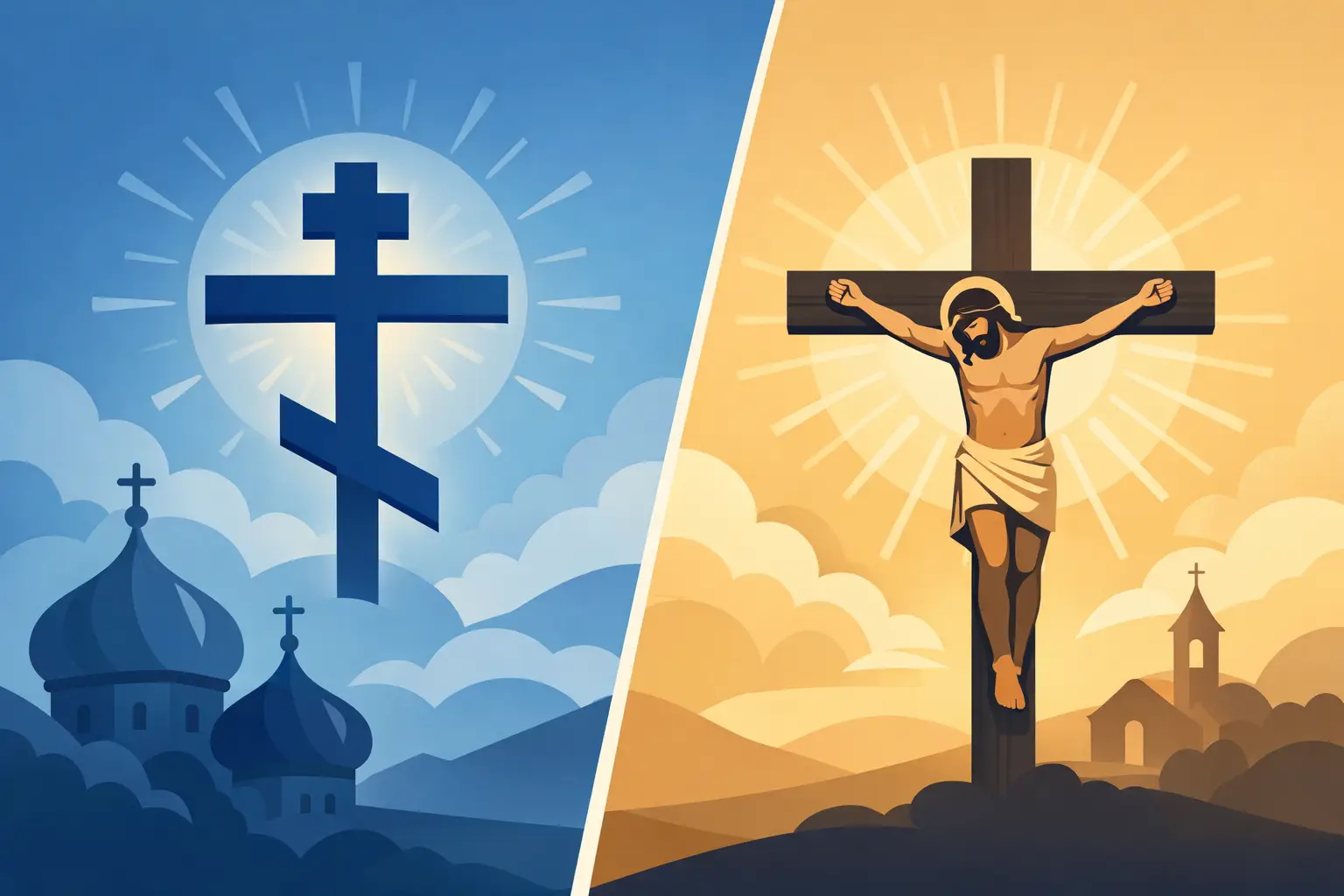
A cross worn at baptism, placed in a prayer corner, or given for a feast day is never merely an ornament. The question of Orthodox cross versus crucifix often arises when someone is choosing a pendant, a house blessing gift, or an image for prayer. The visible difference is real, but the deeper answer begins with what both sacred forms proclaim: Christ’s saving sacrifice and His victory over death.
A cross is the central sign of Christian faith. A crucifix is a cross that bears the visible figure of the crucified Lord. Orthodox Christians honor the Cross profoundly, yet the forms, inscriptions, and artistic language used in Orthodox devotional objects may differ from those familiar in Roman Catholic or Western Christian settings.
In ordinary usage, a cross is the form of the instrument of Christ’s Passion without a depiction of His body. It may be plain, engraved, or decorated with traditional Orthodox inscriptions and symbols. Orthodox baptismal crosses, pectoral crosses, wall crosses, and grave crosses are often made in this form.
A crucifix includes the figure of Christ upon the Cross. The word describes the object itself, not a different doctrine of salvation. Both an empty cross and a crucifix direct the faithful toward the Crucifixion and the Resurrection. The choice between them is usually shaped by local tradition, family custom, prayer practice, and the intended use of the item.
It is not correct to say that Orthodox Christians never use images of Christ crucified. Orthodox churches have a rich iconographic tradition of the Crucifixion. These icons are especially prominent during Holy Week, and they present the Passion with reverence, theological depth, and liturgical meaning. At the same time, many Orthodox personal crosses are made without the corpus, the figure of Christ’s body, and may carry inscriptions that confess the Cross as a sign of triumph.
There is no single shape used by every Orthodox people. The Greek cross, with four equal arms, is widely recognized. So is the familiar Russian Orthodox cross, often called the eight-pointed cross. This form has a short upper bar, a longer central bar, and a lower slanted footrest.
The upper bar is commonly associated with the inscription placed above Christ’s head. In Orthodox depictions, it may bear Greek or Church Slavonic abbreviations, including inscriptions confessing Christ as the King of Glory. The central bar is the crossbeam on which Christ’s hands were nailed. The lower bar represents the footrest.
The slanted footrest has received symbolic interpretation in Orthodox teaching. Its raised end is often understood as pointing toward the repentant thief who entered Paradise, while its lowered end recalls the thief who rejected Christ. This symbolism calls the viewer to repentance, faith, and a sincere response to the mercy offered on Golgotha.
Six-pointed Orthodox crosses, four-pointed crosses, and other regional forms also exist. A person should not assume that one form is more Orthodox simply because it is more elaborate. The Church’s tradition is broader than one national style. A Greek, Serbian, Romanian, Antiochian, Ukrainian, or Russian Orthodox Christian may encounter different forms while remaining within the same confession of faith.
An Orthodox cross may include the abbreviation IC XC for Jesus Christ, along with NIKA, meaning “conquers” or “is victorious.” Some crosses bear the words “Save and Protect,” particularly in the Slavic tradition. Others include a skull beneath the Cross, recalling Adam and the ancient Christian understanding that Christ’s life-giving sacrifice reaches even to the first-formed man.
These details are not decorative extras. They express the Church’s preaching: through the Cross came joy to all the world; Christ trampled down death by death; mercy is stronger than sin. On a small silver pendant, such inscriptions can serve as a quiet confession of faith carried close to the heart.
When Christ is shown on an Orthodox crucifix or Crucifixion icon, the portrayal is generally governed by established iconographic tradition. The image is not intended as a dramatic scene of physical suffering alone. It reveals the voluntary Passion of the incarnate Son of God, who gives Himself for the life of the world.
Western crucifixes may emphasize the visible wounds and agony of Christ in a highly naturalistic manner. Orthodox iconography can also show the wounds of the Passion, but it tends to preserve a stillness and majesty that point beyond the moment of suffering. Christ is crucified, yet He is also the Lord of Glory. The Cross is an instrument of execution transformed into the throne of victory.
This difference should be approached with respect, not as a competition between traditions. Christian sacred art has developed differently across East and West. For an Orthodox believer, the question is not whether the Lord’s sacrifice should be remembered, but whether a particular image is faithful to Orthodox theology, recognizable iconographic tradition, and the prayerful purpose for which it is being chosen.
A personal Orthodox cross is often chosen for baptism, a name day, a wedding, graduation, memorial occasion, or simply as a lasting aid to prayer. For daily wear, many people prefer a modest cross without a corpus, in sterling silver, gold, or another durable material. A smooth reverse side and proportionate edges can matter as much as appearance when a pendant will be worn continuously.
For a baptismal gift, begin with the family’s parish tradition when possible. Some families have a preferred form of cross, language of inscription, or saintly image. If a priest has offered guidance, that guidance should come first. A godparent may also choose a cross that can remain with the child into adulthood, favoring durable craftsmanship over a design chosen only for the present moment.
For a home icon corner, a wall cross or Crucifixion icon can be especially fitting. Here, size, material, and visual harmony with existing icons deserve consideration. A carved wooden cross may suit a traditional icon corner, while a finely made metal cross can become a meaningful gift for a new home or a family beginning a prayer space.
When giving a cross to someone outside your own parish or cultural background, avoid treating a particular style as universal. An eight-pointed Russian cross may be deeply meaningful to one recipient, while a Greek cross may feel more familiar to another. Ask about heritage and parish custom if you can. If the gift is intended as a surprise, a classic, canonically inspired design with clear craftsmanship is often the most thoughtful choice.
A carefully made Orthodox cross can be suitable for devotional use, but an object is not automatically blessed merely because it bears a sacred image or was purchased from a religious seller. Practices differ among parishes and jurisdictions. If you would like a cross, icon, or prayer object blessed, bring it to your priest and follow the custom of your parish.
This distinction protects reverence. The value of a cross is not measured by precious metal, price, or ornament alone. Gold, silver, enamel, and detailed engraving can honor the sacred subject through skilled workmanship, but the Cross calls each person beyond possession toward prayer, repentance, courage, and love of God.
For those seeking traditional Orthodox devotional goods, Andcross offers handmade and artisan-made crosses shaped by established sacred symbolism, with designs suited to personal prayer and meaningful gift-giving. The best choice is one made with care, received with faith, and worn or placed where it can gently turn the heart toward Christ.
Whether you choose an Orthodox cross without the figure of Christ or a reverent Crucifixion image, let the object lead beyond itself. Before the Cross, the Christian does not simply remember an event from the past. He or she stands before the love of Christ, receives its call to faithfulness, and learns again to say, “We venerate Thy Cross, O Master, and we glorify Thy holy Resurrection.”



Use this form to find things you need on this site