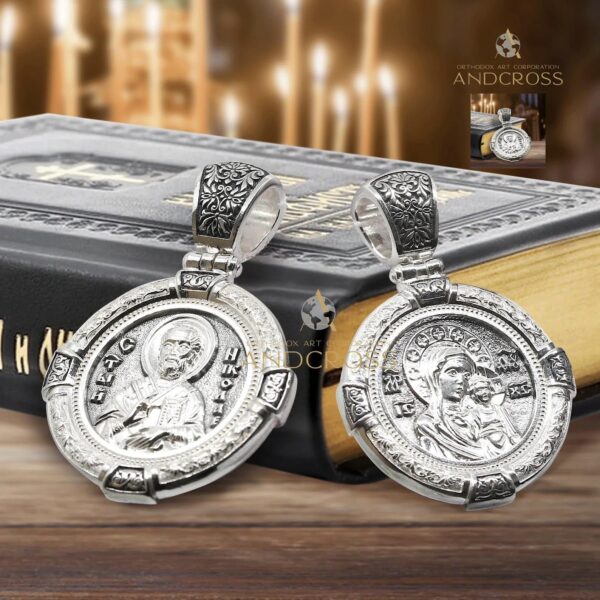
Andcross Orthodox online store offers a wide range of Orthodox products - gift sets, icons, icon cases, books, monastery candles, jewelry and much more. Some of the products of our own production, as well as from other suppliers - monasteries, temples, masters of the entire Orthodox world.
Andcross Orthodox Online Store - Established in 1999

A body cross is not merely a religious accessory. For an Orthodox Christian, it is a visible yet personal confession of faith in Christ’s saving Cross. Received at Baptism or chosen later with the blessing of the Church, it calls its wearer to remember prayer, repentance, courage, and the presence of God throughout ordinary life.
For those asking how to wear a body cross, the simplest answer is this: wear it with reverence, usually close to the body, and let its meaning shape the way you live. The material, chain, and outward style matter, especially when selecting a well-made cross for daily wear, but they come after the sacred meaning of the Cross itself.
In Orthodox practice, a baptismal or body cross is ordinarily worn around the neck, resting on the chest. Many faithful wear it beneath their clothing. This is not because the Cross should be hidden out of shame, but because it is a constant personal sacred object rather than an ornament displayed for attention.
At Baptism, the newly illumined Christian is commonly given a cross to wear. It becomes a reminder that one has put on Christ and belongs to Him. Adults received into the Church may likewise receive or select a cross as part of their life of faith. If you are a catechumen, newly baptized, or uncertain about a local custom, ask your priest for guidance. Parish customs can differ, while the devotion to the Cross remains the same.
A body cross should generally be worn continuously. It may be removed when necessary for medical care, a safety requirement at work, contact sports, or a procedure where jewelry is not permitted. In these circumstances, set it aside carefully in a clean, respectful place and put it back on when it is safe to do so. There is no benefit in treating the cross carelessly, but neither should a Christian ignore genuine safety concerns.
The best body cross is one you can wear faithfully, comfortably, and securely. A small or medium Orthodox cross is often most practical for everyday use. It should be substantial enough to endure, yet not so heavy or sharp-edged that it catches on clothing or becomes uncomfortable while sleeping.
Silver, gold, gold-plated silver, and other durable precious-metal options are traditional choices. Sterling silver offers a classic appearance and can be especially suitable for daily wear. Gold may be chosen for a baptism, wedding, milestone, or family heirloom. A carefully made cross with clearly defined details can preserve its beauty through years of use, particularly when the bail and chain connection are strong.
The form of the cross is also meaningful. Russian Orthodox eight-pointed crosses, Byzantine-style crosses, crucifix crosses, and crosses bearing traditional inscriptions each reflect the Church’s rich visual language. Some crosses show the Crucified Lord; others emphasize the victorious Cross through symbols, prayers, or inscriptions. Choose a design that is canonical, prayerful, and appropriate to your spiritual life rather than simply following jewelry trends.
For a gift, consider the recipient’s age, daily routine, and sensitivities. A child’s cross should be smooth, modest in size, and paired with a secure chain or cord suitable for the child. A cross given for Baptism should be worthy of the occasion, but it does not need to be extravagant. Its lasting value is found in the faith it represents and the prayers surrounding it.
A cross should hang securely at a comfortable length, normally high enough to remain close to the chest without pulling at the neck. Many adults prefer a chain length that allows the cross to rest beneath a shirt or blouse. Others use a sturdy cord, especially for children or for a lighter cross.
The chain should suit the weight and bail of the cross. A delicate chain may be beautiful, but it may not support a heavier silver or gold piece reliably. Check the clasp, links, and attachment point from time to time. If the chain is damaged, replace or repair it promptly rather than continuing to wear a cross that could easily be lost.
Avoid placing several heavy pendants on the same chain as your baptismal cross. It can cause tangling, wear down the bail, and make a sacred object feel like one item in a collection of accessories. If you wear a saint medal or another devotional pendant, many Orthodox Christians prefer a separate chain or ask their priest what is fitting.
For most laypeople, wearing the cross under clothing is the customary choice. A cross resting beneath a shirt remains close to the heart and is protected from unnecessary damage, unwanted attention, and everyday grime. It also guards against the temptation to turn a sacred sign into a display of status or fashion.
That said, a cross may occasionally be visible at the neckline or worn outside clothing without any intention of vanity. Culture, work clothing, climate, and family custom all affect what is practical. The question is not whether every glimpse of a cross is wrong. The question is whether it is worn in a spirit of humility and reverence.
Clergy wear pectoral crosses according to their rank and the blessing of the Church. These are not the same as the personal body crosses worn by laypeople. A layperson should not imitate clerical insignia or wear a large pectoral cross as an emblem of office.
The Cross is holy because of Christ’s sacrifice and victory over death. It is not a charm promising a life without hardship, illness, temptation, or sorrow. To wear a body cross faithfully is to remember the words of the Lord: “If anyone would come after Me, let him deny himself and take up his cross and follow Me.”
When putting on your cross, a simple prayer is enough: “O Lord, bless and protect me by the power of Your precious and life-giving Cross.” You may also make the sign of the Cross with attention and gratitude. These small acts can return the mind to God at the beginning of the day, before travel, during anxiety, or in a moment of temptation.
If your cross has not been blessed, it is good to bring it to your priest and ask for a blessing. Many crosses are made for Orthodox use and bear canonical imagery, but the priest’s blessing places the object within the prayerful life of the Church. Do not be troubled if you are unsure whether a cross purchased long ago was blessed. Speak simply with your priest at a convenient time.
Daily wear naturally leaves traces of skin oils, soap, moisture, and dust. Wipe a silver or gold cross gently with a soft cloth, and use only cleaning methods appropriate for its metal, finish, enamel, stones, or oxidized details. Harsh chemicals and abrasive polishing can damage fine engraving, darkened recesses, plating, and icon-like images.
Remove the cross only when needed, and do not leave it loosely on a counter, in a pocket, or mixed with ordinary objects. A small clean box or pouch is a fitting place to keep it during travel, medical procedures, or repairs. If a chain breaks and the cross is lost, do not despair or fall into superstition. Search carefully, pray, and replace it when necessary.
A damaged cross should not be discarded casually. If it can be repaired, have it repaired. If it cannot, ask your parish priest how to dispose of it respectfully according to local Orthodox practice. The same care applies to an old cross inherited from a parent or grandparent. Such pieces often carry both family memory and the quiet witness of generations of faith.
A body cross is one of the most meaningful Orthodox gifts for a Baptism, name day, wedding, graduation, or return to the Church. It is especially fitting when selected with attention to the recipient’s patron saint, heritage, and manner of life. Fine workmanship, a secure chain, and a proper presentation case honor the sacred purpose of the gift.
Andcross offers traditional Orthodox crosses made with attention to canonical form, durable materials, and the devotional character expected of an object worn every day. Whether chosen in silver, gold-plated silver, or a custom precious-metal design, the cross should be selected as a faithful companion for prayer rather than a passing fashion purchase.
Wear your body cross quietly and steadfastly. Let it rest near your heart as a reminder that Christ is near in joy and sorrow alike, and let the life you lead give honor to the Cross you wear.



Use this form to find things you need on this site