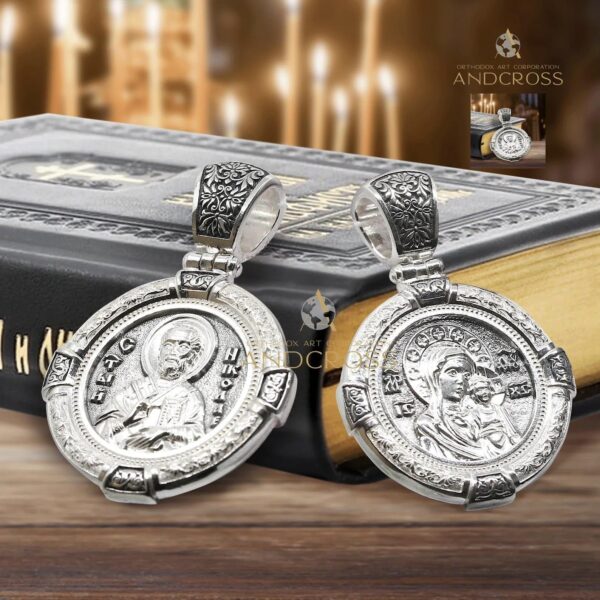
Andcross Orthodox online store offers a wide range of Orthodox products - gift sets, icons, icon cases, books, monastery candles, jewelry and much more. Some of the products of our own production, as well as from other suppliers - monasteries, temples, masters of the entire Orthodox world.
Andcross Orthodox Online Store - Established in 1999
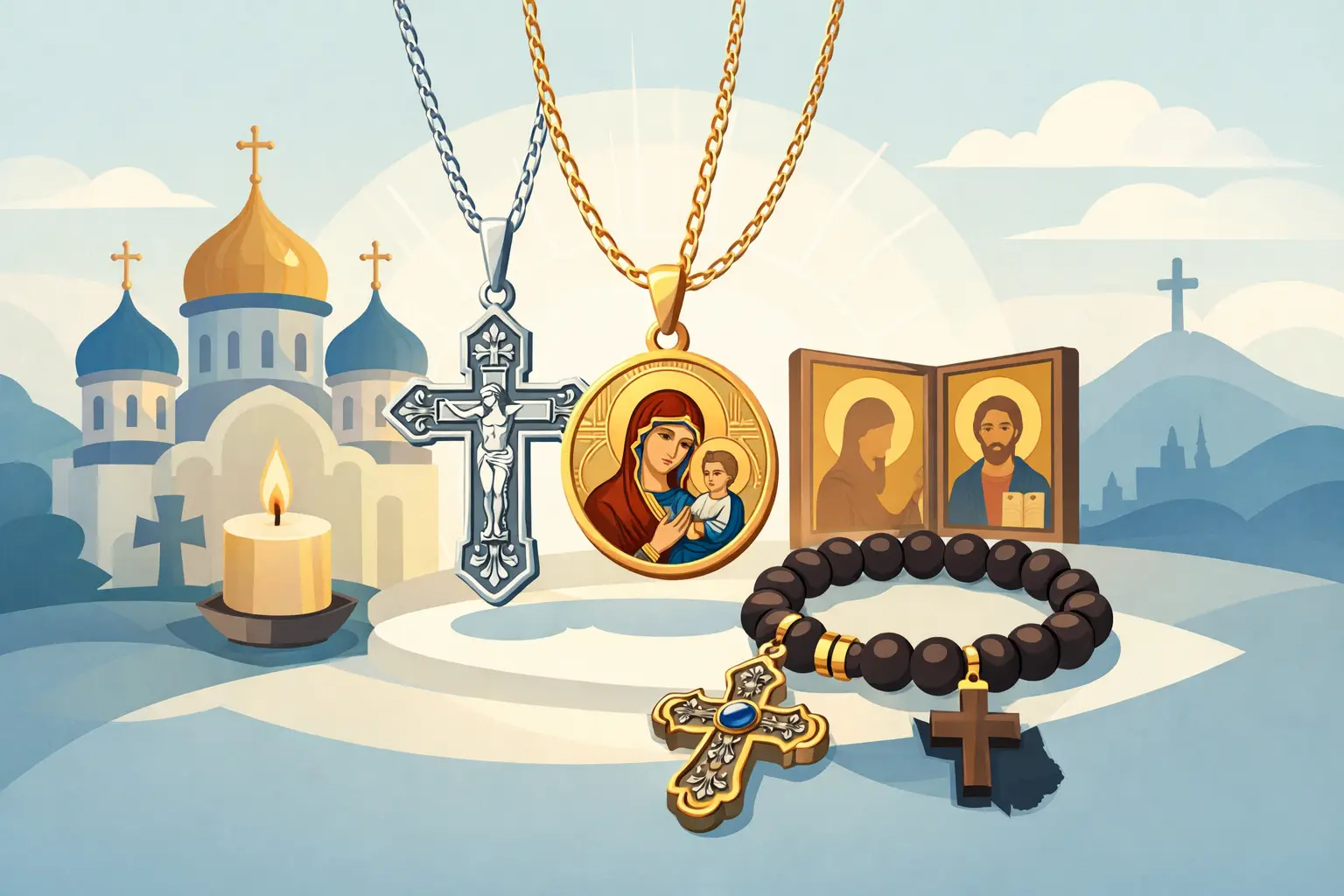
A cross worn at the heart, a ring marked with the Jesus Prayer, or a small icon pendant of a beloved saint can quietly accompany a Christian through work, travel, grief, and joy. Devotional jewelry is not merely an accessory with a religious appearance. When chosen with reverence, it is a visible confession of faith and a personal reminder to turn the mind and heart toward Christ.
For Orthodox Christians, the meaning of such pieces rests first in what they depict: the life-giving Cross, the Lord, the Most Holy Theotokos, the saints, and words received in the prayer life of the Church. Material, craftsmanship, and presentation matter greatly, especially when a piece is given for a baptism, name day, wedding, or memorial occasion. Yet its true place is humble. Jewelry may support prayer and remembrance, but it is never a substitute for prayer, repentance, participation in the sacramental life, or trust in God.
Orthodox devotional jewelry draws its meaning from the sacred imagery and inherited symbols of the Church. The most familiar example is the baptismal cross. Many Orthodox crosses bear the three-bar form associated with the Russian tradition, while others use the traditional Byzantine or Greek form. Both may be fitting when their imagery is respectfully made and recognizable within Orthodox tradition.
An Orthodox cross is often inscribed with words such as “Save and Protect,” the Church Slavonic prayer traditionally associated with many Russian crosses. Crucifix forms may show Christ crucified, while other pieces present the Cross without the Savior’s body. Neither should be treated as a fashion motif. The Cross is the sign of Christ’s victory over death and the center of Christian hope.
Saint pendants and small icon medallions also have a particular devotional purpose. A Christian may wear the image of a patron saint received at baptism, a saint whose intercessions are especially sought, or a feast-day image treasured by the family. The Theotokos, Christ Pantocrator, Saint Nicholas, Saint George, Saint Seraphim of Sarov, and the Guardian Angel are among the images often chosen for daily wear and meaningful gifts.
The distinction is not simply visual. Orthodox sacred images follow a theological language shaped by church tradition. Fine details such as the blessing hand of Christ, the inscriptions around a saint, the form of a halo, and the wording of a prayer are not decorative accidents. They help preserve the identity of the image and the reverence due to it.
The best choice depends on who will wear it and why it is being given. A baptismal cross should be comfortable enough for regular wear, secure on its chain or cord, and appropriate to the recipient’s age. For a child, a small smooth-edged cross is usually wiser than a large, heavily detailed piece. For an adult, a more substantial silver or gold cross may become a lifelong companion.
A pendant or ring can be chosen more personally. A name-day gift is an opportunity to honor the recipient’s heavenly patron. For someone beginning an Orthodox life, a simple cross or modest icon pendant may be more helpful than an elaborate piece with symbolism they do not yet understand. For a longtime church member, a carefully made saint medallion, engraved ring, or custom gold cross may mark a milestone with dignity.
Consider the following practical questions before purchasing:
These questions are not secondary. A cross that is too heavy, a chain that is too fine, or an icon with unclear imagery can make a beautiful gift less useful in daily life.
Sterling silver is valued for its quiet beauty, strength, and traditional appearance. It suits both men and women and can be detailed with deep engraving, oxidized backgrounds, or raised icon relief. Silver does require care, as it naturally tarnishes over time, but gentle polishing with an appropriate cloth will restore its luster.
Gold is often selected for baptismal crosses, wedding gifts, and heirloom pieces. Yellow gold has a warm, traditional character; white gold offers a restrained, silvery appearance; rose gold brings a softer tone. The best choice is usually the one the wearer will actually wear with gratitude. A precious-metal cross need not be extravagant to be meaningful.
Gold-plated devotional pieces offer the appearance of gold at a more accessible price. Their trade-off is durability. Plating can wear over years of constant contact with water, perfume, perspiration, and rough surfaces. This does not make gold plating unsuitable. It simply makes thoughtful use and care more necessary.
Orthodox rings may carry the Cross, a saint’s image, or prayer words such as “Lord Jesus Christ, have mercy on me.” These inscriptions can turn an ordinary glance at the hand into a prompt for inward prayer. Still, a ring should not become an object of superstition. Its value lies in the prayer it recalls, not in an imagined power contained in the metal itself.
Fit matters especially with rings. Because engraved bands and icon rings can be difficult to resize without affecting their design, confirming the correct size before ordering is prudent. A wide band often feels tighter than a narrow one of the same measured size.
Some devotional goods are made in monastic workshops or received from church-related sources; others are handmade by Orthodox craftspeople according to traditional forms. A buyer may also wish to have a new cross, pendant, or ring blessed by his or her parish priest. Local practice can differ, so it is appropriate to ask the priest rather than assume that every item has already been blessed.
Once blessed, devotional jewelry should be handled respectfully. This does not require anxiety over ordinary life. A cross may be worn during a busy workday, while traveling, or under clothing. But it is wise to remove fine pieces before swimming, using harsh cleaning agents, contact sports, or tasks that could bend a bail, scratch an icon face, or break a delicate chain.
Store silver and gold pieces separately in a soft pouch or lined case to reduce scratches. Avoid abrasive household cleaners and ultrasonic cleaning for items with enamel, stones, oxidized detail, or fragile coatings. A soft dry cloth is enough for regular care. For a valuable heirloom piece, professional jewelry cleaning may be the safer choice.
Devotional jewelry is especially fitting when a gift should speak beyond the moment it is opened. A baptismal cross may remain with a person from childhood into adulthood. A patron saint pendant given for a name day can encourage a deeper relationship with that saint. A cross presented to a godchild, spouse, parent, or convert can become part of the family’s spiritual memory.
Presentation matters because the occasion matters. A proper gift box, clear information about metal purity and dimensions, and a design that can be worn regularly all show care for both the recipient and the sacred image. For major occasions, custom work in silver, platinum, or different gold colors can make it possible to match a family tradition, a favored icon style, or an existing chain.
Andcross offers devotional pieces shaped by traditional Orthodox symbolism, including crosses, rings, icon pendants, and gift-ready religious articles made for personal prayer and significant Christian occasions.
A well-chosen cross or saint image should never demand attention for itself. Its quiet purpose is better: to remain near the heart, call the wearer back to prayer, and bear witness to the One whom the Cross reveals.



Use this form to find things you need on this site