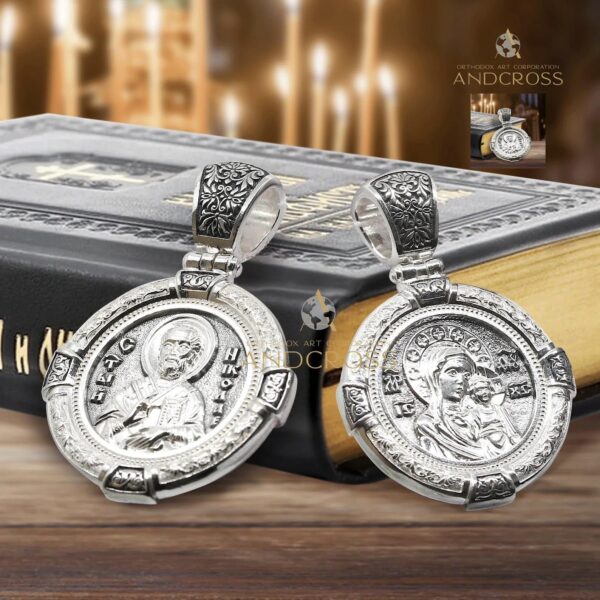
Andcross Orthodox online store offers a wide range of Orthodox products - gift sets, icons, icon cases, books, monastery candles, jewelry and much more. Some of the products of our own production, as well as from other suppliers - monasteries, temples, masters of the entire Orthodox world.
Andcross Orthodox Online Store - Established in 1999
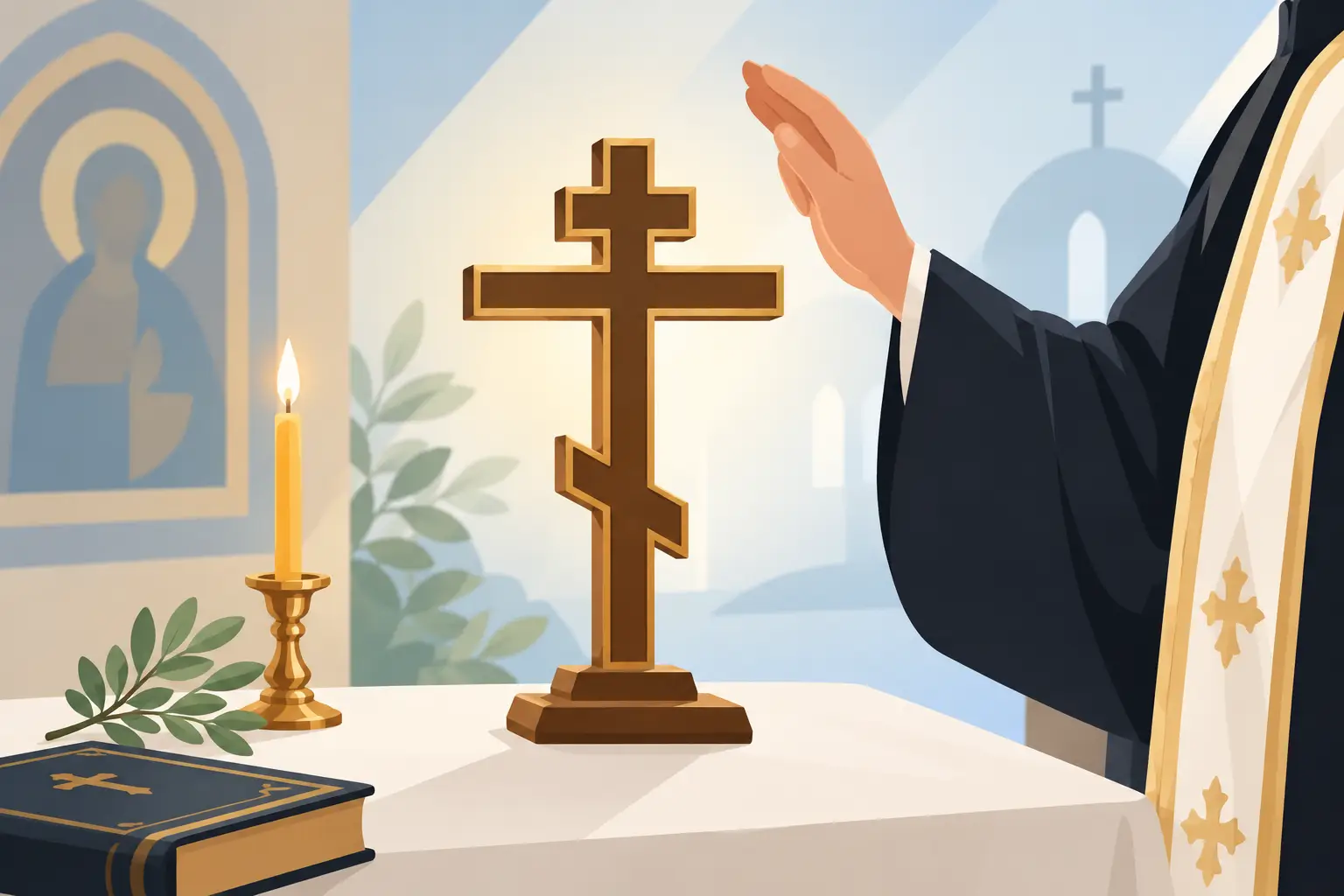
A cross may be small enough to rest in the palm of a hand, yet it points to the saving sacrifice and Resurrection of Christ. For this reason, many faithful ask, can Orthodox crosses be blessed before they are worn, given as a gift, or placed in a home icon corner? Yes. An Orthodox cross may be brought to a priest for blessing, and doing so is a reverent and fitting custom.
The blessing does not turn the cross into a charm or promise a life free from hardship. Rather, the Church sets apart a sacred object for prayerful use and asks God to grant grace, protection, and spiritual benefit to the person who bears it with faith. The Cross remains a sign of Christ’s victory over death. Its blessing calls the wearer to live under that sign with repentance, courage, and prayer.
In ordinary parish life, a priest blesses crosses, icons, prayer ropes, homes, and other objects intended for Christian devotion. The rite commonly includes prayers and the sprinkling of holy water. Local practice may differ somewhat between Greek, Russian, Serbian, Antiochian, Romanian, and other Orthodox jurisdictions, but the pastoral principle is the same: an object used for prayer may be blessed by the Church.
If you receive a cross at Baptism, it may be blessed as part of the baptismal service or by the priest separately. A cross purchased later in life, inherited from family, made to order, or received as a gift can also be brought to church for blessing. There is no requirement that it be expensive, antique, or made from a particular metal. A simple wooden cross and a finely made sterling silver cross are equally suitable when approached with reverence.
A priest may also bless a cross intended for a child, a godchild, a spouse, or someone preparing to enter the Church. When giving such a gift, it is good to present it respectfully, ideally in a suitable case, and to explain that it is not merely jewelry. It is a visible confession of faith.
Careful language matters. A blessed cross is a sacred object set apart for devotional use, but it is not automatically a relic. A reliquary cross containing an authenticated particle of a saint’s relic is a different matter and should come with clear ecclesiastical documentation.
Likewise, a cross made in a monastery or obtained from a church workshop may be especially meaningful because of its origin, but monastic craftsmanship and a formal blessing are not always identical claims. Product descriptions should state plainly whether an item is blessed, consecrated according to a particular practice, monastery-made, or simply created in accordance with Orthodox tradition. This honesty protects both the faithful and the dignity of the sacred object.
There is no need to wait for a special occasion. Many people ask their priest to bless a new baptismal cross or pectoral cross before first wearing it. Others bring a cross after receiving it for Christmas, Pascha, a name day, graduation, wedding, or memorial occasion. If a family cross has been stored away for years, it can be cleaned carefully and brought to the parish for blessing before returning it to prayerful use.
The best time is often simple and practical: speak with the priest after a service, or call the parish office to ask when he prefers to bless devotional articles. Do not place a cross on the Holy Table or enter the altar area unless you have been specifically invited and blessed to do so. Bring it in a clean pouch or gift box, and receive it back with gratitude.
Some faithful also ask whether a cross must be blessed again if it has been dropped, repaired, or worn during a difficult period. Usually, there is no rule requiring this. A damaged clasp can be repaired, and a worn chain can be replaced. If receiving another blessing would bring peace of conscience or mark a renewed commitment to prayer, speak with your priest. He can offer guidance suited to your situation rather than a mechanical rule.
A cross should be chosen first for its Orthodox form and spiritual meaning, then for the realities of daily wear. A baptismal cross for a child should have smooth edges, a secure clasp, and a light weight. A cross worn every day by an adult may need a stronger chain and durable metal. Silver, gold-plated silver, gold, wood, and carefully finished bronze each have their place.
Traditional Orthodox crosses appear in several forms. The Russian eight-pointed cross includes the slanted footrest and carries deep theological symbolism. Four-pointed crosses are also widely used throughout the Orthodox world. A crucifix may bear the image of the crucified Lord, while other crosses emphasize the victorious and life-giving Cross through inscriptions such as IC XC NIKA – Jesus Christ Conquers.
The form should not become a source of argument. Orthodox Christians have received more than one venerable cross tradition. What matters is that the image is faithful to the Church’s confession and that the cross is treated with honor.
For a cross intended as a gift, quality is part of that honor. Clear iconographic detail, a properly formed bail, secure fittings, and durable workmanship are practical concerns, not vanity. At Andcross, crosses are selected and made with attention to traditional symbolism, devotional purpose, and gift-worthy presentation, so that a meaningful religious gift can also serve faithfully in daily life.
The main concern is not fashion, but intention. A cross should not be selected as a lucky token, costume accessory, or object of superstition. It should not be treated carelessly, thrown into a drawer with ordinary trinkets, or used to promote ideas contrary to Christian faith.
If a cross breaks beyond repair, do not discard it casually. Ask your parish priest what is customary in your community. Often, sacred objects that can no longer be used are respectfully burned or buried in a proper place. The same care applies to worn icons, prayer books, and blessed candles.
Orthodox Christians commonly wear a baptismal or pectoral cross close to the body, often beneath clothing. This is a humble custom, not an absolute law. Some crosses are worn visibly, particularly by clergy or in particular cultural settings. The right practice is one that preserves reverence and avoids turning the Cross into display.
A blessed cross may be removed for medical treatment, work safety, sports, swimming, or repair. God is not absent when circumstances require this. Store it cleanly and respectfully, preferably in an icon corner, prayer drawer, or dedicated case rather than among unrelated accessories. Before putting it on, a brief prayer such as, “O Lord, bless,” can help restore attention to its true purpose.
Avoid exposing plated or silver pieces to harsh chemicals, perfumes, chlorinated water, and abrasive cleaners. A soft dry cloth is often enough for routine care. For valuable gold, silver, or custom-made crosses, a qualified jeweler can address repairs without altering sacred images or inscriptions.
The blessing of a cross is not meant to make the Christian life easier in a worldly sense. Christ tells His disciples to take up the cross, and every believer learns that this includes patience, forgiveness, faithfulness, and hope amid sorrow. A cross worn at the heart is a quiet reminder that suffering is not meaningless when united to Christ.
Bring your cross to your priest with a simple request and an open heart. Then wear it not as an ornament of protection alone, but as a daily invitation to prayer, to remember the Lord, and to live more faithfully beneath the sign of His life-giving Cross.



Use this form to find things you need on this site