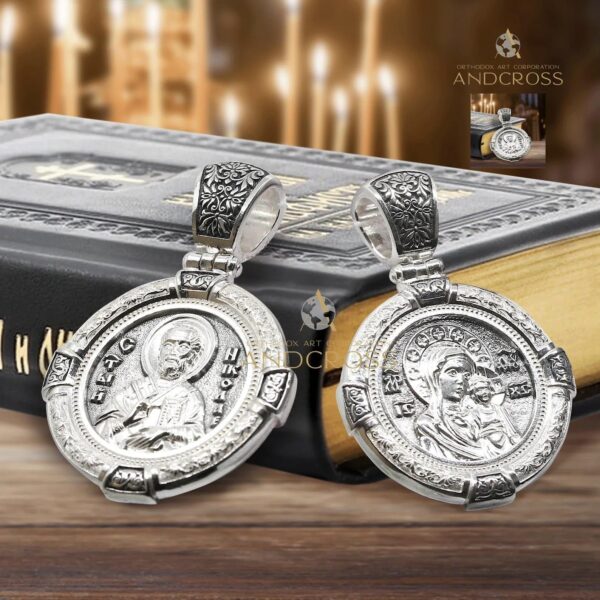
Andcross Orthodox online store offers a wide range of Orthodox products - gift sets, icons, icon cases, books, monastery candles, jewelry and much more. Some of the products of our own production, as well as from other suppliers - monasteries, temples, masters of the entire Orthodox world.
Andcross Orthodox Online Store - Established in 1999

A cross worn close to the heart is not simply an ornament. It is a confession of Christ’s victory over death, a visible reminder of baptism, prayer, and the life to which every Orthodox Christian is called. A custom cross commission gives this sacred object a personal form while preserving the reverence, symbolism, and traditional character proper to the Cross.
For some, the reason is practical: a baptismal cross has been lost, a cherished family cross needs to be recreated, or a pendant must be made in a size suitable for daily wear. For others, it is a spiritual and familial occasion – a memorial gift, a blessing for a godchild, or a cross bearing the name of a patron saint. A well-considered commission begins not with decoration, but with the meaning the cross will carry.
A commissioned Orthodox cross may be created in sterling silver, gold-plated silver, yellow gold, white gold, rose gold, or platinum, depending on the desired appearance, budget, and intended use. Silver has a quiet, traditional dignity and is often chosen for baptismal crosses and daily prayer wear. Gold offers warmth, durability, and an especially fitting character for a significant family gift. Platinum is valued for its strength and restrained beauty, though it generally requires a larger investment.
The form of the cross deserves equal attention. The familiar eight-pointed Russian Orthodox cross, with its upper title bar and slanted footrest, carries profound theological meaning. Four-pointed and six-pointed forms can also be made in accordance with Orthodox tradition. A maker may work from a historic model, a family photograph, a sketch, or a description of the desired style.
The commission can also include an Orthodox inscription, an image of the Savior, the Mother of God, or a patron saint where appropriate to the design. The words “Save and Protect,” rendered in Church Slavonic, Russian, Greek, English, or another suitable language, remain a beloved choice. Engraving may be placed on the reverse, around the edge, or incorporated into the design itself. The inscription should be clear enough to endure as part of the piece, rather than treated as a passing fashion.
Before choosing metal or ornament, consider who will receive the cross and how it will be worn. A baptismal cross for an infant needs smooth edges, modest dimensions, and a secure bail. A cross for an adult’s everyday use should be substantial enough for years of wear without becoming uncomfortable. A memorial cross may call for a more detailed reverse inscription, while a gift for a priest, reader, or church servant may require particular consultation regarding form and suitability.
This is where a custom order differs from selecting an ordinary pendant. The dimensions, weight, thickness, bail opening, and chain all affect whether the cross will be worn faithfully or left in a box. A finely detailed design may look beautiful at a larger scale but lose clarity if reduced too far. Conversely, a simple engraved cross can remain legible and prayerful even in a small baptismal size.
If the commission is intended for a child, it is wise to plan for growth. Some families choose a small cross for baptism and later commission a larger version of the same design for adulthood. Others select a modest but durable cross that can remain with the child for many years. There is no single correct answer. The right choice depends on comfort, family custom, and the occasion.
Orthodox sacred art is not merely decorative. Each image, inscription, and form belongs to a living inheritance of faith. For this reason, a custom cross should be developed with respect for traditional iconography rather than assembled from unrelated symbols.
An eight-pointed cross may bear the image of the Crucified Christ, the hand-made image of the Savior, a vine motif, or traditional floral and geometric ornament. The title above Christ may be rendered according to established practice. The slanted lower bar recalls both the thief who turned toward Paradise and the tragic refusal of the unrepentant thief. Even a small cross can quietly proclaim this theology.
Personal elements should serve that sacred center. A patron saint may be included because the wearer bears that saint’s name or seeks his or her prayers. A date of baptism, marriage, or repose may be engraved discreetly. A family monogram can be appropriate on the reverse of certain designs, but it should never overpower the Cross itself. When there is uncertainty about an image or inscription, asking one’s priest for guidance is a wise and peaceful step.
Precious metal is part of the cross’s lasting character. Sterling silver is often finished with polished highlights, darkened recesses, or both. Oxidized details can bring depth to engraved lettering and small iconographic elements, while a full polish gives a brighter appearance. Neither is inherently better. A darkened finish may reveal detail more clearly, while high polish can suit a clean, formal design.
Gold commissions require a decision about color as well as karat. Yellow gold has a classic warmth associated with many traditional Orthodox pieces. White gold offers a cooler, more restrained appearance, and rose gold introduces a softer tone. The choice should complement the wearer’s existing jewelry only after the cross’s sacred purpose has been considered. The Cross is not meant to compete with an outfit, but it can certainly be made with beauty and care.
Ask how the design will be produced. Hand-finished metalwork, carefully cut engraving, strong soldered bails, and cleanly defined edges matter greatly in a cross intended for regular use. Fine detail should not come at the expense of structural strength. A fragile openwork design may be suitable for occasional wear, while a solid-bodied cross is usually the more practical choice for daily prayer and travel.
At Andcross, custom work is approached as both sacred craftsmanship and a clear personal order. Providing the desired metal, approximate size, inscription, reference image, and intended occasion helps the workshop prepare a faithful proposal. A good commission process should make the customer feel informed about the design, production details, and final presentation.
A custom cross commission becomes smoother when the initial request is specific. Rather than saying only that you want a “Russian-style cross,” describe the features that matter: eight points or four, crucifix or plain form, polished or oxidized finish, a saint or inscription, and the approximate height in inches or millimeters.
It also helps to state whether the measurement includes the bail. This small detail can change the final proportion considerably. If a chain will be used, provide its thickness or request guidance on an appropriate chain opening. A bail that is too narrow creates frustration later, especially with a heavier chain or a cross intended as a gift.
Photographs of family heirlooms can be valuable references, even when an exact copy is not possible. They may show the proportion of the arms, the treatment of the footrest, old lettering, or a style of engraving that holds meaning for the family. A responsible maker will explain which details can be retained and which need adjustment for durability, scale, or faithful execution.
Custom sacred work should not be rushed carelessly. Design approval, metal preparation, casting or fabrication, engraving, finishing, and quality inspection each require attention. Complex iconographic pieces, unusual metals, and detailed inscriptions may take longer than a simple cross. If the piece is needed for a baptism, name day, wedding, or memorial date, begin the conversation well in advance.
Gift presentation also matters. A cross given for baptism or a major feast is often kept for a lifetime, along with the prayerful memory of the person who gave it. A proper gift box or case protects the piece and makes the occasion feel appropriately honored without turning a sacred gift into something merely luxurious.
The finest custom cross is not necessarily the largest, most elaborate, or most expensive. It is the one made truthfully: sound in its Orthodox form, carefully crafted in worthy material, comfortable to wear, and chosen with prayer. Whether it recalls a baptism, honors a beloved saint, or continues a family tradition, it can become a quiet companion through ordinary days, feast days, sorrows, and joys.
Approach the commission with a clear purpose and a reverent heart. The resulting cross may be personal in its details, yet it will always point beyond the person who wears it – toward Christ, whose Cross remains the hope and protection of the faithful.



Use this form to find things you need on this site