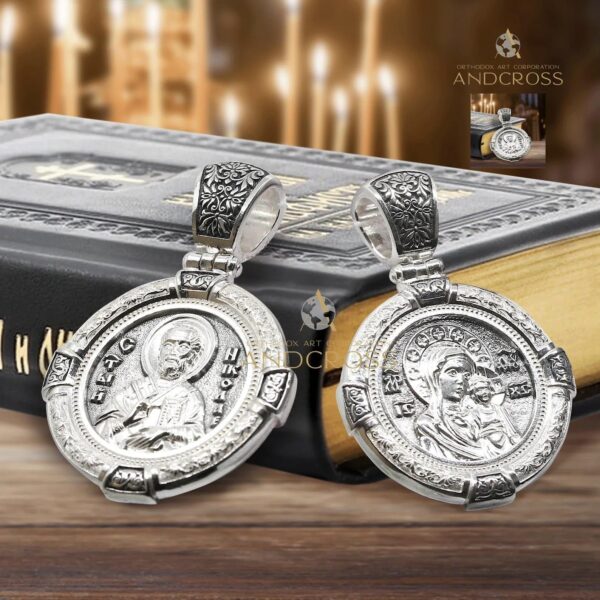
Andcross Orthodox online store offers a wide range of Orthodox products - gift sets, icons, icon cases, books, monastery candles, jewelry and much more. Some of the products of our own production, as well as from other suppliers - monasteries, temples, masters of the entire Orthodox world.
Andcross Orthodox Online Store - Established in 1999
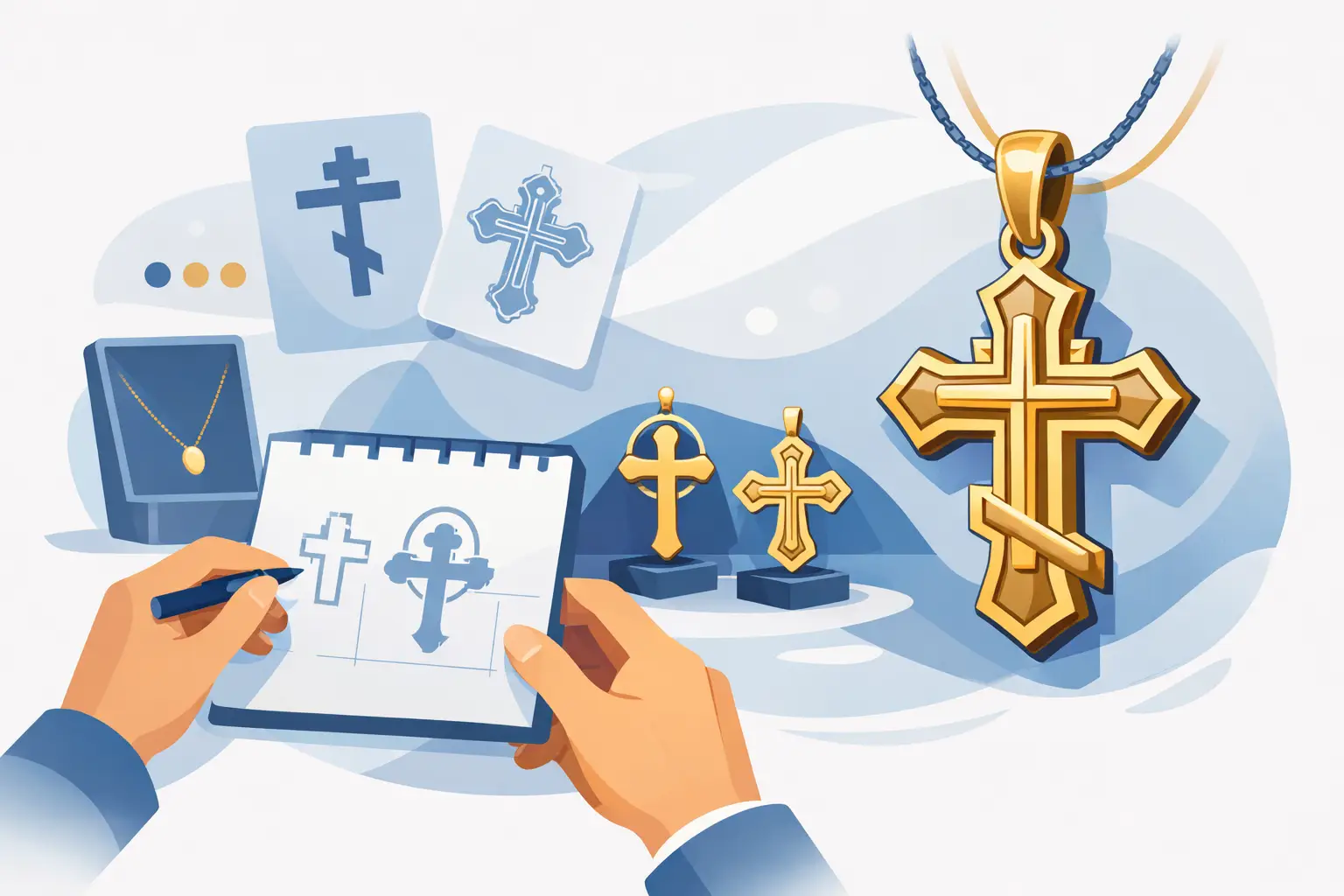
A custom Orthodox cross pendant is not simply jewelry made to match a preference. It is a personal confession of faith, worn close to the heart and often received at baptism, on a name day, or at a moment when a family wishes to give something enduring. Its form, inscription, metal, and workmanship deserve thoughtful attention because the Cross is sacred before it is decorative.
For Orthodox Christians, a custom piece can make it possible to unite traditional church symbolism with details that belong to one person or family: a patron saint, a baptismal date, a prayerful inscription, or a carefully chosen precious metal. The best commissions preserve reverence for the canonical image while allowing these personal elements to serve devotion rather than distract from it.
The first choice is the cross itself. A Russian Orthodox eight-pointed cross is especially familiar to many Orthodox faithful. Its upper bar recalls the inscription placed above Christ, while the slanted lower footrest speaks of the two thieves crucified beside Him and of the solemn reality of judgment. Other traditional forms, including the Greek cross and Byzantine cross, are also used within Orthodox life and may better reflect a family’s heritage or parish tradition.
There is no single pendant shape required for every Orthodox Christian. What matters is that the image is treated faithfully and respectfully. A cross designed as an abstract fashion motif may not carry the same devotional clarity as a piece based on established Orthodox forms. When commissioning a pendant, it is wise to ask whether the design follows traditional iconographic and liturgical understanding, particularly if it includes the Crucifixion, the Savior, the Theotokos, angels, or saints.
A crucifix pendant may show Christ crucified, sometimes with the traditional abbreviations above and around Him. On a Russian-style cross, the inscriptions IC XC, NIKA, and the title above Christ may be incorporated according to established practice. The reverse can bear the prayer, “Save and protect,” a beloved inscription found on many Orthodox crosses.
Details should be legible enough to honor their meaning. Extremely small engraving can become indistinct, while an overly crowded design can make sacred lettering difficult to read. A skilled maker balances relief, proportion, and scale so that the pendant remains suitable for daily wear without reducing holy images to ornament.
Silver remains one of the most beloved materials for an Orthodox cross. Sterling silver offers a dignified appearance, substantial feel, and a restrained beauty appropriate to a devotional object. It can be polished, oxidized to deepen engraved details, or paired with a modest gold-plated accent. For many baptismal gifts and first crosses, silver is a practical and meaningful choice.
Gold is traditionally associated with honor and glory, making it especially fitting for a milestone gift or family heirloom. Yellow gold has a warm, classic character; white gold gives a quieter, cooler finish; and rose gold can be selected for its gentle color. The right choice depends on personal taste, budget, sensitivity to metals, and how the pendant will be worn. A solid gold cross generally offers greater long-term value than plating, but a carefully made gold-plated pendant may be appropriate when a family seeks a more accessible gift.
Platinum is exceptionally durable and naturally white, yet its density and cost make it a more specialized commission. It is well suited to a person who wants a cross designed for a lifetime of constant wear. In every metal, ask about purity, finish, weight, and the strength of the bail. A beautiful pendant should also be secure enough for a chain and habits of daily life.
Custom engraving gives a pendant its intimate character. A baptismal name, the date of baptism, a name day, initials, or a brief prayer can turn a gift into a lasting remembrance. On the reverse of a cross, the traditional “Save and protect” is often the most fitting choice. Some families also choose a short Church Slavonic, Greek, or English inscription when it is accurate and clearly engraved.
A patron saint can be included on the reverse, in a small medallion form, or as a separate accompanying pendant. This is especially meaningful for a baptism, chrismation, graduation, wedding, or memorial gift. Still, the available surface is limited. A good custom design gives the Cross its rightful central place, rather than trying to include every beloved symbol in one small object.
If the pendant will be a surprise gift, confirm the recipient’s baptismal name and saint carefully. A secular name does not always correspond directly to the saint commemorated at baptism. When uncertainty remains, a family member, godparent, or parish priest may help clarify the proper dedication.
A pendant that appears ideal in a product photograph may be too small for a detailed Crucifixion or too large for someone who prefers to wear a cross discreetly. Dimensions should be considered in millimeters, along with the thickness of the relief. A small cross can be deeply meaningful and easy to wear under clothing, while a larger pendant gives engravings and iconographic details more room to be seen.
The chain should match both the pendant’s bail and its weight. A delicate chain may be suitable for a small silver cross, but a substantial gold or platinum pendant needs a stronger chain with a dependable clasp. For children, smooth edges, a modest size, and a secure but comfortable chain are especially helpful. For adults, the decision often comes down to whether the cross will be worn visibly or beneath clothing as a private sign of faith.
It is also worth considering allergies and maintenance. Some finishes may wear over time, and silver naturally develops patina. Many faithful appreciate that softened patina because it brings out the relief and gives the cross a lived-in character. Others prefer a brighter finish and occasional professional cleaning. Neither preference changes the spiritual purpose of the pendant.
At baptism, the cross is commonly given by godparents, parents, or close family. It should be worthy of the sacrament without becoming an anxious display of expense. A well-made silver cross with a canonical image and a simple inscription may become more precious through decades of prayer than a more elaborate piece chosen only for appearance.
For an adult convert or someone returning seriously to Orthodox practice, a custom cross can mark a new beginning with humility. For a wedding, anniversary, or memorial occasion, a pair of crosses or a pendant engraved with a loved one’s name may carry a quiet and lasting tenderness. Gift presentation also matters: a protective case, clear material information, and careful packaging show respect for both the sacred article and the person receiving it.
Andcross works with traditional Orthodox forms and custom commissions in silver, platinum, and several gold colors, allowing buyers to discuss the details that make a pendant appropriate for a particular occasion. For international gifts, allow time for production and delivery, especially when a design includes hand engraving or a newly created relief.
A cross purchased from a workshop or store is not automatically blessed unless this has been specifically arranged or stated. Many Orthodox Christians bring a new cross to their parish priest for blessing before wearing it, particularly when it has been commissioned for baptism or a significant feast day. Local practice may vary, so a priest’s guidance is always welcome.
Once blessed, treat the pendant with the reverence given to a sacred object. Store it respectfully, avoid using it as an accessory for unsuitable occasions, and repair it rather than casually discarding it if a chain breaks or a clasp fails. If a cross is no longer wearable, ask a priest how it should be handled.
The finest custom choice is usually the one that will be worn faithfully: a canonical cross, carefully made in a durable metal, bearing only those details that help the heart turn toward Christ. Let its beauty be quiet, its workmanship honest, and its presence a small daily call to prayer.



Use this form to find things you need on this site