Andcross Orthodox online store offers a wide range of Orthodox products - gift sets, icons, icon cases, books, monastery candles, jewelry and much more. Some of the products of our own production, as well as from other suppliers - monasteries, temples, masters of the entire Orthodox world.
Andcross Orthodox Online Store - Established in 1999
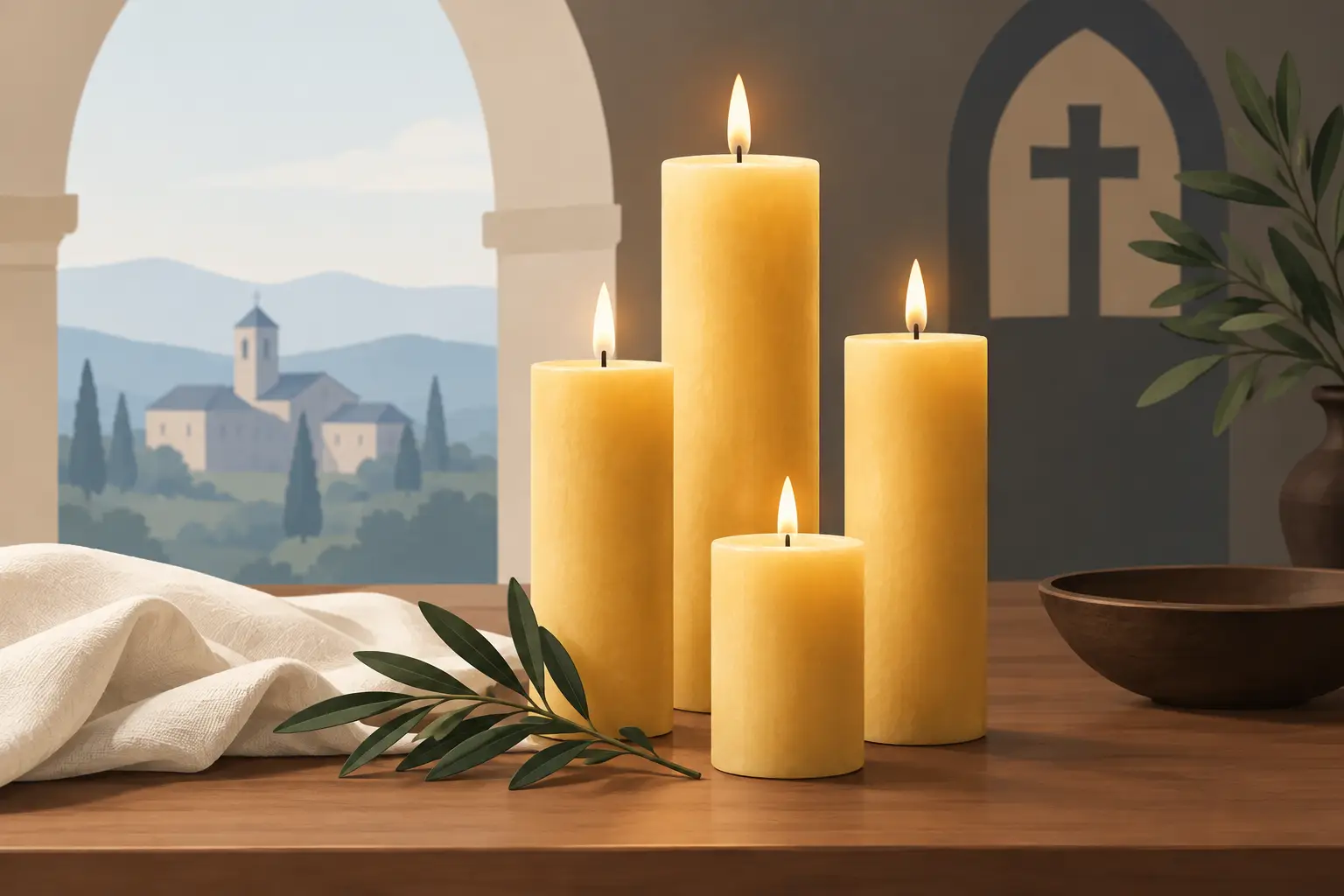
A candle may be small enough to hold between two fingers, yet it carries a visible confession of faith. Before an icon, its quiet flame accompanies the sign of the Cross, prayers for the living and departed, and the long vigil of the heart. That is why monastery candle authenticity matters to Orthodox Christians. The question is not merely whether a candle looks traditional, but whether it has been represented honestly and chosen with reverence.
An authentic monastery candle is not a charm, and its value does not rest on a seller’s dramatic claims. Its meaning comes from its proper use in prayer, its connection to Orthodox Christian life, and the integrity of the people who make and offer it. Knowing what to look for helps a faithful buyer select candles with confidence for the home icon corner, church observance, memorial prayer, or a meaningful religious gift.
In Orthodox tradition, a candle is an offering. It gives light while it is consumed, recalling Christ as the Light of the world and calling the person praying to offer his or her own life to God. Beeswax has long held a special place in church use because it is pure, natural, and produced through the labor of living creatures. Still, the spiritual purpose of a candle is never reduced to its material alone.
When people speak of an authentic monastery candle, they often mean a candle made by a monastic community, supplied through a monastery or temple, or produced according to the traditional materials and practices used in Orthodox devotional life. These are related meanings, but they are not identical. A candle may be handmade from pure beeswax without having been made inside a monastery. Another may come from a monastery workshop but contain a wax blend chosen for practical reasons.
Honest provenance is therefore the first measure of authenticity. A trustworthy description should state what is known: whether the candles come from a monastery, are made by nuns or monks, are sourced from a temple workshop, or are crafted by Orthodox artisans in a traditional manner. It should not use monastic language simply as decoration.
There is also an important distinction between monastery-made and consecrated. A candle may be made in a monastery without receiving a separate rite of blessing. Conversely, an item described as blessed or consecrated should be presented carefully and truthfully, with no promise of automatic spiritual results. Orthodox faith is not a matter of collecting spiritually powerful objects. Prayer, repentance, participation in the sacramental life of the Church, and trust in God remain at the center.
The strongest sign is a clear account of origin. A responsible seller can identify the monastery, temple, workshop, or Orthodox source when that information may properly be shared. At minimum, the description should distinguish between candles sourced from monastic communities and candles merely made in a monastic style.
Specificity builds trust. “Pure beeswax candles from an Orthodox monastery workshop” is meaningful when it reflects the actual source. Vague phrases such as “ancient holy monastery candle” without a location, maker, material, or other supporting detail deserve caution. Sacred language should clarify a candle’s place in Church life, not replace basic product information.
Traditional beeswax candles have recognizable qualities. Their color may range from pale cream to deep gold or warm brown, depending on the wax, pollen, age, and filtering process. They often carry a gentle honeyed or natural wax scent, though the fragrance can be faint. They may soften in heat and may burn differently from mass-produced paraffin candles.
Yet appearance alone cannot prove purity. Beeswax can be filtered to a very light color, while some blended candles are dyed yellow to resemble beeswax. A natural scent is not proof either, because fragrance can be added. Look for direct wording such as “100% beeswax,” “beeswax blend,” or “paraffin-based church candle.” Each has its proper place, but the buyer deserves to know which one is being offered.
The wick also matters. A well-made candle generally has a wick sized for its diameter so that the flame is steady and the candle burns with reasonable cleanliness. Handmade candles can show small variations in taper, texture, or finish. Such marks are often evidence of handwork, not defects. On the other hand, a rough finish should not excuse a candle that is cracked, excessively smoky, damp, or poorly formed.
Authentic devotional goods are usually described with sobriety. Their spiritual meaning is honored without exaggerated promises about healing, protection, wealth, or guaranteed answers to prayer. A seller may rightly explain that a candle is suitable for prayer before an icon, for a memorial, or for a feast day. No honest seller should suggest that buying a particular candle compels divine favor.
This restraint is not coldness. It is respect for the holy. The candle becomes part of a person’s offering to God, not a substitute for faithfulness.
Price can be a clue, but it is not a final test. Pure beeswax and careful handwork often cost more than factory-made paraffin, especially when a candle has traveled from a monastery or distant Orthodox workshop. But a high price does not create monastic origin, and an inexpensive candle is not automatically unworthy of use.
Packaging is also secondary. A simple bundle tied with paper may be entirely genuine, while elaborate presentation can be used to create an impression of rarity. For gift-giving, a protective box or a carefully prepared set is valuable, but it should not be mistaken for proof of source.
Nor should a buyer judge by burn time alone. Beeswax quality, candle width, wick size, drafts, room temperature, and the angle at which a taper stands can all affect how it burns. If a candle burns unevenly once, trim the wick slightly, keep it away from moving air, and ensure it is held securely upright. A prayer candle is meant to be used attentively, with ordinary care for fire safety.
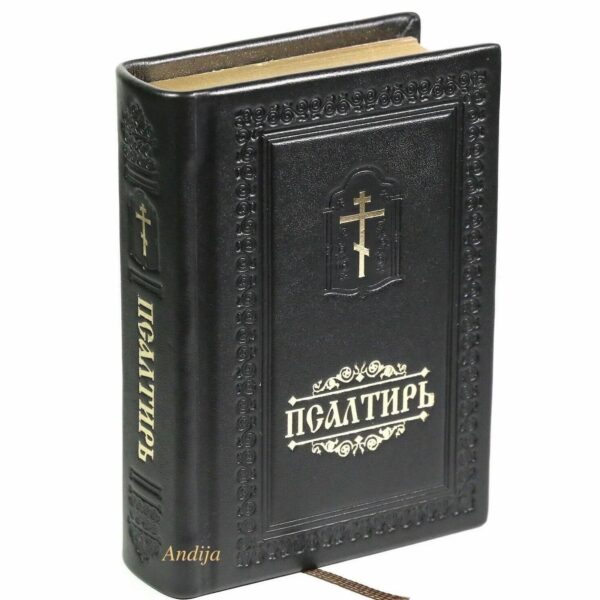
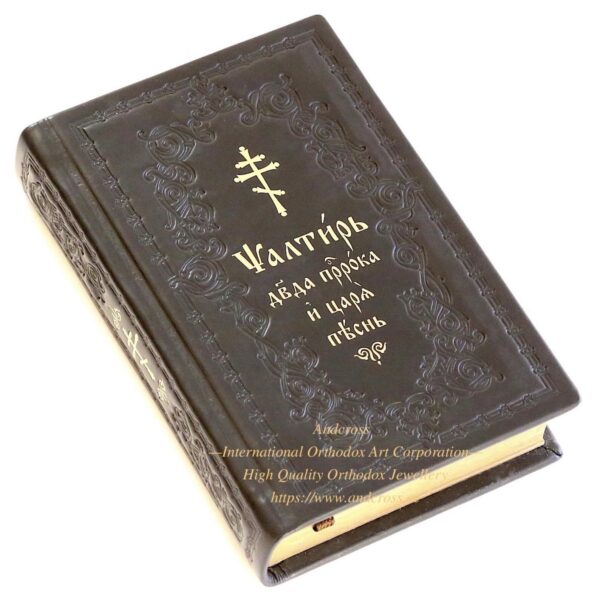
For a home icon corner, choose a size suited to your normal prayer rule. Thin tapers are appropriate when you wish to light a candle briefly before morning or evening prayers. Larger beeswax candles may be preferable for extended reading of the Psalter, an all-night vigil at home when appropriate, or prayers around a family remembrance.
For memorial prayer, many faithful choose plain beeswax candles as a quiet offering for the departed. For major feasts, baptisms, name days, and Orthodox wedding gifts, a more substantial candle set can be fitting, especially when presented alongside an icon, prayer book, or cross. The occasion should guide the choice, but simplicity is never out of place.
Consider practical details as well. If you live in a warm climate, store beeswax candles away from sunlight and heat. Keep them flat or upright in a cool, dry place so fine tapers do not bend. Use a stable brass, ceramic, or metal candleholder, and never leave a flame unattended near icons, fabrics, books, or children.
When purchasing online, good questions are part of responsible devotional buying. Ask whether the candle is made from pure beeswax or a blend, whether its source is monastic, temple-based, or artisan-made, and what quantity, length, and approximate burn time are included. If the candle is intended as a gift, confirm whether it arrives in suitable protective packaging.
It is also reasonable to ask whether the image, inscription, or accompanying icon follows Orthodox tradition when purchasing a candle set. Established Orthodox retailers should be able to provide clear, respectful answers rather than relying on vague devotional marketing. At Andcross, the same care given to canonical icons, crosses, and prayer goods should extend to honestly described monastery-sourced candles and their materials.
The goal is not to investigate every candle with suspicion. It is to buy with discernment, so that the object placed before your icons is offered with a peaceful conscience. A candle with a known source, truthful materials, careful workmanship, and a proper purpose is worthy of that place.
When you light it, let the question of authenticity lead to something deeper: a sincere prayer, spoken simply before God, with gratitude for the light that no flame can fully express.



Use this form to find things you need on this site