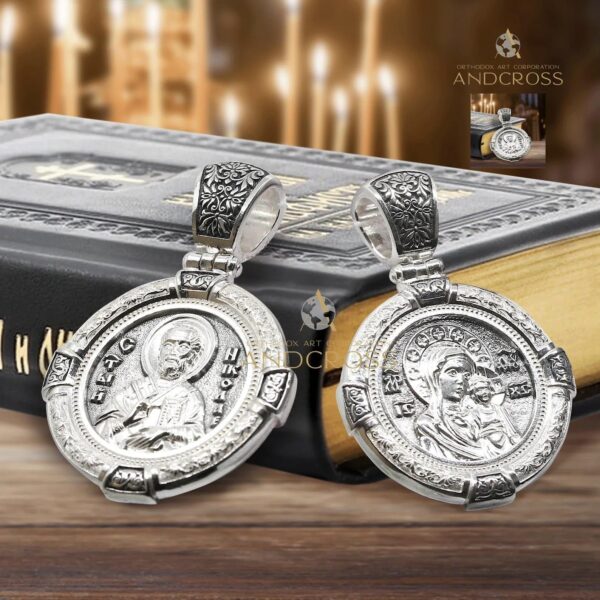
Andcross Orthodox online store offers a wide range of Orthodox products - gift sets, icons, icon cases, books, monastery candles, jewelry and much more. Some of the products of our own production, as well as from other suppliers - monasteries, temples, masters of the entire Orthodox world.
Andcross Orthodox Online Store - Established in 1999
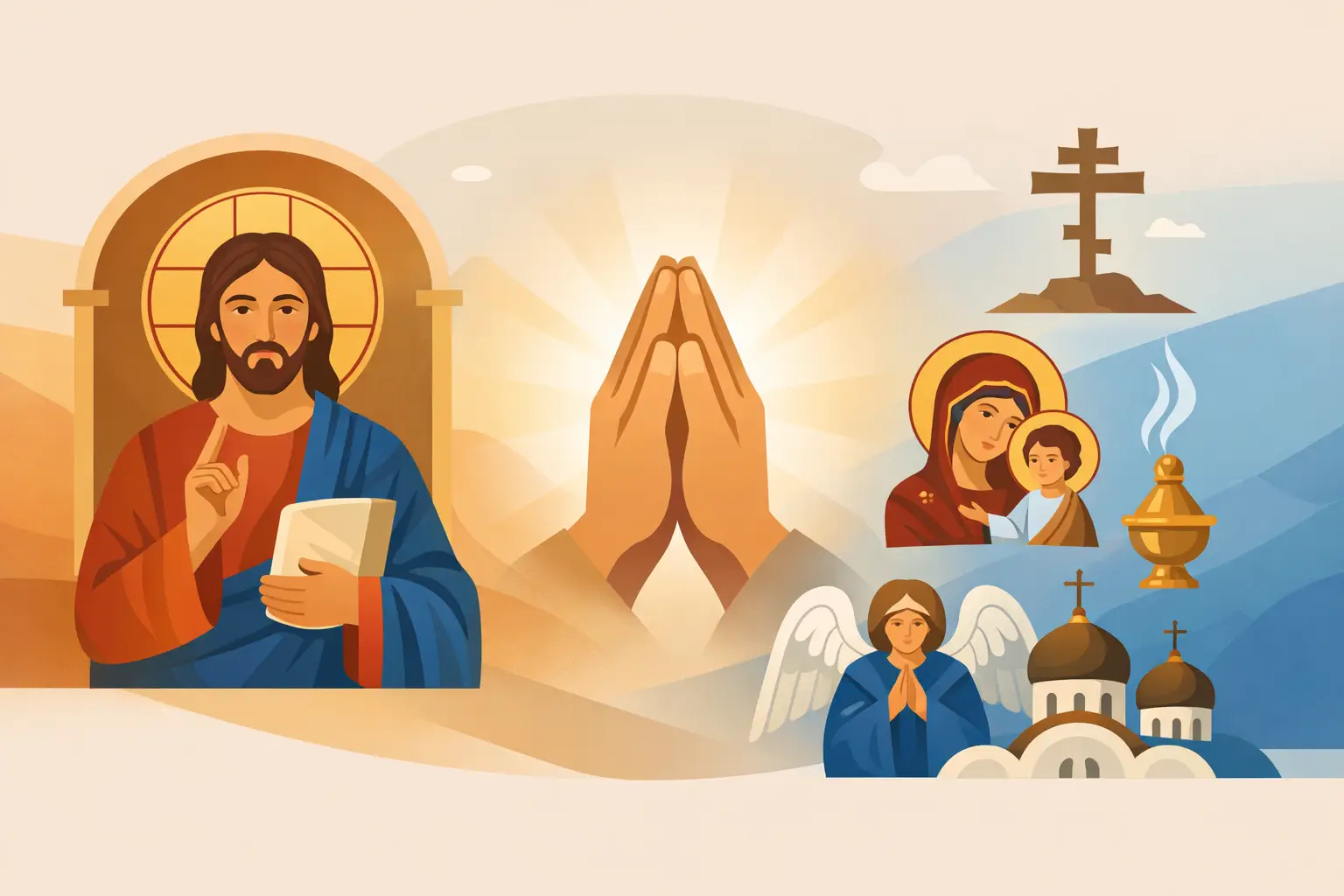
An icon is not religious decoration arranged around a room. Before it, the faithful person stands in prayer before Christ, His Most Pure Mother, or the saint depicted. This iconography symbol guide helps readers recognize the visual language of Orthodox icons, so that choosing an image for a home icon corner, a baptism gift, or a feast day becomes an act of informed devotion rather than guesswork.
Orthodox iconography follows a tradition received through the Church. Details such as a halo, a hand raised in blessing, a book, a cross, or the colors of a garment are not arbitrary ornament. They bear witness to the person depicted and to the Gospel truth proclaimed through the image. At the same time, icons from different Orthodox lands may show local artistic character. A Russian icon, Greek icon, Serbian icon, or Romanian icon may differ in line, color, or inscription while remaining faithful to the same sacred teaching.
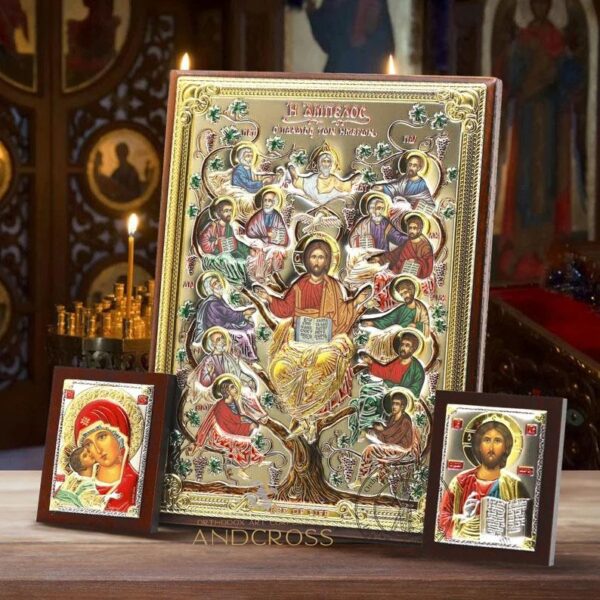
The first question before an icon is simple: Who is shown? The answer is usually given through the image itself and through its inscription. In traditional Orthodox practice, Christ is identified by the Greek letters Ο Ω Ν within His halo, meaning “He Who Is.” This refers to the divine name revealed in Scripture and distinguishes the Lord’s halo from that of every saint.
The Theotokos is commonly marked by the Greek abbreviation ΜΡ ΘΥ, meaning Mother of God. On many icons, three stars appear on her forehead and shoulders. They confess her perpetual virginity: before the Nativity, in the Nativity, and after the Nativity of Christ. In some compositions, one star may be hidden by the Christ Child, but its meaning remains.
Saints are generally named in inscriptions near their heads. This matters when selecting an icon as a personal patronal gift. Saint Nicholas, Saint George, Saint Seraphim of Sarov, Saint Xenia of Petersburg, Saint Olga, and many other beloved saints may share certain visual features with other holy figures, while the written name confirms their identity. When ordering an icon, check the saint’s name, feast day, and title carefully, especially where several saints have the same name.
A halo is not merely a mark of admirable character. It signifies the grace of God shining in the person who has been sanctified. Christ’s cruciform halo is unique because He is the incarnate Son of God. The halos of the Theotokos, angels, apostles, martyrs, and saints testify that they live in the light of God and intercede for us.
Gold backgrounds and gold halos carry a related meaning. Gold does not represent earthly wealth in an icon. It points toward the uncreated light and the Kingdom of God, where time, shadow, and decay do not rule. A finely made gold-plated or gilded icon can therefore be both a beautiful gift and a reverent expression of this theological language. Yet material finish should never be the only measure of an icon’s worth. Canonical imagery, careful workmanship, and prayerful use matter more than ornament alone.
Christ is often shown raising His right hand in blessing. In many Orthodox icons, the fingers form the letters IC XC, an abbreviation of Jesus Christ. The gesture proclaims that blessing comes from the Lord Himself. Bishops and priests may also be depicted blessing, but their blessing is received within the life of the Church and points to Christ.
When Christ, an apostle, an evangelist, or a hierarch holds a Gospel book, it speaks of the Word of God and apostolic teaching. A closed book may emphasize divine wisdom or the authority of the teaching office. An open book often contains a Gospel passage or a liturgical text connected with the feast or saint. These words are worth reading when they are visible, because they frequently explain the entire icon.
Color in Orthodox iconography is meaningful, but it should be read with humility. There is no single color chart that explains every icon in every school. Pigments, regional customs, restoration, and artistic period all affect the final image. Still, certain patterns are deeply rooted in tradition.
Christ is often clothed in red and blue. Red may point to His humanity, sacrifice, kingship, and life-giving love, while blue speaks of heaven and divinity. The Theotokos is often shown in a deep red or burgundy outer garment over blue, expressing that she, a human person, was overshadowed by divine grace and bore the Son of God. Angels frequently wear luminous garments, while white may signify divine light, purity, resurrection, or transfiguration.
Dark colors can have their own place. In icons of monastic saints, black or deep brown garments recall repentance, humility, and renunciation of worldly vanity. Green may suggest life, renewal, or the Holy Spirit, particularly in icons associated with Pentecost. These meanings serve prayer; they are not a code to be applied mechanically.
The objects carried by saints often reveal their vocation or manner of witness. A martyr may hold a cross, showing voluntary faithfulness to Christ unto death. A bishop may carry a Gospel book and wear episcopal vestments. A monastic saint may hold a prayer rope, scroll, or cross. Saint George may be shown on horseback defeating the serpent, while Saint Panteleimon may carry a medicine box, recalling his service as an unmercenary healer.
In icons of the prophets, scrolls point to their proclamation of the coming Messiah. Apostles may hold scrolls or books as bearers of the Gospel. Holy rulers may wear crowns, not to glorify political power, but to show that their authority was offered in service to Christ. Every attribute should direct attention away from human achievement and toward the grace of God at work in the saint.
Feast icons deserve special attention because they teach the Church’s calendar through sacred imagery. In the Nativity icon, the cave recalls the fallen world into which Christ enters, while the swaddling clothes foreshadow His burial. The star above Bethlehem leads downward toward the Child, confessing that the One born is from heaven.
In the icon of Theophany, Christ stands in the Jordan as the heavens open and the Holy Spirit appears in the form of a dove. The waters, mountains, angels, and river personification belong to a visual proclamation of creation’s sanctification. In the Transfiguration, the radiant mandorla surrounding Christ expresses divine glory beyond ordinary earthly light.
The Resurrection icon, often called the Descent into Hades, shows Christ breaking the gates of death and raising Adam and Eve. This is not an illustration of a private moment. It is the Church’s confession that Christ has trampled down death by death. When choosing a feast icon for the home, consider the feast most closely connected to your parish life, family name, or regular prayer rule.
A faithful icon should be recognizable, reverent, and made with attention to the Church’s inherited forms. For a first icon corner, many Orthodox Christians begin with Christ and the Theotokos, then add their patron saint and a feast icon over time. A small icon may be ideal for a desk, travel prayer set, or baptism gift; a larger icon gives a family prayer space a stronger focal point.
For a gift, personal connection is often more meaningful than size. An icon of a namesake saint, a baptismal patron, a wedding feast, or a guardian angel can accompany a person for many years. Materials also matter in practical ways. Silver, gold-plated metal, wood, enamel, and printed icons each offer different durability, weight, cost, and presentation. A gift case and clear indication of dimensions are especially helpful when an icon is being sent for a special occasion.
Andcross selects icons and devotional goods with respect for Orthodox tradition, offering carefully described materials, dimensions, and gift-ready options for the faithful worldwide. If an icon is intended for prayer, it may be blessed according to the practice of your parish and with the guidance of your priest.
The clearest way to read sacred symbols is to return to prayer. Place the icon reverently, light a candle if this is part of your household practice, and ask the Lord for mercy through the prayers of His saints. Over time, the halo, inscription, colors, and gestures will cease to be distant details. They will become familiar witnesses to the faith handed down in the Church.



Use this form to find things you need on this site