Andcross Orthodox online store offers a wide range of Orthodox products - gift sets, icons, icon cases, books, monastery candles, jewelry and much more. Some of the products of our own production, as well as from other suppliers - monasteries, temples, masters of the entire Orthodox world.
Andcross Orthodox Online Store - Established in 1999
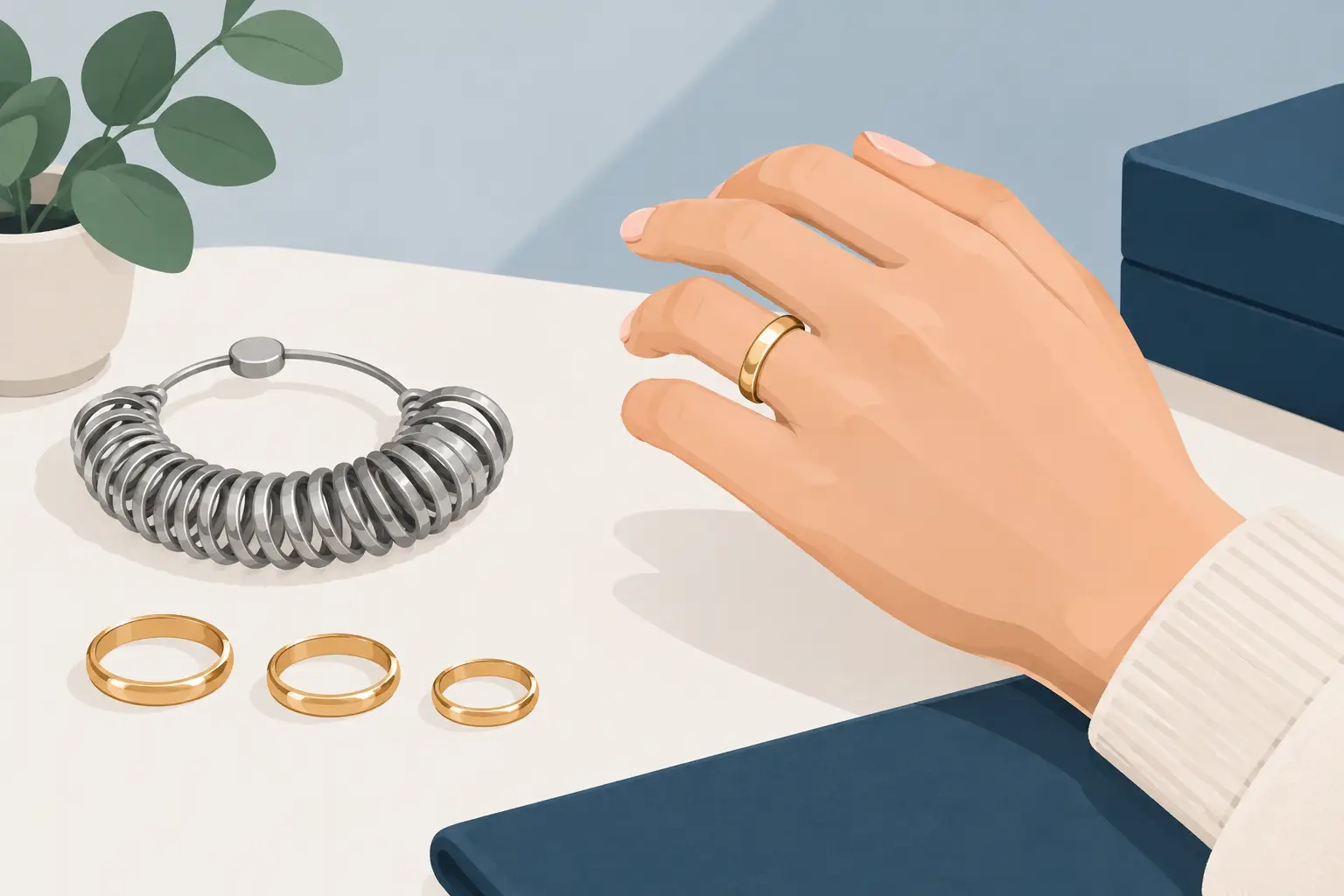
A prayer ring is often worn without fanfare: while lighting a candle, keeping a fast, working with the hands, or standing quietly before an icon. Orthodox ring sizing deserves care for that very reason. A ring bearing the Cross, the Jesus Prayer, a saint’s image, or a sacred inscription should feel present but not distracting – secure enough for daily wear, yet comfortable enough that it does not press, pinch, or demand constant attention.
Orthodox rings are not merely ornaments. Whether chosen as a personal reminder of prayer or given for a baptism, name day, wedding, or feast, they carry sacred imagery that should be treated with reverence. Selecting the correct size helps protect the ring from being lost, bent, or left unworn in a drawer because it never felt right.
The best fit is not always the tightest fit. A well-sized ring passes over the knuckle with gentle resistance, sits securely at the base of the finger, and can be removed without force. It should not leave a deep mark, cause numbness, or spin constantly around the finger. This balance matters especially for rings in sterling silver, gold, platinum, or gold-plated finishes, where repeated stretching, squeezing, or rough handling can affect the form and surface of the piece.
There is no single church rule that requires every Orthodox Christian to wear a ring on one particular finger. Family custom, local tradition, and the purpose of the ring may guide the choice. Wedding rings follow traditions that can differ among Orthodox peoples, while a devotional ring may be worn on the finger that feels most practical and respectful. Before measuring, decide where the ring will actually be worn.
Fingers are not the same size throughout the day. Heat, cold, salt, exercise, travel, pregnancy, arthritis, and physical work can all change how a ring fits. A measurement taken immediately after carrying groceries or coming indoors from winter weather may not reflect your usual size.
For the most dependable result, measure when your hands are at a normal, comfortable temperature. Late afternoon or early evening is often more useful than first thing in the morning, when fingers may be slightly swollen. If you are between sizes, repeat the measurement on two or three different days rather than trusting one quick reading.
A professional jeweler can provide the clearest answer with a ring sizer. This is especially wise when ordering a precious-metal ring, a wide engraved band, or a custom piece. If visiting a jeweler is not practical, measure an existing ring that already fits the intended finger. Place it flat and measure the inside diameter across the center, from one inner edge to the other. Do not include the thickness of the metal in the measurement.
A printable sizing guide or a narrow strip of paper can also help, but both require patience. The paper must lie flat against the finger without being pulled tight, and the mark should be checked against the knuckle as well as the base of the finger. A loosely taken measurement can produce a ring that slips off; an overly tight one can result in a painful fit.
Ring sizes are not expressed the same way in every country. US sizing is commonly given in whole, half, and quarter sizes, while many European and international systems use different numbers. When purchasing from an Orthodox workshop or retailer that serves customers worldwide, confirm which sizing system is being used before placing the order.
If you know only the inside diameter or circumference in millimeters, ask for the corresponding US size rather than making a rough conversion. A small difference can matter. For example, moving from a US size 7 to 7.5 may seem minor on paper, but it can greatly improve comfort over a knuckle or on a warm day.
One of the most common sizing mistakes comes from comparing a narrow ring with a wide band. A slim ring may feel comfortable in one size, while a broad Orthodox prayer ring with raised lettering, an openwork Cross, or a substantial engraved surface can feel noticeably tighter in that same size.
As a general guide, consider ordering a half size larger when choosing a band that is about 6 mm wide or wider. This is not an absolute rule. A ring with a rounded interior, known as a comfort-fit profile, may feel easier to wear than a flat interior of the same width. Conversely, a heavily detailed inner surface may require more room.
The ring’s design also deserves attention. An inscription around the outside usually does not change sizing, but raised relief, side panels, stones, or a signet-style face can alter the ring’s weight and balance. A larger devotional ring may turn on the finger if it is slightly loose. If the design has a defined front, such as an icon medallion or Cross, a closer but still comfortable fit will help keep it facing outward.
Do not assume that the same size works on both hands. The dominant hand is often slightly larger, and each finger can differ by several sizes. A ring intended for the right ring finger should be measured on that finger, not estimated from a left-hand wedding band.
For prayer rings, many faithful choose a finger that allows the ring to remain discreet during work and prayer. Others prefer the ring finger because it is accustomed to jewelry, or the middle finger because a wider band feels more stable there. The right choice is the one that can be worn with peace and proper care.
If the ring is a gift and the recipient’s size is unknown, borrowing a ring that they wear on the same finger is the safest approach. Measure only a ring known to fit well. A ring worn on another finger, even if it appears similar, can lead to an inaccurate order. When possible, choose a design that can be resized by a qualified jeweler, though resizing is not equally suitable for every ring.
Sterling silver rings can often be resized by an experienced jeweler, depending on the engraving and construction. Gold rings may also be resized, but a change in size can interrupt a continuous prayer inscription or alter decorative details. Gold-plated pieces need particular care because cutting and soldering can affect the finish.
Platinum is durable but requires specialized work. Rings with uninterrupted raised prayers, enamel, stones set around the full band, or detailed relief may be difficult or unwise to resize. For this reason, accurate Orthodox ring sizing is especially valuable before commissioning a custom silver, gold, or platinum piece.
When ordering a handmade ring, provide the requested size clearly, including any half or quarter size. It is also helpful to mention if the design is intended as a wide band, a wedding ring, or a daily prayer ring. At Andcross, careful sizing information supports a more confident choice when selecting devotional jewelry made for lasting wear.
A sacred ring should never become an object of anxiety. If it is too loose, there is the concern of losing something cherished. If it is too tight, it can become physically burdensome and may need to be removed at the wrong moment. The fitting process is practical, but it serves a devotional purpose: allowing the ring to remain a quiet witness to faith through ordinary life.
Once your ring arrives, try it on when your hands are calm and dry. It should move over the knuckle with a little resistance and rest naturally at the base of the finger. Give yourself a few days to become accustomed to its weight, width, and texture. A well-chosen Orthodox ring does not call attention to itself at every moment. It simply remains close, like a small reminder to turn the heart toward Christ.



Use this form to find things you need on this site