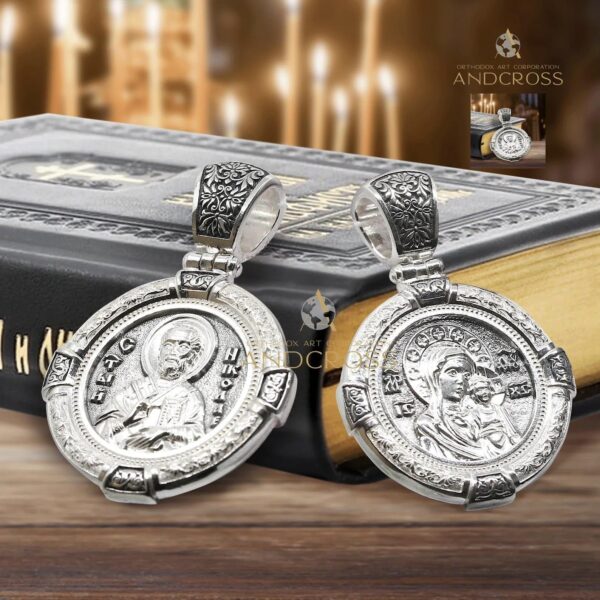
Andcross Orthodox online store offers a wide range of Orthodox products - gift sets, icons, icon cases, books, monastery candles, jewelry and much more. Some of the products of our own production, as well as from other suppliers - monasteries, temples, masters of the entire Orthodox world.
Andcross Orthodox Online Store - Established in 1999
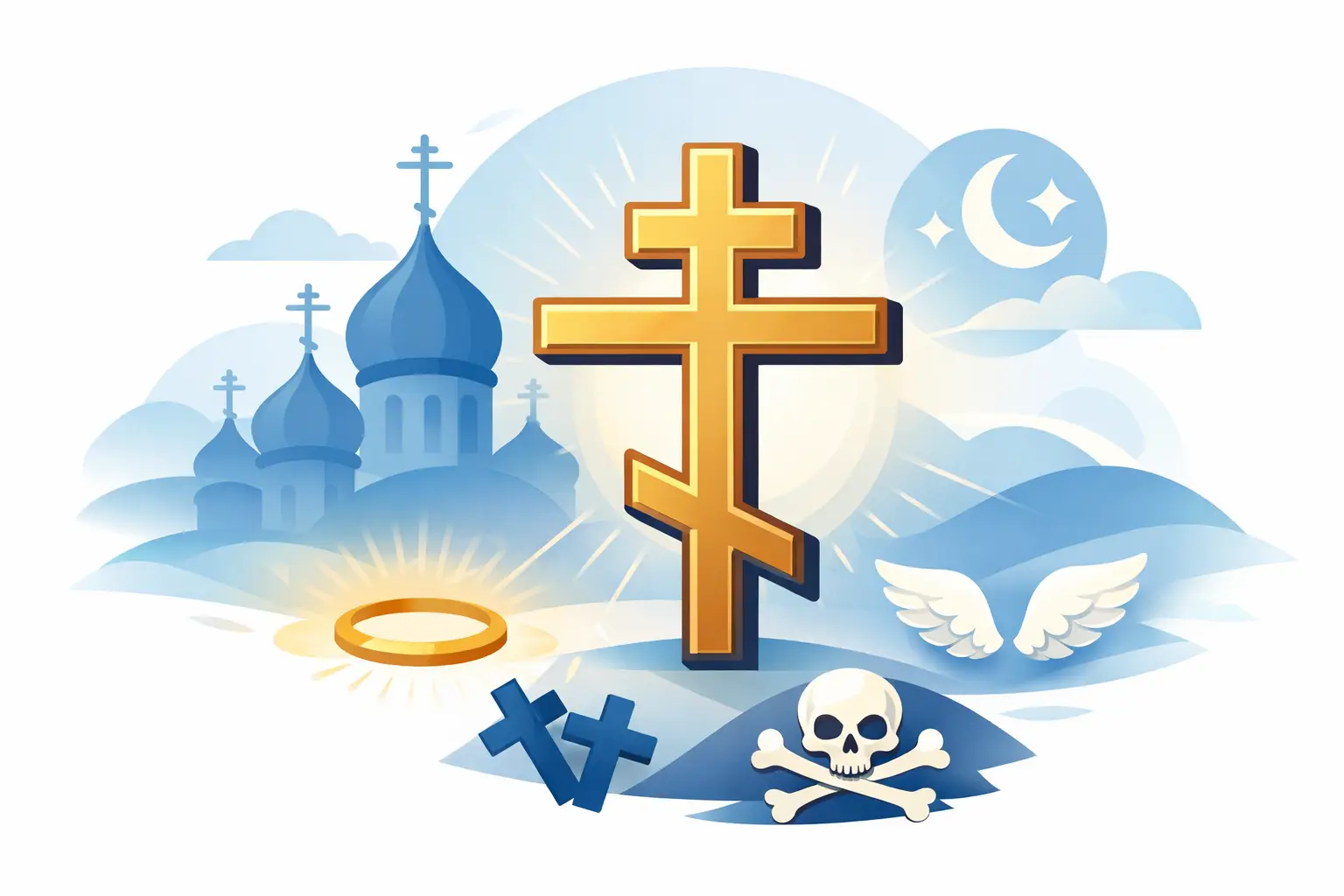
A Russian Orthodox cross is not simply a decorative form of the Christian Cross. It stands before the faithful as a confession of Christ’s Passion, victory, mercy, and judgment. The Russian Orthodox cross meaning is therefore found not in ornament alone, but in the Gospel events and Orthodox prayer that give each bar its place.
For many Orthodox Christians, this cross is familiar from church domes, baptismal crosses, grave markers, icons, and pectoral pendants. For those new to the faith, its distinctive shape can raise a simple question: why does it have three horizontal bars, and why is the lowest one slanted? The answers lead directly to the Crucifixion and to the Church’s teaching on salvation.
The Russian Orthodox cross is often called the three-bar cross or the eight-pointed cross. Its central upright beam is crossed by three horizontal elements: a short upper bar, the wider main crossbeam, and a slanted lower footrest. Together, these create the traditional eight-pointed outline.
The design is not unique to one nation, even though it is especially associated with Russian and Slavic Orthodox tradition. Variations of the three-bar cross have long appeared across the Orthodox Christian world. A cross may be plain or richly engraved, made for a church dome or worn close to the heart in silver or gold. Its material and craftsmanship can differ, while its sacred meaning remains rooted in the same confession: Jesus Christ, the Son of God, was crucified and rose again for the life of the world.
The short upper bar represents the inscription placed above the Lord’s head at His Crucifixion. The Gospels record that Pontius Pilate wrote, “Jesus of Nazareth, the King of the Jews.” In iconography and Orthodox crosses, this may appear in abbreviated forms, often using the letters INRI in Western-language settings or equivalent Church Slavonic and Greek inscriptions.
This bar reminds the faithful that Christ’s kingship is not worldly power. He reigns from the Cross in humility and self-giving love. What appeared to His persecutors as shame became the revelation of His divine glory.
The broad middle bar is the crossbeam upon which the Savior’s hands were nailed. It is the visual center of the cross and recalls Christ embracing the whole human race. Orthodox hymnography repeatedly speaks of the Cross as the place where death is trampled down and reconciliation is offered to all.
When a Christian wears a Russian Orthodox cross, this central bar calls for more than cultural identity. It is a quiet witness that following Christ includes faithfulness, repentance, forgiveness, and the willingness to carry one’s own cross.
The lower slanted bar is the footrest, traditionally understood as the support beneath Christ’s feet. Its upward and downward direction has received a powerful spiritual interpretation in Orthodox teaching.
The raised end points toward the repentant thief, traditionally known as St. Dismas, who confessed Christ and heard the promise, “Today you will be with Me in Paradise.” The lowered end points toward the unrepentant thief, who remained hardened even beside the crucified Lord. The footrest therefore recalls that the Cross reveals both divine mercy and the human response to it.
This should not be understood as a diagram that assigns final judgment to particular people. Rather, it places a question before every believer: will I turn toward Christ in repentance? The slanted bar gives the Russian Orthodox cross its instantly recognizable form, but it also gives it a searching spiritual depth.
Because the three horizontal bars and the upright beam create eight visible ends, the Russian Orthodox cross is also called eight-pointed. In Christian symbolism, the number eight is often connected with the new creation and the day beyond the seven-day cycle of the old world. Christ’s Resurrection, celebrated on the first day of the week, is also understood as the eighth day, the beginning of eternal life.
This connection is fitting. The Cross is never separated from the Resurrection in Orthodox life. On Good Friday, the Church stands in reverence before the Crucified Lord. At Pascha, she proclaims that Christ is risen and death has been overcome. The Cross carries the reality of suffering, yet it is always the life-giving Cross.
Many Orthodox crosses also bear inscriptions such as IC XC, the traditional abbreviation for Jesus Christ, and NIKA, meaning “conquers” or “is victorious.” These letters express a central proclamation of the faith: Jesus Christ conquers sin, death, and the power of the grave.
Not every Russian Orthodox cross is identical. On some crosses, the lower bar slopes upward from left to right as viewed by the person looking at it. On others, the orientation may appear reversed because of the way a cross is carved, embroidered, or viewed from the back. Details such as the titulus inscription, a skull at the base, rays, vine patterns, or the instruments of the Passion may also be present.
The skull sometimes shown beneath the Cross refers to the ancient tradition that Golgotha, “the place of the skull,” was associated with Adam’s burial. In this image, Christ’s blood reaches Adam, signifying that the first human being and all humanity are restored through the new Adam, Christ.
A pectoral cross may also carry the words “Save and Protect,” a familiar devotional inscription in Russian Orthodox practice. These words are not a charm or promise of an easy life. They are a prayerful appeal to the Lord, asking that the wearer be kept in faith, guarded from evil, and strengthened to live according to the Gospel.
Orthodox Christians commonly receive a cross at baptism and wear it beneath their clothing. It is a personal sign of belonging to Christ, not merely an accessory. A cross given for baptism, a name day, a wedding, a memorial occasion, or a feast can become a lasting reminder of prayer and family faith.
When choosing a cross, the form should serve devotion rather than distract from it. A simple silver cross may be best for daily wear, especially for a child or someone beginning an Orthodox Christian life. A finely made gold, gold-plated, or handcrafted cross can be a fitting heirloom or a meaningful gift for a major sacramental occasion. What matters most is that the design respects Orthodox tradition and that the wearer approaches it with reverence.
For a baptismal gift, consider the size, smoothness of the edges, chain length, and whether the piece is suitable for regular wear. For an adult, an engraved or more detailed cross may hold special significance, particularly when it includes traditional inscriptions or an image of the Crucifixion. If a cross is to be blessed, it is appropriate to ask a priest, especially when it has not already been blessed or received through a church setting.
The Cross is honored because of Christ, not because metal, wood, or a particular pattern possesses power apart from Him. Orthodox Christians venerate the Cross as the instrument through which the Lord brought salvation. They make the sign of the cross in prayer, bless their homes with it, and look to it in times of sorrow because it directs the heart to the Crucified and Risen Savior.
This distinction matters when selecting or giving a Russian Orthodox cross. The finest workmanship, precious metal, or elaborate engraving has value when it helps preserve a sacred object with care and dignity. Yet the deepest value is spiritual: the cross calls its wearer to remember Christ, to pray, and to live with hope.
A well-made Russian Orthodox cross can accompany a person through ordinary days, difficult decisions, illness, travel, worship, and joy. Held quietly during prayer or worn beneath the garment, it offers the same enduring invitation: take up the Cross with faith, turn toward the mercy of Christ, and keep the Resurrection before your heart.



Use this form to find things you need on this site