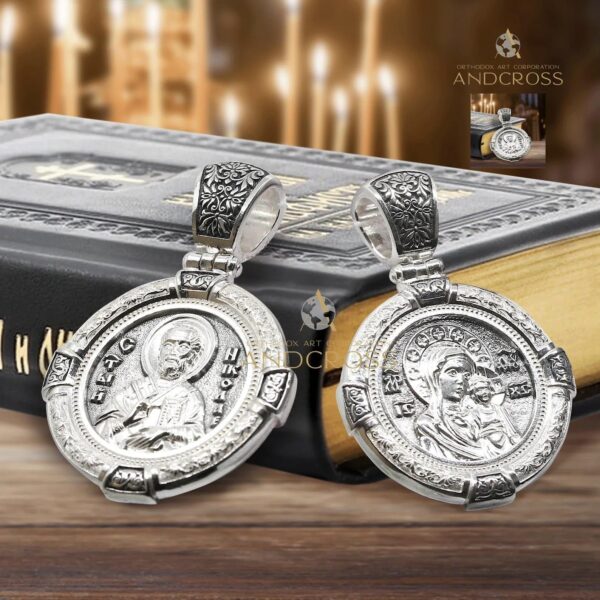
Andcross Orthodox online store offers a wide range of Orthodox products - gift sets, icons, icon cases, books, monastery candles, jewelry and much more. Some of the products of our own production, as well as from other suppliers - monasteries, temples, masters of the entire Orthodox world.
Andcross Orthodox Online Store - Established in 1999
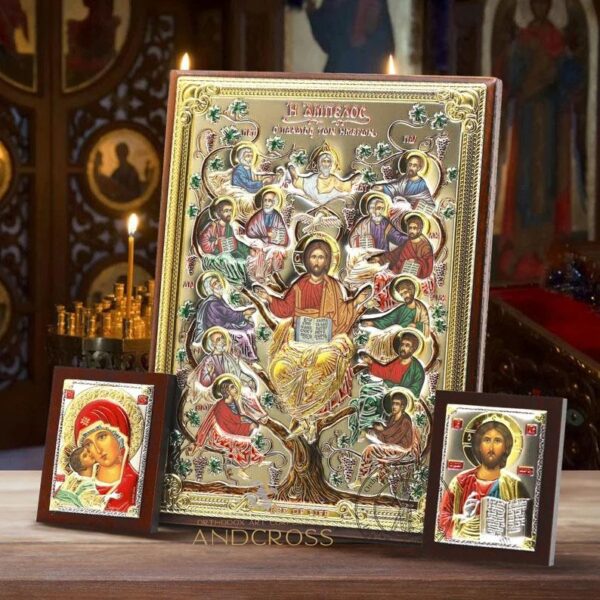
A home icon corner is not completed by decoration. It becomes a place of prayer through the presence of Christ, His Most Pure Mother, and the saints depicted in holy icons. Silver plated Orthodox icons offer a dignified way to honor that sacred presence, joining canonical imagery with finely worked metal coverings that catch the light without distracting from the holy face.
For many Orthodox families, such an icon is chosen for a baptism, a wedding, a name day, a memorial gift, or the beginning of a prayer corner in a new home. The right choice is not simply the most ornate one. It is the icon whose subject, craftsmanship, size, and spiritual purpose suit the person who will pray before it.
A silver-plated icon commonly combines a printed, painted, or finely reproduced icon image with a metal oklad, also called a riza in some traditions. The metal cover frames the holy image and may reveal the face and hands while covering the garments with engraved, chased, or embossed details. Halos, borders, and inscriptions can be highlighted with delicate ornament, giving the icon a reverent presence appropriate for home prayer.
This tradition has deep roots in Orthodox lands. Faithful Christians have long adorned beloved icons with precious materials as an offering of honor, not because metal itself makes an icon holy. The veneration offered before an icon passes to the person depicted: Christ, the Theotokos, or a saint. Silver plating continues this visual language in a more accessible form than solid silver, while preserving the luminous character of traditional metalwork.
The material also brings practical advantages. A well-made silver-plated cover can provide an elegant finish at a more approachable price than a sterling-silver riza. It is often a strong choice for gift giving, especially when a family wishes to present a meaningful icon in a fitted case or gift box. Quality varies, however, and the difference is visible in the clarity of the image, the depth of the relief, the neatness of the edges, and the way the metal cover sits against the icon.
Silver plated means that a layer of silver has been applied over a base metal. It should not be confused with solid sterling silver, which carries a higher material value and generally requires a larger investment. Gold-plated icons use a similar principle, with a gold-colored or gold layer over metal, and may suit a particular icon corner, church gift, or family preference.
There is no single “best” option for every purpose. A sterling-silver icon may be chosen for an heirloom anniversary gift or a significant church offering. A silver-plated icon can be the fitting choice for a baptism, a name-day gift, or a first icon corner because it unites beauty, tradition, and practical value. What matters most is that the icon is treated with faith and placed where it can support prayer.
Begin with the person depicted. For a personal icon, many Orthodox Christians choose their patron saint, the saint whose name they bear, or an image of Christ or the Mother of God that has become dear to their household. For a family, Christ Pantocrator and the Theotokos are natural foundations for the icon corner. The Savior is traditionally placed to the right of the person praying, while the Mother of God is placed to the left.
For a baptism or chrismation, an icon of the recipient’s heavenly patron is especially meaningful. The inscription should clearly identify the saint, particularly where several saints share a name. For a wedding, Christ and the Theotokos may be selected as a pair, recalling the blessing of a Christian home. An icon of Saints Peter and Fevronia, the Holy Martyrs Adrian and Natalia, or other saints associated with faithful marriage may also be appropriate where this reflects the couple’s tradition.
Memorial occasions call for special sensitivity. An icon of Christ, the Theotokos, a guardian angel, or the departed person’s patron saint can be a quiet and lasting expression of prayerful remembrance. The gift need not be large to be substantial. A carefully made icon in a protective presentation case often becomes a treasured part of the family’s prayer life.
When selecting an icon online, examine the details that speak to both reverence and workmanship. The icon’s dimensions should be clear, since a small bedside icon serves a different purpose from a larger centerpiece for an icon corner. Look for a description of the underlying icon panel or image, the plated metal finish, the style of the oklad, and any included stand, hanging fixture, or gift case.
Canonical imagery deserves equal attention. Orthodox iconography is not merely religious-themed artwork. The inscriptions, gestures, garments, and traditional composition help identify the holy person and preserve the Church’s visual inheritance. An icon made according to established Orthodox forms gives the faithful confidence that the image belongs naturally within prayer and worship.
For a gift, presentation matters, but it should support rather than overshadow the sacred object. A well-fitted box protects the icon during international delivery and makes it ready to give for a feast day or family celebration. If the icon is intended for a child, consider a size that can remain with them as they grow, rather than something selected only for a nursery shelf.
An icon should be placed in a clean, respectful location. Many homes reserve an eastern wall or a quiet corner for prayer, though the practical layout of an apartment or house may require another place. Avoid positioning an icon where it is likely to be knocked over, exposed to cooking grease, or surrounded by clutter. A small lampada, candle holder used safely, prayer book, and cross may be kept nearby according to the household’s practice.
Silver plating benefits from gentle care. Dust it with a soft, dry cloth rather than rough paper towels or abrasive cleaning products. Moisture, perfume, hairspray, and household chemicals can dull a plated surface over time. Do not use aggressive silver polish unless the maker specifically recommends it, since polishing compounds can wear through a thin plated layer and damage fine relief work.
Keep the icon away from direct, intense sunlight and sharp changes in heat or humidity. This is particularly wise for icons with wood elements, painted surfaces, or detailed mounted covers. If an icon has been stored for a long time, inspect the backing, hanging point, and metal edges before placing it on the wall.
If you receive an icon that has not been blessed, ask your parish priest whether he may bless it. Practices can differ by parish and local tradition, and a priest’s guidance is the proper answer to questions about blessing, placement, or the use of devotional objects. A blessed icon should still never be treated as a charm. Its purpose is to call the heart toward repentance, thanksgiving, and communion with God.
Silver plated Orthodox icons are often given at moments when words feel insufficient. They mark a child’s entry into the Church, a marriage beginning under God’s mercy, a parent’s anniversary, or a loved one’s name day. Unlike a gift chosen only for a season, an icon can remain near a person through joy, illness, travel, and loss.
At Andcross, the care given to traditional Orthodox craftsmanship reflects this enduring purpose. Whether an icon comes from a workshop, monastery source, or Orthodox artisan, the most fitting piece is one made with clear sacred imagery, honest material details, and respect for the person who will receive it.
Choose the icon prayerfully. Learn the saint’s name, consider where the icon will be kept, and select workmanship worthy of the occasion. Then let the gift do what a holy icon is called to do: turn the gaze beyond itself, toward Christ and the life of prayer.



Use this form to find things you need on this site