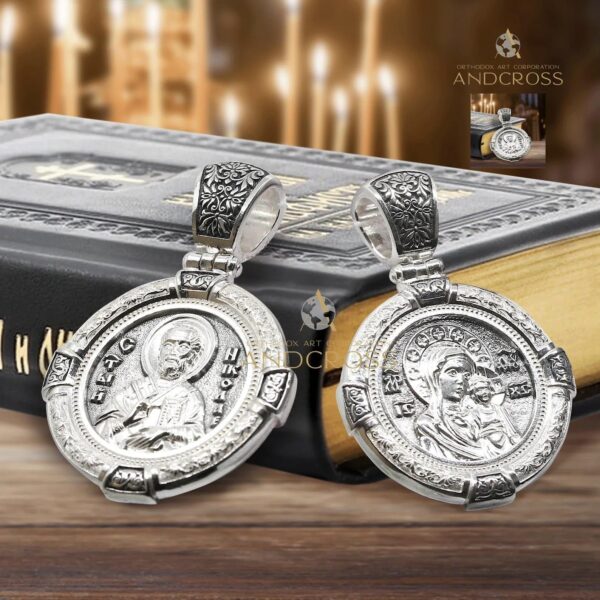
Andcross Orthodox online store offers a wide range of Orthodox products - gift sets, icons, icon cases, books, monastery candles, jewelry and much more. Some of the products of our own production, as well as from other suppliers - monasteries, temples, masters of the entire Orthodox world.
Andcross Orthodox Online Store - Established in 1999
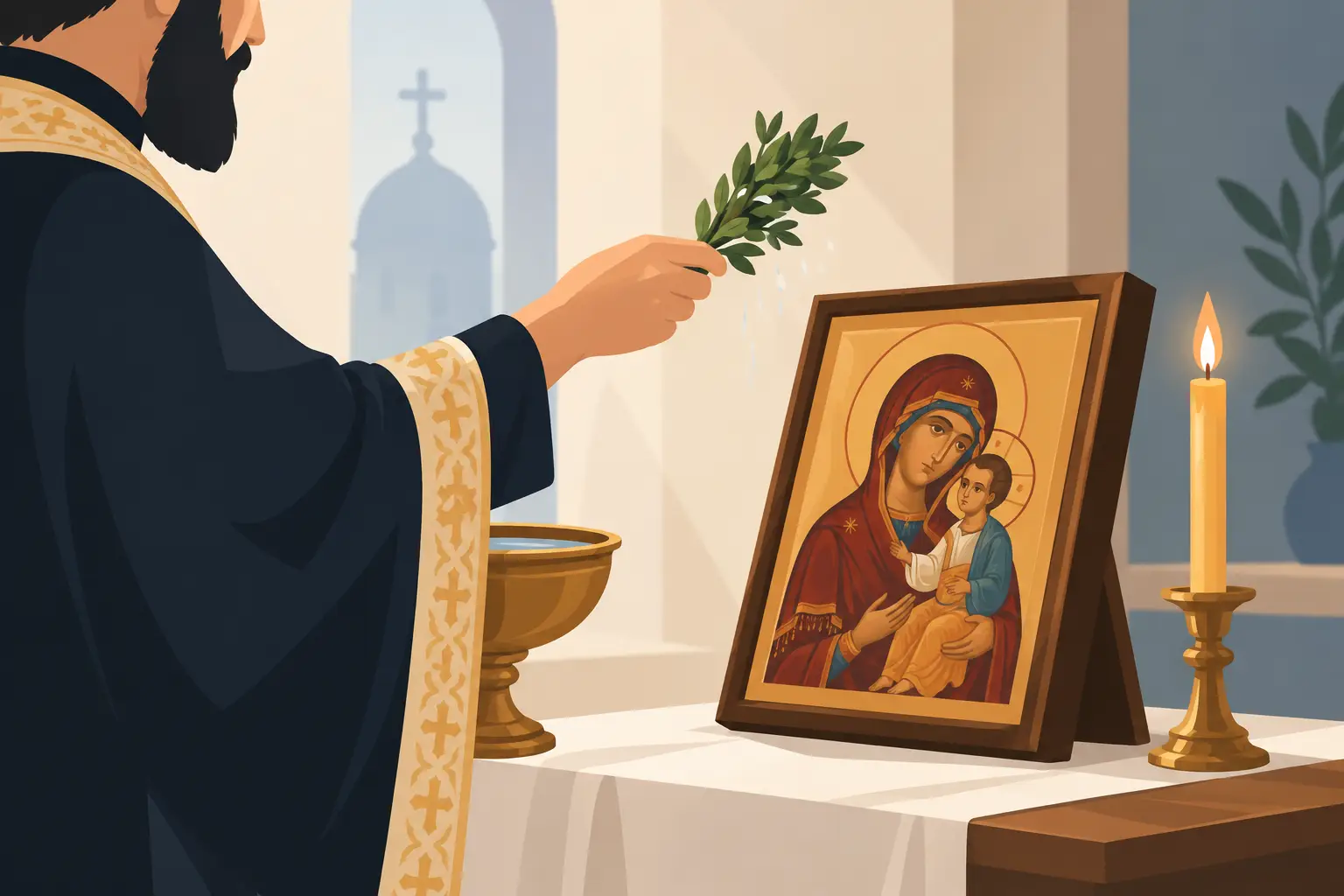
An icon is not simply religious decoration for a wall. It is a holy image of Christ, the Mother of God, the angels, or the saints, received with reverence as a witness to the Incarnation and an aid to prayer. For this reason, those asking how to bless icons are usually asking a deeper question: how should a sacred image be brought properly into the prayer life of the home?
In the Orthodox Church, the blessing of an icon belongs to the priestly ministry. A faithful Orthodox Christian may prepare an icon, place it prayerfully in the home, and venerate it, but should not attempt to perform the Church’s rite of blessing personally. The simplest and most faithful course is to bring the icon to your parish priest and ask his blessing.
The Orthodox Church does not treat an icon as an ordinary object made holy merely by a private intention. An icon is painted or crafted according to the Church’s tradition and depicts a holy person or event. Its blessing sets it apart formally for devotional use through the prayer of the Church.
During the rite, the priest reads prayers asking God to send grace upon the image and upon those who will honor it in faith. In many parishes, he sprinkles the icon with holy water. The precise prayers and local custom may differ slightly among Orthodox jurisdictions, but the essential point remains the same: the icon is blessed by the Church, not by an individual acting alone.
Blessing does not make the wood, silver, gold plating, enamel, or pigments magical. Nor does Orthodox veneration stop at the material image. Honor given before an icon passes to the person depicted. When we kiss an icon of Christ, we worship Christ alone. When we venerate the Theotokos or a saint, we ask for their prayers before God.
If you have purchased or received an icon that has not already been blessed, contact your parish office or speak with your priest after a service. It is courteous to ask when he would prefer you to bring it. Some priests bless icons after the Divine Liturgy; others may do so at Vespers, during a house blessing, or by appointment.
Bring the icon clean and ready to be blessed. If it has a presentation box, protective wrapping, or a removable price label, remove these beforehand. A gift box is appropriate for presenting an icon, especially for a baptism, wedding, name day, or memorial gift, but the icon itself should be accessible for the priest.
You may simply say, “Father, would you please bless this icon?” If it is an icon for a particular purpose, such as a wedding icon set or an icon for a new home, it is fine to mention this. The priest may offer pastoral guidance about where to place it, which prayers to use, or whether a particular saint is especially fitting for the occasion.
There is no need to be anxious about bringing an icon from a reputable Orthodox workshop, monastery source, or religious store. A blessing is not a test of whether the icon is expensive. A carefully made printed icon, a hand-painted panel, and a silver icon may all be blessed when they bear an Orthodox image worthy of veneration. What matters is faithfulness to the Church’s iconographic tradition and the reverence with which the icon will be used.
Many icons sold through monasteries, churches, and Orthodox workshops are already blessed or consecrated before being sent to the faithful. If an icon is clearly described as blessed, no second blessing is normally necessary.
Still, practices vary. If you are uncertain, ask your priest rather than relying on assumptions. He may tell you that the icon needs no further rite, or he may bless it for your peace of mind. Do not worry that a previously blessed icon becomes less holy through travel, gift wrapping, or ordinary careful handling.
Before the priest blesses the icon, or after you bring home one that is already blessed, prepare a worthy place for it. Traditionally, Orthodox Christians establish an icon corner in a clean, quiet area of the home. Where possible, it is placed on an eastern wall, recalling the expectation of Christ’s coming, though the layout of a modern home does not always make this practical.
The best location is one where the household can stand and pray without distraction. Avoid placing icons in a bathroom, directly on the floor, or in a setting where they are treated as casual décor. An icon should also be kept away from smoke, kitchen grease, prolonged direct sunlight, and excess moisture, all of which can damage wood, paint, gilding, or metal finishes.
A home prayer corner often includes an icon of Christ and an icon of the Theotokos. Families may also add their patron saints, the feast icon of their parish, guardian angel icons, or saints connected with family members and loved ones. A prayer book, Psalter, Gospel book, candleholder, and small vigil lamp may be placed nearby if space and safety permit.
Use candles with care. Keep a stable holder beneath them, never leave a flame unattended, and keep flame well away from the icon surface and any fabric covering. A beautiful icon deserves careful preservation, not because it is a museum piece, but because it will serve generations of prayer.
When the icon arrives home, make the moment deliberate. Light a candle if appropriate, make the sign of the Cross, and say the Trisagion prayers, the Lord’s Prayer, or another prayer from your Orthodox prayer book. Then venerate the icon with a bow and a kiss, according to local custom.
If the icon has not yet been blessed, you may still treat it respectfully while waiting to take it to church. Do not use holy water as though you were performing the priest’s rite yourself. You may ask God to bless your home and guide your prayer, but leave the liturgical blessing of the icon to the priest.
No. Orthodox Christians may keep holy water in their homes and use it reverently, often by drinking a small amount or sprinkling it in the home with prayer according to pastoral guidance. But holy water does not give a layperson the authority to perform the Church’s formal blessing of an icon.
This distinction protects the meaning of the sacramentals and prayers of the Church. Orthodox life is personal, but it is never merely private. We pray at home as members of the Body of Christ, connected to the parish, the priesthood, and the communion of saints.
A priest can advise you if you have questions about a particular image, especially when buying an icon online or choosing a gift for someone new to Orthodoxy. Look for clear identification of the saint or feast, traditional Orthodox imagery, and respectful craftsmanship. Avoid images that are sentimentalized, historically confused, or made primarily as novelty items.
Materials can be chosen according to purpose and budget. A small printed icon may be ideal for travel, a child’s room, or a prayer book. A hand-painted wood icon can become a family heirloom. Silver or gold-plated icon settings offer a dignified choice for baptisms, weddings, anniversaries, and name days, especially when presented in a protective gift case.
At Andcross, icons and devotional gifts are selected with attention to Orthodox symbolism, traditional craftsmanship, and the occasions for which families seek them. Yet the finest materials are always secondary to the prayer offered before the holy image.
An icon becomes part of the life of the home through faithful use. Bring it to your priest for blessing when needed, place it with honor, and return to it in prayer on ordinary mornings, difficult evenings, feast days, and moments when the heart needs to remember that the saints are near and Christ is merciful.



Use this form to find things you need on this site