Andcross Orthodox online store offers a wide range of Orthodox products - gift sets, icons, icon cases, books, monastery candles, jewelry and much more. Some of the products of our own production, as well as from other suppliers - monasteries, temples, masters of the entire Orthodox world.
Andcross Orthodox Online Store - Established in 1999

A first icon is not merely a religious decoration. It becomes a holy image before which a Christian learns to stand quietly, make the sign of the Cross, and turn the heart toward God. The best icons for new converts are therefore not necessarily the largest, rarest, or most expensive pieces. They are the icons that establish a faithful beginning: Christ at the center, His Most Pure Mother close beside Him, and a saint whose intercession becomes personally familiar.
For someone entering the Orthodox Church, an icon corner may begin with only two or three images. That is enough. The purpose is prayer, not collecting. A carefully made icon in the Orthodox tradition can help make a home a place of reverence, remembrance, and daily return to the Lord.
The first and most essential icon for an Orthodox home is an icon of our Lord Jesus Christ. Common and beloved forms include Christ Pantocrator, Christ the Teacher, and Christ the Savior. In each, Christ is shown blessing with His right hand and holding the Gospel in His left, revealing Him as the Word of God and Judge of all.
For a new convert, Christ Pantocrator is often an especially fitting choice. The name means “Ruler of All,” yet the icon does not present distant power alone. The face of Christ holds both truth and mercy. Before this icon, a person can bring repentance, thanksgiving, confusion, and need without pretense.
Choose an image with clear, canonical features and careful workmanship. A printed paper icon can serve a sincere devotional purpose, particularly at the beginning. Yet a well-crafted icon on a stable wooden panel, with a quality finish and faithful colors, is made to remain in the home for many years. It may become part of family prayer, feast-day observance, and the Christian memory of the household.
The second foundational icon is of the Most Holy Theotokos, the Mother of God. Orthodox Christians honor her because she freely received the Word of God and gave birth to Christ in the flesh. Veneration offered before her icon passes to the person depicted, asking her maternal intercession before her Son.
Several images are suitable for a first prayer corner. The Theotokos of Tenderness, often called Eleousa, expresses the loving closeness of Mother and Child. The Hodegetria, or “She Who Shows the Way,” depicts the Mother of God directing the faithful toward Christ. The Kazan Mother of God is also deeply loved in Russian Orthodox homes and is frequently chosen for a wedding, baptismal gift, or family icon corner.
There is no need to feel pressure to choose the “perfect” image immediately. A new Orthodox Christian may be drawn to one icon through a parish, a feast, family history, or a moment of prayer. That affection can be received with gratitude, while remaining rooted in the Church’s faith rather than personal taste alone.
After Christ and the Theotokos, an icon of one’s patron saint is a natural next step. At baptism or chrismation, many converts receive the name of a saint. This saint is not an abstract historical figure or a good-luck symbol. He or she is a heavenly intercessor, a brother or sister in Christ, and a companion in the path of salvation.
An icon of your patron saint gives a simple place to begin: learn the saint’s life, observe the feast day, and ask for prayers in times of trial. If a baptismal name has not yet been chosen, it is wise to speak with a priest rather than rush the decision. The name received in the Church carries meaning beyond personal preference.
Some converts also choose an icon of a saint closely connected with their journey. St. Mary of Egypt is beloved by those seeking repentance and a changed life. St. Moses the Ethiopian speaks powerfully to those who know the weight of past sins. St. Herman of Alaska, St. Raphael of Brooklyn, and St. Tikhon of Zadonsk are meaningful to many American Orthodox Christians. Still, these are additions, not replacements for the central place of Christ and His Mother.
Not every image sold as an icon is made with the same reverence for Orthodox tradition. A suitable icon should preserve the Church’s recognizable language: the inscriptions, gestures, garments, halos, and theological meaning handed down through generations. It should not turn Christ or the saints into sentimental portraits, fantasy figures, or generic religious art.
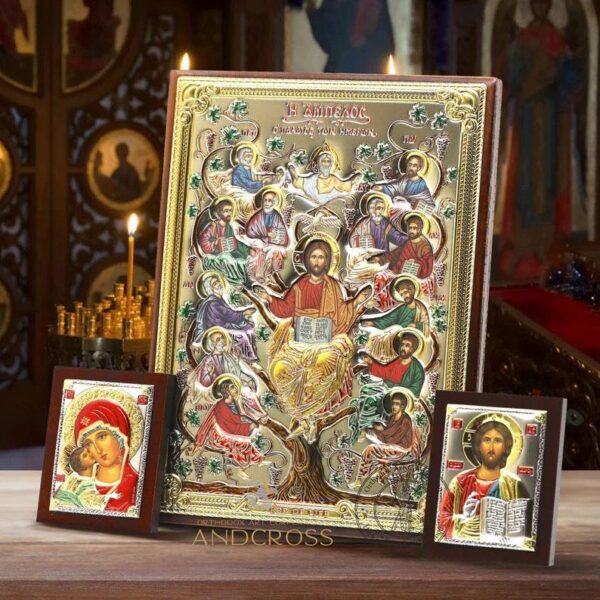
Materials matter, but they are not the whole matter. An icon may be printed, mounted on wood, hand-painted, or adorned with a metal covering called a riza or oklad. Gold-plated and silver icons can be especially fitting as baptismal, wedding, or feast-day gifts, and their detailed metalwork gives a home prayer corner a dignified presence. Handmade icons and icons obtained through monasteries, temples, and experienced Orthodox craftspeople also carry a visible connection to the living tradition of the Church.
A modest icon, faithfully made, is better than an elaborate image chosen only to match a room. If budget allows, select the best workmanship you can reasonably afford. If it does not, begin simply and without embarrassment. Prayer does not wait for a complete collection.
A small icon, often around 4 to 8 inches, is practical for an apartment, dormitory, or first home. It can stand on a shelf or be hung where prayer is possible without distraction. Larger icons are beautiful for a permanent icon corner, but they require more wall space and may be better chosen after a household’s prayer rule has become established.
Traditionally, Orthodox Christians place icons on an eastern wall when possible, facing east in prayer as a sign of awaiting Christ’s coming. In many modern homes, that arrangement is not practical. A clean, quiet corner is more important than forcing an awkward placement. Icons should not be placed where they are treated casually or crowded among unrelated decorative objects.
A small shelf, a votive lamp used safely, a prayer book, and a few beeswax candles may be added over time. Keep the space orderly. This is not about creating a display. It is about preparing a place where morning and evening prayer can become a faithful habit.
This question deserves a careful answer. Orthodox practice varies by jurisdiction and local custom. Icons are holy images because they depict the Incarnate Lord, His Mother, the angels, and the saints according to the faith of the Church. Some parishes have a practice of blessing icons, while others do not require a separate blessing for every icon purchased for prayer.
If you are uncertain, bring the icon to your priest and ask his guidance. This is especially appropriate for a convert who is learning local parish practice. It is also wise to buy from a source that identifies the icon clearly, respects canonical imagery, and describes its materials and origin honestly. Andcross offers icons and devotional articles selected with attention to Orthodox tradition, artisanal craftsmanship, and gift-ready presentation for homes and families worldwide.
New converts sometimes feel they need an icon of every feast, every favorite saint, and every biblical event at once. There is beauty in a rich icon corner, but it develops slowly. Begin with Christ, the Theotokos, and your patron saint. Live with these images through ordinary days, fasts, feasts, illness, joy, and repentance.
Later, an icon of the Resurrection, the Holy Trinity, a guardian angel, or a beloved feast may find its rightful place. Let each addition arise from prayer and the life of the Church. The finest beginning is not a crowded wall, but a sincere heart that returns before the icons and says, simply, “Lord Jesus Christ, have mercy on me.”



Use this form to find things you need on this site