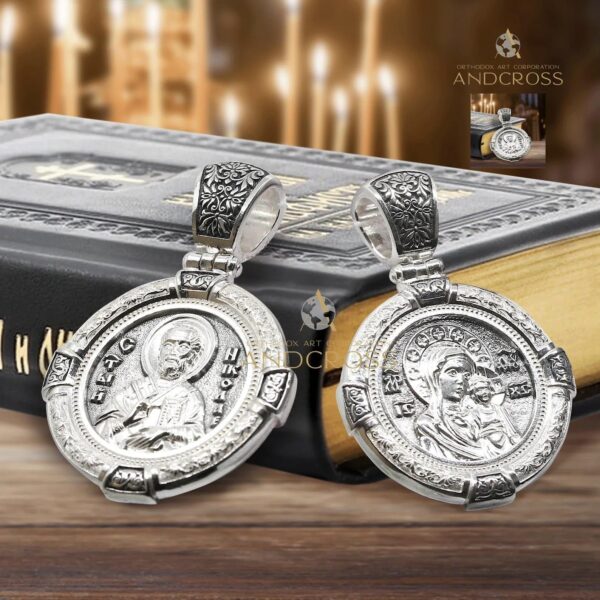
Andcross Orthodox online store offers a wide range of Orthodox products - gift sets, icons, icon cases, books, monastery candles, jewelry and much more. Some of the products of our own production, as well as from other suppliers - monasteries, temples, masters of the entire Orthodox world.
Andcross Orthodox Online Store - Established in 1999
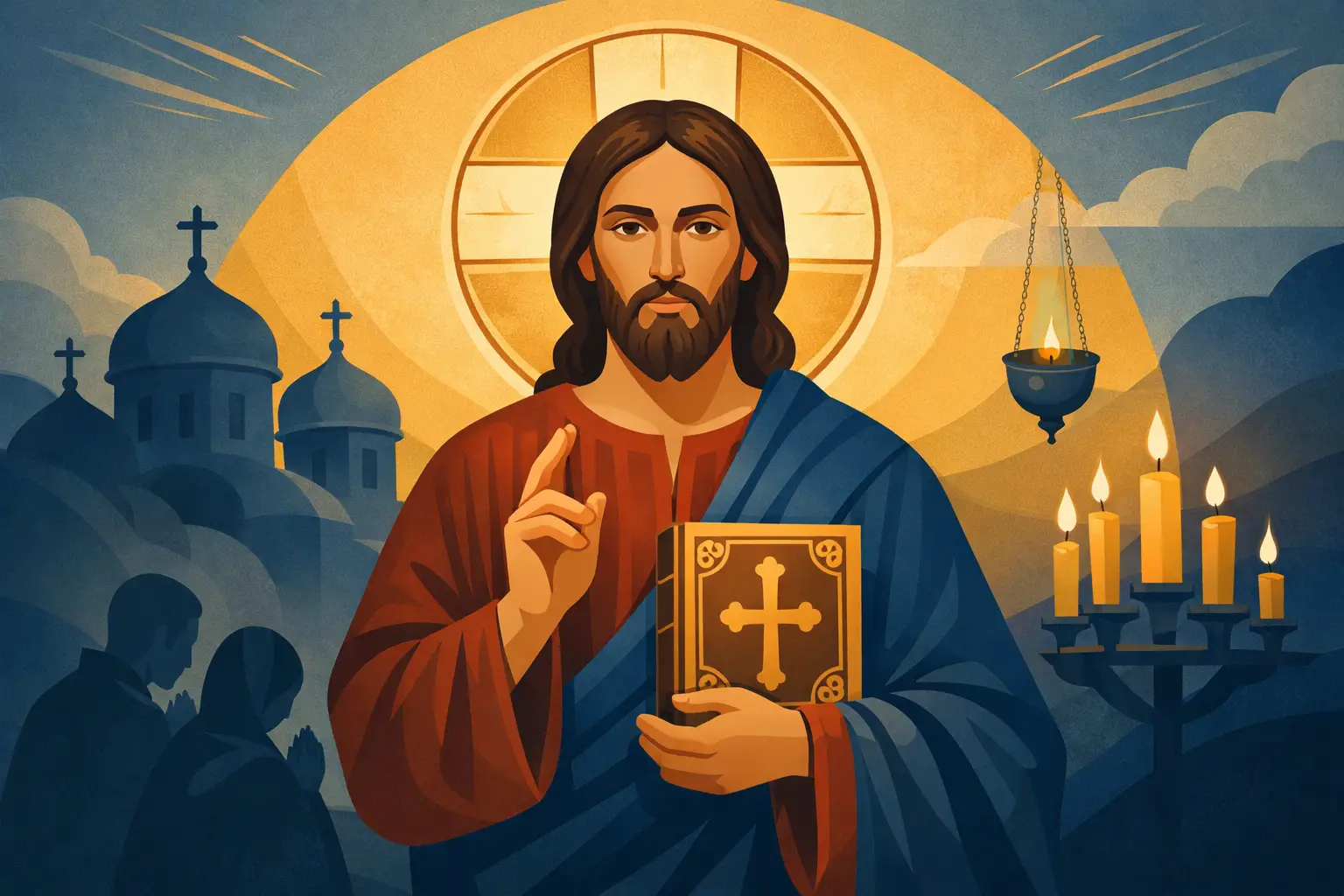
A Christ Pantocrator icon does not present the Savior as a distant religious figure or a decorative image. It places before the faithful Christ Himself: the incarnate Son of God, merciful Judge, Teacher of the Gospel, and Lord of all creation. For the Orthodox Christian praying before this image, the Christ Pantocrator icon meaning is both solemn and consoling. The One who sees the heart is also the One who blesses it.
Pantocrator comes from the Greek word Pantokrator, commonly translated as “Almighty” or “Ruler of All.” The title appears in Scripture and in the Church’s worship to confess that Christ possesses divine authority over heaven and earth. He is not merely a wise teacher, a prophet, or a holy man. He is the eternal Word of God who took flesh for the salvation of the world.
In Orthodox iconography, this title is especially associated with the majestic image of Christ facing the viewer, usually shown from the waist or chest upward. His right hand is raised in blessing. In His left hand He holds the Gospel Book, either closed and richly covered or opened to words of divine teaching.
The icon brings together truths that must not be separated. Christ is fully God and fully man. He is gentle toward the repentant and uncompromising toward sin. He comes in humility, yet He will come again in glory to judge the living and the dead. This is why the Pantocrator is not meant to feel casual. It calls the believer to reverence, repentance, trust, and faithful prayer.
A canonical icon is a confession of faith expressed through color, gesture, inscription, and proportion. Details may differ among Greek, Russian, Serbian, Romanian, and other Orthodox traditions, but the central theological meaning remains unchanged.
Christ’s right hand is raised in blessing. In many traditional icons, the fingers are arranged to form the Greek letters IC XC, an abbreviation for Jesus Christ. The gesture proclaims that the blessing comes from the Savior Himself, not from human strength or sentiment.
When a person stands before this icon, he or she is not simply looking at an artistic representation of blessing. The Church teaches us to receive the icon with honor, directing veneration to the Prototype – Christ. The raised hand reminds the faithful that the Lord still blesses, heals, forgives, and strengthens those who come to Him.
The Gospel held in Christ’s left hand speaks of His teaching and His authority. A closed Gospel Book often emphasizes the divine wisdom and judgment entrusted to the Lord. An open Gospel may display a passage such as, “Come to Me, all who labor and are heavy laden,” or “I am the Light of the world.” The exact text can vary by iconographic school and language.
Both forms are fitting. The closed Gospel does not mean that Christ’s word is hidden from us. Rather, it points to the depth of divine wisdom, which is received through faith, prayer, and life in the Church. The open Gospel gives the worshiper a direct call to hear and obey the words of Christ.
Christ’s halo is marked with a cross, distinguishing Him from saints and angels. Within the cross are the Greek letters Ο Ω Ν, meaning “He Who Is.” These words recall God’s revelation to Moses: “I AM WHO I AM.” Their presence in Christ’s halo is a clear Orthodox confession that Jesus Christ is truly God.
The abbreviations IC XC appear beside His head. Even a small icon can carry this essential confession: Jesus Christ, the One who is, the Lord revealed in the Scriptures and worshiped by the Church.
The face of Pantocrator is often calm, direct, and deeply attentive. Christ looks outward, yet the icon also seems to ask the viewer to look inward. Before Him, excuses become difficult. The Christian is invited to examine his conscience, confess sins, and return to the Gospel.
At the same time, this gaze is never meant to lead to despair. The Savior who judges is the Savior who accepted the Cross. His eyes hold truth and mercy together. This is one reason the Pantocrator icon has remained central to Orthodox homes and churches for centuries.
Christ is traditionally clothed in a red inner garment and a blue outer garment, though shades and details vary. Red may signify His humanity, sacrifice, royal dignity, and life-giving blood. Blue is often associated with heaven and divine mystery. Together, the garments proclaim the union of divine and human nature in the one Person of Christ.
Not every icon uses identical colors, and one should avoid treating color symbolism as a rigid code detached from the whole image. The icon’s meaning is carried by its complete canonical witness: Christ’s name, halo, Gospel, blessing, and sacred presence.
In many Orthodox churches, the Pantocrator appears in the central dome. From above, Christ looks upon the gathered faithful as Lord of heaven and earth. This placement is not intended to create fear alone. It declares that all worship takes place under His kingship and within His mercy.
The dome icon also expresses the Church’s vision of the cosmos. Christ holds all things together. The saints, angels, feasts, Scripture readings, and prayers of the Church are not separate fragments. They are gathered around the living Lord.
For a home icon corner, a smaller Christ Pantocrator icon can serve a similar purpose. It helps establish prayer as an encounter with God rather than a moment of private reflection alone. Whether placed beside an icon of the Theotokos, a family patron saint, or the Holy Cross, Christ remains at the center.
The famous sixth-century icon of Christ Pantocrator from Saint Catherine’s Monastery on Mount Sinai is one of the most revered early images of Christ. Its face has a strikingly asymmetrical appearance: one side seems gentle and compassionate, while the other carries a more solemn expression of authority. Many believers see in this a powerful reminder of Christ as both merciful Savior and righteous Judge.
This particular visual feature belongs to that historic icon and should not be demanded from every Pantocrator image. Orthodox iconography has several faithful forms. What matters is whether an icon preserves the Church’s confession of Christ and is made with reverence for canonical tradition.
A Pantocrator icon is suitable for a home prayer corner, a baptismal or wedding gift, a name-day offering, or a meaningful gift for someone beginning an Orthodox life. For daily devotion, select a size that can be seen clearly during morning and evening prayers. A small metal icon may be practical for travel, while a larger wooden icon can become the central image of a home icon corner.
Materials deserve thoughtful consideration, especially when the icon is intended as a lasting family gift. Silver, gold-plated silver, and finely detailed metalwork offer durability and a dignified presentation. A traditional wooden icon has its own warmth and prayerful character. The right choice depends on where it will be kept, how it will be used, and the occasion being marked.
For Orthodox buyers seeking a sacred gift, canonical imagery matters more than ornament alone. A carefully made Christ Pantocrator icon, prepared in continuity with Church tradition, can remain with a family through years of prayer, feast days, joys, and trials. At Andcross, this respect for traditional symbolism stands alongside careful craftsmanship and gift-ready presentation.
The icon is not an object of worship. Worship belongs to God alone. Yet the icon is a holy aid to prayer because it directs the mind and heart toward the Person depicted. A Christian may begin simply by making the sign of the Cross, venerating the icon with reverence, and praying, “Lord Jesus Christ, Son of God, have mercy on me, a sinner.”
There is no need for elaborate words. Stand honestly before Christ. Bring grief, gratitude, confusion, repentance, and the names of those who need prayer. The Pantocrator’s blessing hand teaches that no faithful prayer is offered outside the Lord’s care, while the Gospel Book calls each believer to shape life according to His word.
Let the icon be more than a beautiful sacred possession. Kept in a prayerful place and approached with faith, it becomes a steady reminder that Christ reigns with truth, receives the repentant, and blesses those who seek Him.



Use this form to find things you need on this site