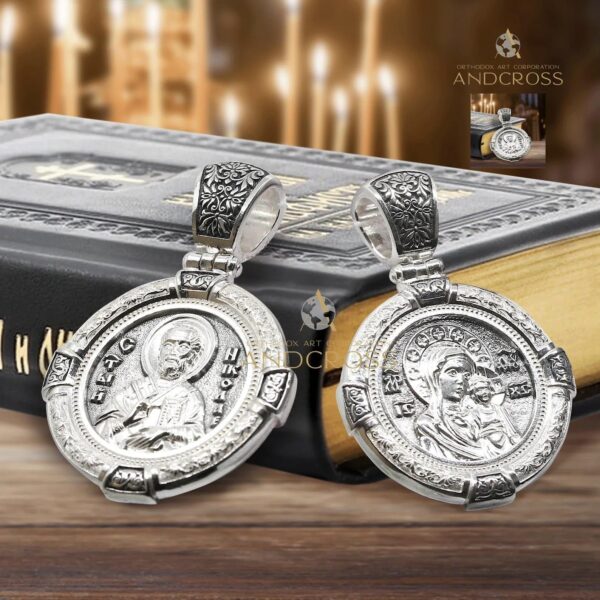
Andcross Orthodox online store offers a wide range of Orthodox products - gift sets, icons, icon cases, books, monastery candles, jewelry and much more. Some of the products of our own production, as well as from other suppliers - monasteries, temples, masters of the entire Orthodox world.
Andcross Orthodox Online Store - Established in 1999
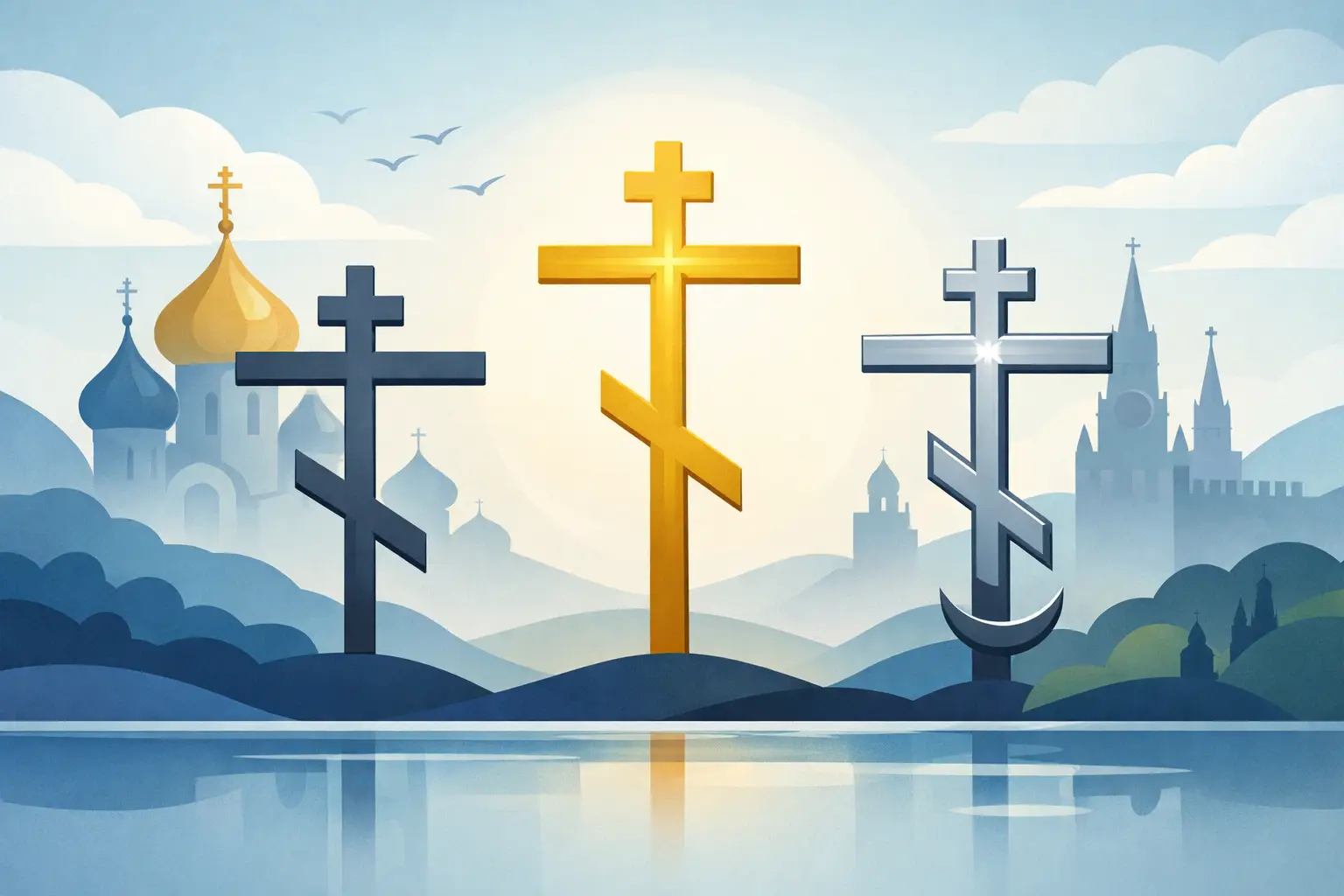
A Russian Orthodox cross is not chosen as a simple ornament. Worn at baptism, kept near an icon corner, or given for a feast day, Russian Orthodox crosses witness to Christ’s sacrifice and Resurrection. Their familiar three-bar form carries a theology that can be held close to the heart.
The form most often associated with Russian Orthodox tradition is the eight-pointed cross. It has a short upper bar, a longer central bar, and a slanted lower footrest. Each element recalls the Gospel account of the Crucifixion, while the whole image directs the faithful toward prayer, repentance, and hope.
The upper bar represents the inscription placed above the Lord: “Jesus of Nazareth, King of the Jews.” On a small pectoral cross, it may bear abbreviated sacred letters instead, such as IC XC for Jesus Christ or NIKA, meaning “conquers.” These inscriptions are not decorative additions. They proclaim the victory of Christ over sin and death.
The central bar is where the Savior’s hands were nailed. The lower bar represents the footrest. Its sloping shape is traditionally understood in connection with the two thieves crucified beside Christ: one turned toward repentance, while the other rejected Him. The raised side is often shown toward Christ’s right, reminding the faithful of the repentant thief who heard the promise of Paradise.
There are variations in how this footrest is drawn, especially in handmade work and regional designs. The essential meaning is not found in measuring an angle, but in receiving the Cross with faith and reverence.
Russian Orthodox crosses may be plain, bearing only the Crucified Lord or a brief inscription. Others include a rich arrangement of traditional symbols. A larger cross may show the sun and moon, the spear and reed used during the Passion, the skull of Adam beneath Golgotha, or Greek and Church Slavonic inscriptions. These details connect the Crucifixion to the entire history of salvation.
The skull of Adam, for example, recalls the tradition that Christ was crucified at the place associated with Adam’s burial. The blood of the New Adam descends upon the old, showing that death is overcome through the Cross. Such imagery can appear solemn at first, but its purpose is deeply hopeful: Christ enters even the grave in order to raise humanity.
For daily wear, many Orthodox Christians choose a simpler baptismal cross. A small silver cross with the Crucifixion on one side and a prayer or the Mother of God on the reverse can be especially fitting. For an icon corner or a meaningful gift, a more detailed eight-pointed cross may offer greater space for canonical imagery and careful engraving.
Orthodox sacred art never separates the Cross from the Resurrection. Christ is truly crucified, and His suffering is real. Yet the Cross is also called life-giving because, through it, death itself is defeated. This is why a pectoral cross may be worn every day, including on ordinary workdays and difficult days. It is a quiet confession of faith, not merely a piece reserved for church feasts.
The image of Christ on a Russian Orthodox cross may differ from Western devotional styles. Orthodox iconography commonly presents the Lord with reverent stillness and royal dignity, even in the Passion. This does not lessen the suffering of the Crucifixion. Rather, it bears witness that the One who suffers willingly is the victorious Son of God.
The right cross depends on its purpose, the person who will receive it, and the level of detail desired. A baptismal or everyday cross should be comfortable, durable, and proportionate. If it will be worn beneath clothing, a modest size with softened edges and a secure bail is often the wisest choice.
Silver remains a beloved material for Russian Orthodox crosses. It has a quiet, traditional appearance and works well for engraved details. Sterling silver can develop a natural patina over time, which many faithful consider part of its character. Gold-plated silver offers a warm finish while preserving fine relief work, while solid gold, platinum, and custom-made designs are often chosen for a baptism, wedding, anniversary, or family heirloom.
A cross made by skilled Orthodox craftspeople should have clear lines, readable inscriptions, and a balanced form. On a small pendant, excessive detail can become difficult to see. On a larger cross, deeper relief and hand-finished texture can bring the sacred imagery into fuller view. There is no single best material or size. A simple cross, prayerfully worn, is more fitting than an elaborate one chosen only for display.
When selecting a gift, consider the recipient’s age and daily life. A child’s cross should be light, smooth, and secure. An adult may prefer a more substantial silver or gold cross, especially one with a favorite prayer, saint, or traditional Crucifixion image. A gift box and clear presentation are worthwhile for baptisms, name days, Pascha, Christmas, and memorial occasions, but the spiritual intention remains the true heart of the gift.
Traditionally, an Orthodox pectoral cross may be worn on a cord or a chain. A cord can be practical for children and for those who prefer the cross to remain discreet beneath clothing. A silver or gold chain may suit a more formal gift or a heavier pendant. The chain should be strong enough for the cross and comfortable enough for daily use.
The cross itself should be treated with care. Store it respectfully when it is not being worn, avoid exposing delicate finishes to harsh chemicals, and clean precious metals gently. If a clasp, bail, or chain becomes worn, repair it before it is at risk of being lost.
A cross is a sacred Christian image and should always be handled reverently. Many Orthodox Christians wish to wear a cross that has been blessed by a priest, particularly when it is purchased outside a church setting or given as a special gift. In other cases, crosses obtained through a monastery, temple, or established Orthodox source may already be prepared for devotional use according to local practice.
Customs can differ by parish and jurisdiction. If you are uncertain, ask your priest to bless the cross. This is especially appropriate for a new baptismal cross, a family heirloom being returned to use, or a cross received as a gift. The priest’s blessing places the object within the prayerful life of the Church, rather than treating it as a personal charm.
A pectoral cross is not meant to promise worldly success or protect its wearer from every hardship. It calls the Christian to carry the Cross with patience, to pray, and to remember Christ in moments of joy as well as trial. That distinction matters when choosing and giving sacred goods.
For those building an Orthodox home, a Russian Orthodox cross can stand beside icons, a prayer book, and beeswax candles as a visible sign of devotion. For one received at baptism, it can become a lifelong companion. For a family, it may become a treasured gift passed from one generation to another.
Andcross selects traditional crosses with attention to canonical symbolism, quality metalwork, and gift-worthy presentation, including handmade and custom options for significant occasions. Whether a cross is plain or richly detailed, silver or gold, its deepest value is found when it leads the heart back to Christ. Choose one with care, have it blessed when appropriate, and wear or keep it as an invitation to faithful prayer.



Use this form to find things you need on this site