Andcross Orthodox online store offers a wide range of Orthodox products - gift sets, icons, icon cases, books, monastery candles, jewelry and much more. Some of the products of our own production, as well as from other suppliers - monasteries, temples, masters of the entire Orthodox world.
Andcross Orthodox Online Store - Established in 1999

A saint is not chosen as a lucky symbol or a decoration for a shelf. In the Orthodox Church, the question of how to choose patron saints begins with a relationship of prayer: a holy person who lived in Christ, now intercedes before Him, and can become a familiar heavenly companion throughout one’s life.
For many Orthodox Christians, the first and most enduring answer is already given at Baptism. Yet people may also feel a sincere closeness to other saints through family heritage, a difficult season, a profession, a parish feast, or a saint’s particular witness. The goal is not to collect patrons, but to seek faithful examples who lead us more deeply toward Christ.
Your baptismal saint is ordinarily your principal patron. If you received a Christian name at Baptism, you were named for a saint, and that saint’s feast day is commonly observed as your name day. This is a day for prayer, confession when possible, receiving Holy Communion with preparation and blessing, reading the saint’s life, and giving thanks for his or her intercessions.
Sometimes the connection is obvious. A man named Nicholas is usually named for St. Nicholas the Wonderworker; a woman named Mary may be named for the Most Holy Theotokos under a particular feast or for one of several saints named Mary. Other names have variations across languages. Elena may correspond to Helen, Yuri to George, and Ksenia to Xenia. In such cases, family tradition, baptismal records, and guidance from a priest can clarify the proper saint.
If you are unsure, do not guess simply because an icon has a similar name printed on it. Ask the priest who baptized you, your parish priest, or a trusted godparent. The Church’s memory is precise, and this small act of care honors the sacrament through which you entered the life of Christ.
Orthodox Christians may ask the prayers of every saint. Choosing an additional saint for regular devotion is therefore not a replacement for one’s baptismal patron, nor does it require a dramatic sign. Often it grows quietly from attention, reading, and prayer.
A saint may become especially meaningful because his or her life speaks to your own need. St. Luke the Surgeon is beloved by physicians and those facing illness. St. Phanourios is often invoked when something lost needs to be found. St. John the Russian offers a powerful example of endurance, humility, and faithfulness in hardship. Saints Joachim and Anna are often remembered by married couples and families praying for children.
These associations can be helpful, but they should not reduce saints to specialists who grant a single request. A saint’s life is larger than one need. Read the life, notice the virtues revealed there, and ask whether this witness calls you to repentance, courage, mercy, patience, or a more serious prayer rule.
For a new Christian, it can be wise to begin with a few enduring companions: the baptismal saint, the saint connected with one’s given name, and a saint whose life has been read carefully. Depth is better than novelty. A small icon before which you pray regularly can become more spiritually fruitful than many icons chosen without knowledge or attention.
A family’s Orthodox inheritance can offer a natural starting point. Perhaps your grandparents kept an icon of St. George, St. Olga, St. Nektarios, or St. Seraphim of Sarov in their home. Perhaps your family comes from a village, country, or parish where a particular saint is especially honored. This does not make that saint more powerful than another, but it may help restore a living thread of remembrance.
Your parish calendar also matters. A parish dedicated to the Protection of the Theotokos, St. Michael, or a local saint teaches its people through its feast day, hymns, and prayers. To honor that patron is to enter more fully into the worshipping life of the community God has given you.
Icons are sacred images, but the name written on an icon should lead to the saint’s life and the Church’s hymnography. Before purchasing or giving an icon, learn a few true details: when the saint lived, what trials were endured, what virtues were shown, and on which day the Church commemorates the saint.
This is particularly important with popular names. There are many saints named John, Catherine, Theodore, Alexander, and Maria. A well-made icon should identify the saint clearly, often with a traditional inscription, so there is no uncertainty about whom it depicts. When selecting a commissioned icon, pendant, or cross, provide the saint’s full title or feast designation whenever possible.
There is no need to wait for extraordinary dreams, coincidences, or private revelations. In Orthodox spiritual life, a quieter path is safer. Stand before the icons, make the sign of the Cross, and ask God to guide you. Read a saint’s life over several days. Pray simply: “Holy Saint of God, pray to God for me.”
If a saint’s witness continues to draw you toward humility and prayer, receive that with gratitude. If the choice creates anxiety or becomes an obsession with signs, return to the simple foundations of Church life: the Divine Liturgy, confession, Scripture, fasting according to your priest’s guidance, and daily prayer.
A priest can be especially helpful when someone is preparing for Baptism or Chrismation, choosing a Christian name, returning to the Church, or seeking a saint during grief, illness, marriage, or another major transition. Spiritual discernment is not a private consumer decision. It belongs within the Church.
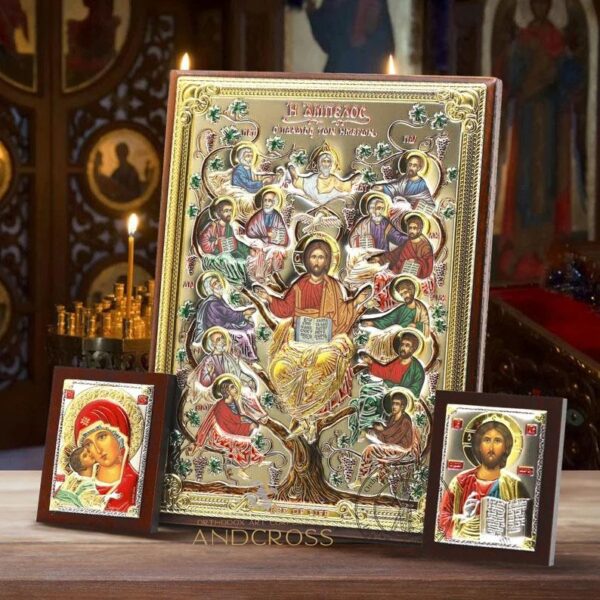
A patron saint icon is most fitting when it will be used for prayer. For a home icon corner, many families choose a carefully made icon in a size appropriate for the prayer space, with the saint’s name clearly inscribed. A small icon may be suitable for a desk, bedside table, travel prayer set, or a child’s room, while a larger icon can become a lasting baptismal, wedding, or name-day gift.
Material and craftsmanship deserve thoughtful attention, particularly for a gift meant to be kept for decades. Traditional Orthodox imagery, careful facial features and inscriptions, durable wood or metalwork, and reverent finishing all help preserve the dignity of the sacred image. A gift case can be practical for presenting an icon on a baptism or feast day, but the gift’s real value lies in the prayer it encourages.
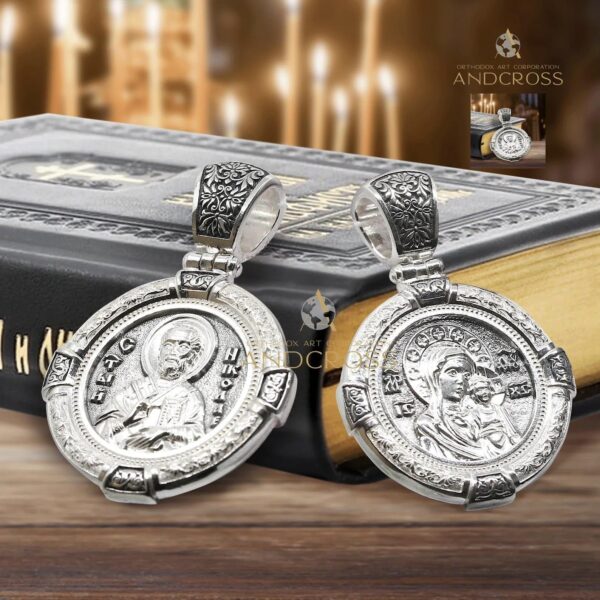
A cross or saint medal may also be chosen in honor of a patron. Here, clarity matters. A baptismal cross remains first of all a confession of Christ crucified and risen. A pendant bearing a saint may be worn as a reminder to pray and live faithfully, never as an amulet. For precious-metal pieces, confirm the metal purity, dimensions, image, and inscription so the item suits both daily wear and the recipient’s Orthodox tradition.
At Andcross, those choosing a saint icon or custom devotional gift can look for canonical imagery, named saints, traditional craftsmanship, and gift-ready presentation. For a personalized commission, the baptismal name, exact saint, preferred metal, and intended occasion should be established before production begins.
Yes. Your baptismal saint remains your principal patron, while you may regularly ask the prayers of other saints who are meaningful in your life. The Church is one family in Christ, not a system of exclusive spiritual affiliations.
Speak with your priest. A corresponding Christian name may exist in another language, or a saint may have been chosen at Baptism for a reason known to your family or parish. The baptismal record, if available, is often the best guide.
Yes, especially for Baptism, a name day, a wedding, a birthday, recovery from illness, or a house blessing. Choose the recipient’s baptismal saint when known. If it is not known, an icon of Christ, the Theotokos, the guardian angel, or a universally beloved saint may be more appropriate than making an uncertain assumption.
Let the choice of a patron saint be patient and prayerful. Learn the name, honor the feast, keep the icon with reverence, and return often to the saint’s example. The surest sign of a good choice is not excitement over an object, but a steadier desire to live in Christ.



Use this form to find things you need on this site