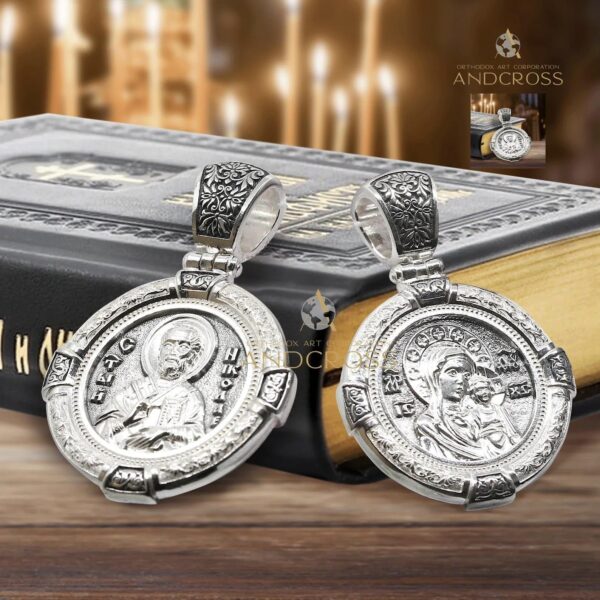
Andcross Orthodox online store offers a wide range of Orthodox products - gift sets, icons, icon cases, books, monastery candles, jewelry and much more. Some of the products of our own production, as well as from other suppliers - monasteries, temples, masters of the entire Orthodox world.
Andcross Orthodox Online Store - Established in 1999

A home icon corner should draw the heart toward prayer, not leave a believer wondering whether an image belongs to the Church’s sacred tradition. Learning how to identify canonical icons helps when choosing an icon for your family, a baptismal gift, a memorial, or a feast day. It also helps distinguish a faithful sacred image from religious decoration that borrows Orthodox symbols without preserving their meaning.
An icon is not valued merely for age, expense, or elaborate metalwork. Its first measure is faithfulness: faithfulness to Holy Scripture, the lives of the saints, the dogmatic teaching of the Orthodox Church, and the iconographic tradition received through generations of prayer.
A canonical icon follows the Church’s established way of depicting Christ, the Most Holy Theotokos, angels, saints, and sacred events. The word does not mean that every icon must look identical. Russian, Greek, Serbian, Romanian, Georgian, and other Orthodox traditions may differ in color, line, architectural details, and artistic manner. Yet they share the same theological foundation.
The icon bears witness to a real person or a real event in the life of salvation. Christ is depicted as the incarnate Son of God, not as a generic spiritual teacher. The Theotokos is honored as the Mother of God. Saints are shown as persons transfigured by grace, never as fantasy characters, fashion portraits, or sentimental figures detached from their lives of holiness.
For this reason, canonical iconography is not simply an artistic style. It is visual theology. A well-made icon may be modest in size or richly adorned with a silver or gold-plated riza, but its spiritual purpose remains the same: to direct reverence to the one depicted.
Begin with the central subject. A reliable icon clearly identifies Christ, the Theotokos, a named saint, an angel, or a recognized feast. The image should correspond to the Church’s received depiction of that subject. For example, an icon of Christ Pantocrator traditionally shows the Lord blessing with one hand and holding the Gospel with the other. An icon of the Crucifixion should preserve the sobriety and saving meaning of the Cross, rather than turn it into a scene of dramatic spectacle.
Look carefully at the face and posture. Orthodox icons are usually characterized by stillness, inward attention, and spiritual dignity. The saint may show suffering or joy, but not theatrical emotion. The gaze is often direct, peaceful, and grave. Proportions may appear unlike naturalistic painting because the icon is not trying to imitate an ordinary photograph. Its perspective and form point beyond passing earthly appearance toward the Kingdom of God.
Sacred symbols also matter. Christ’s halo normally contains the cross and the Greek letters O Ω N, meaning “He Who Is.” The Theotokos is commonly marked with the Greek abbreviation MP ΘΥ, meaning Mother of God, and often wears three stars as a sign of her perpetual virginity. Saints commonly have their names written beside them, while angels, prophets, apostles, martyrs, and monastics may be recognized by traditional garments or attributes.
An icon need not contain every familiar detail to be canonical. Space can be limited on a small travel icon, pendant icon, or gift set. Still, the essential identity of the holy person and the meaning of the scene should remain clear.
Inscriptions are among the most useful signs of a canonical icon. They identify the person depicted and protect the image from vague or mistaken interpretation. The name may appear in Greek, Church Slavonic, Russian, Romanian, English, or another Orthodox language. Spelling and abbreviations vary by tradition, so an unfamiliar script is not automatically a concern.
What deserves caution is a missing, incorrect, or invented name. A seller should be able to state plainly which saint is shown, what feast is depicted, and what the inscription says. This is especially important with saints who share a name, such as Saint Nicholas, Saint George, Saint John, or Saint Mary. A proper identification gives the buyer confidence that the icon is intended for the saint they seek.
Some devotional art can be beautiful and sincerely made without being suitable as an Orthodox icon. Decorative images may use halos, crosses, gold backgrounds, or saint-like faces while departing from the Church’s theology and established forms. A sentimental image of Christ with unrealistic features, an angel designed as a fashionable home accessory, or a saint portrayed with modern symbols unrelated to his or her life should be considered carefully.
The distinction is not meant to encourage harsh judgment about art. It is an act of care toward prayer. An icon is kissed, censed, placed in an icon corner, and carried in processions because it is a sacred image of a specific holy person or event. A decorative religious picture may inspire reflection, but it does not necessarily serve the same liturgical and devotional role.
Be cautious of images that blend Orthodox subjects with occult symbols, astrology, New Age language, or invented spiritual claims. Orthodox iconography does not offer luck, anonymous “energy,” or protection separated from faith in Christ. It calls the believer to prayer, repentance, and communion with God.
A canonical image may be hand-painted, printed from a faithful original, engraved, cast in metal, or made using other careful methods. Hand-painted icons are treasured for their labor and individuality, but a printed or metal icon is not less worthy simply because it is reproduced. What matters first is whether the image is faithful and treated reverently.
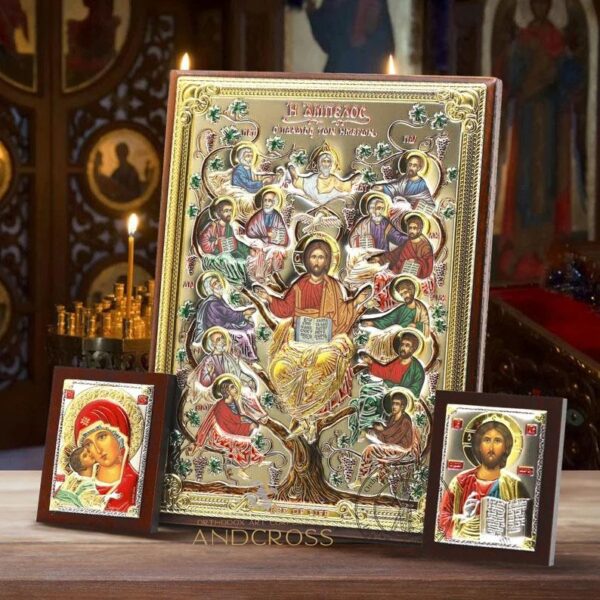
Good workmanship supports that purpose. Clear features, legible inscriptions, balanced composition, and carefully finished metal coverings show respect for the sacred subject. Silver settings, gold plating, enamel, wood, and protective glass may add beauty and durability, particularly for icons given at baptisms, weddings, name days, or memorial occasions. They should not conceal a poorly formed image underneath.
When considering a metal icon or an icon with a riza, ask what material is used and whether the maker provides clear specifications. Sterling silver purity, plated finishes, dimensions, backing material, and gift packaging are practical details that help a buyer choose responsibly. For a home prayer corner, size matters as well: an icon should be visible and suitable for veneration without overwhelming the space.
A trustworthy seller should be open about an icon’s source. Icons made in an Orthodox workshop, obtained from a monastery or temple, or created by known Orthodox craftspeople carry a meaningful connection to living tradition. Origin alone does not prove canonicity, but vague descriptions and unsupported claims deserve more caution than transparent information.
It is also helpful to understand the difference between canonical form and blessing. An icon can be painted according to the canon yet not have been blessed. Conversely, a blessing is not a substitute for sound iconography. In many Orthodox communities, believers bring newly acquired icons to a priest for blessing, especially when the source or history is uncertain. Local pastoral practice varies, so the guidance of one’s parish priest remains valuable.
If you are buying an icon as a gift, do not assume every recipient needs the same image. A baptismal gift may be a guardian angel icon or the patron saint of the baptized person. For a wedding, Christ and the Theotokos are traditional choices. For a family’s prayer corner, Christ Pantocrator, an icon of the Theotokos, and the household’s patron saints form a meaningful beginning.
Before purchasing, take a moment to confirm four things:
These questions are useful whether you are selecting a small silver icon for daily carrying or a larger handcrafted image for a family icon corner. At Andcross, careful descriptions of saints, materials, and workmanship are meant to make that choice clearer, especially for those purchasing an Orthodox gift from afar.
Some icons have several accepted versions. The Theotokos of Kazan, Vladimir, Iveron, and the Sign are each honored depictions with distinct compositions. Saint Nicholas may appear as a hierarch, in a life icon surrounded by scenes from his ministry, or among other saints. The hospitality of Abraham is an accepted Old Testament image of the Holy Trinity, while other images require greater discernment and should be considered in light of Orthodox teaching.
When two icons look different, the question is not always which is “correct.” Ask whether both forms are recognized within Orthodox tradition and whether the seller identifies them accurately. A priest, experienced iconographer, or knowledgeable parish bookstore can help when an image is unfamiliar or the subject has theological complexity.
Choose with a prayerful mind and with enough practical care to know what you are bringing into your home. The finest icon is not a collectible kept at a distance. It becomes part of a life of prayer: a quiet witness before which a family gives thanks, asks mercy, remembers the departed, and turns again toward Christ.




Use this form to find things you need on this site