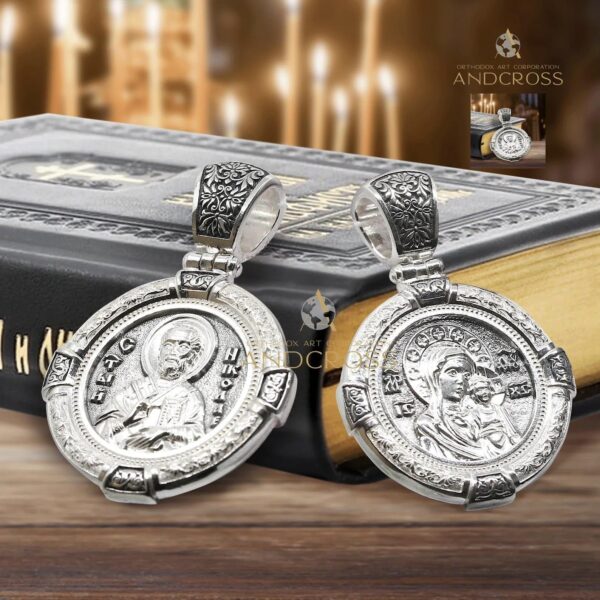
Andcross Orthodox online store offers a wide range of Orthodox products - gift sets, icons, icon cases, books, monastery candles, jewelry and much more. Some of the products of our own production, as well as from other suppliers - monasteries, temples, masters of the entire Orthodox world.
Andcross Orthodox Online Store - Established in 1999
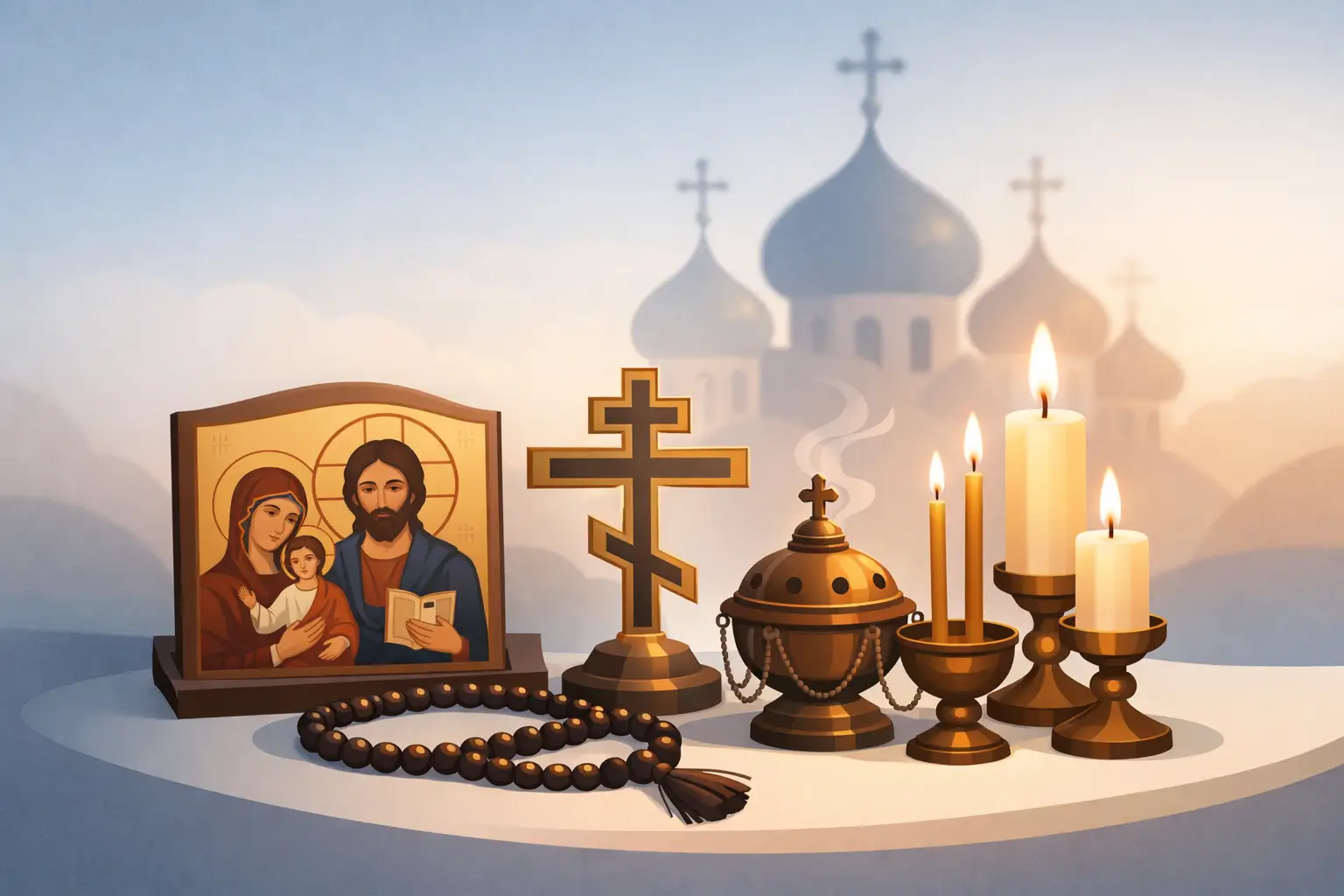
A home prayer corner need not be elaborate to become a faithful place of daily standing before God. An Orthodox prayer set with candles gathers the essential visible signs of this devotion: holy icons, a prayer book, and candles whose quiet flame accompanies morning prayers, evening prayers, feast days, and private petitions.
For many Orthodox families, this is not simply a group of devotional articles arranged on a shelf. It is a small domestic sanctuary, formed with reverence and used with consistency. For a convert establishing a first icon corner, a family preparing a housewarming gift, or someone seeking a fitting memorial offering, choosing each piece with care gives the set lasting spiritual and practical value.
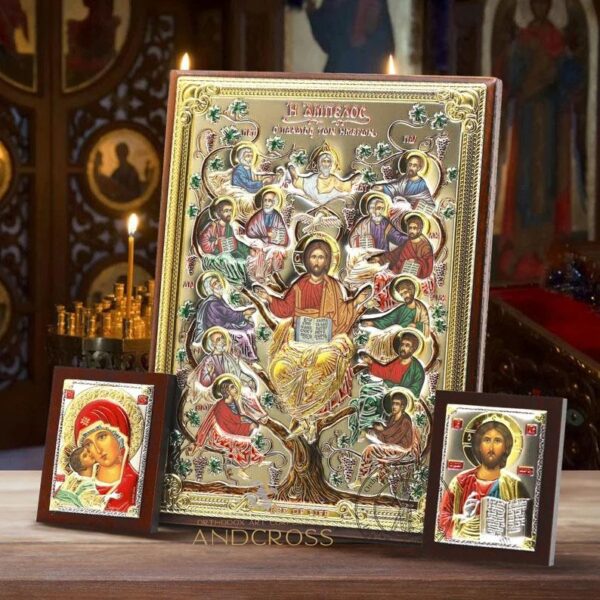
The center of a traditional home prayer set is an icon of Christ and an icon of the Most Holy Theotokos. They witness to the Incarnation and direct prayer toward the Lord, with the Mother of God honored as the foremost intercessor. These icons are commonly placed together in the prayer corner, often with Christ on the right as one faces them and the Theotokos on the left.
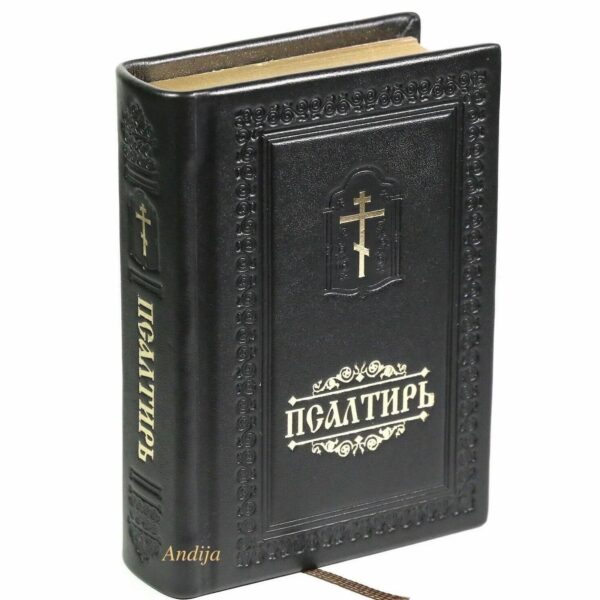
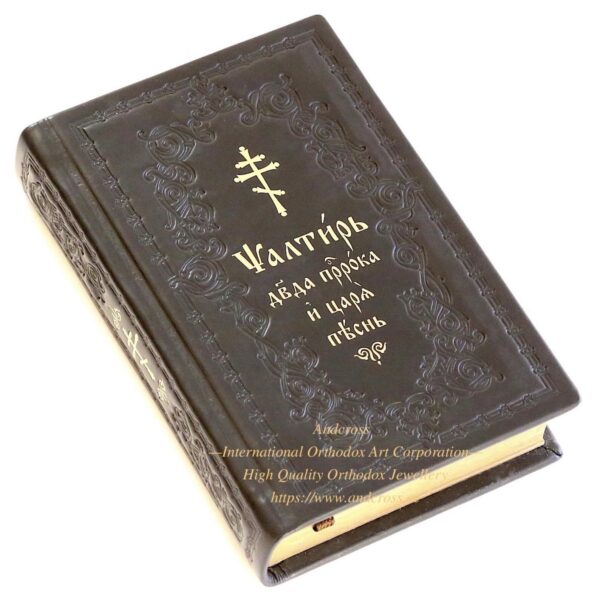
A prayer book gives shape to this place of prayer. Depending on the household, it may contain morning and evening prayers, prayers before and after Communion, an akathist, a Psalter, or selected prayers for the departed. A small Gospel book can also be especially meaningful, although it should be chosen for regular reading rather than only for display.
Candles complete the set in a simple but profound way. Lighting a candle is not a substitute for attention, repentance, or prayer. It is an outward offering that accompanies them. The flame recalls Christ, the Light of the world, and the candle itself represents a modest sacrifice offered with love. In Orthodox homes, beeswax candles are especially cherished for their natural material, warm light, and longstanding use in church life.
A prayer rope, hand cross, censer, bottle of holy water, or a small icon of a family patron saint may also have a place. Yet the best set is not always the largest one. A modest pair of well-made icons, a dependable prayer book, and a supply of proper candles can serve a household far better than many objects chosen only for appearance.
An icon is not religious decoration. It is a sacred image received within the Church’s tradition, inviting the faithful into prayerful communion with Christ, His Mother, and the saints. For this reason, canonical imagery and careful craftsmanship matter.
Begin with the icon of Christ and the Theotokos. A matching diptych or icon pair is a natural choice for a new prayer corner because the size, style, and finish are already harmonious. Silver-plated, gold-plated, or finely printed icons may each be appropriate. The decision depends on the intended setting, budget, and whether the set is meant as an everyday household blessing or a formal gift for a baptism, wedding, or major feast.
For an additional icon, choose one with a real connection to the recipient. A name saint is especially fitting for a personal gift. Saint Nicholas, Saint George, Saint Seraphim of Sarov, Saint Matrona of Moscow, the Guardian Angel, and the family’s beloved local or national saints are also frequently chosen. In a family set, an icon of the patron saint of each spouse or child can grow naturally over time.
Size deserves practical thought. A small icon may be ideal for a bedside table, apartment prayer shelf, or travel use. A larger icon carries a stronger presence in a dedicated corner, but it needs a secure and respectful place. Before selecting a set, measure the shelf or wall space and consider whether the icons will stand, hang, or rest on a lectern.
Church candles are meant to be used, not stored indefinitely as ornaments. A prayer set should therefore include candles that are suitable for the candleholder and the space where prayer takes place. Thin taper candles burn beautifully but need a stable holder. Shorter candles can be more practical for brief daily prayers or homes with limited space.
Beeswax is traditionally preferred, particularly when candles come from a monastery or are made in accordance with Orthodox devotional practice. Its gentle scent and clean golden color suit the prayer corner without drawing attention away from prayer itself. Paraffin candles may be easier to find and less costly, but natural beeswax is often worth choosing when possible.
Candles require ordinary care. Place them on a heat-safe surface, away from curtains, paper icons, and drafts. Never leave a burning candle unattended, especially around children or pets. A small brass or metal candleholder with a wide base is both practical and dignified. Wax drips are normal, but a holder with a tray makes the prayer corner easier to keep clean.
There is no need to light many candles at once. One candle, lit attentively before prayer, is sufficient. On great feasts, family prayers, or a memorial day, additional candles may express the solemnity of the occasion. The measure is reverence, not display.
A prayer set becomes part of life when it supports a rule that can actually be kept. Someone new to Orthodox practice may begin with a short selection of morning and evening prayers, the Trisagion prayers, the Creed, and a Psalm. A more experienced reader may want a complete Orthodox prayer book, Psalter, Gospel, or an akathist to a beloved saint.
It depends on the person’s spiritual father, parish custom, family responsibilities, and health. Long prayer rules are not automatically better. A short rule said faithfully and with attention is a sound beginning. If there is uncertainty about which prayers are appropriate, a parish priest can give guidance suited to the individual rather than a one-size-fits-all answer.
For gift sets, an English-language prayer book is often most useful for US-based converts and younger family members. A bilingual or Church Slavonic edition may be deeply meaningful for those maintaining Russian or Slavic prayer traditions. The best choice respects both the recipient’s heritage and the language in which he or she can pray with understanding.
An Orthodox prayer set with candles is a fitting gift because it serves the recipient beyond the day it is opened. It may be given for a baptism, chrismation, wedding, house blessing, name day, birthday, Nativity, Pascha, or the beginning of a new home. It can also be prepared quietly for someone grieving, with an icon, prayer book, and candles for prayers for the departed.
Gift-ready presentation matters, particularly for a milestone occasion. A well-fitted case protects the icons during shipping and gives the offering the dignity it deserves. Still, the spiritual thought behind the selection matters more than elaborate packaging. An icon of the recipient’s patron saint, paired with monastery beeswax candles, is often more personal than a costly set chosen without that connection.
Those buying from a distance should look closely at the stated dimensions, material, icon technique, and what is included. A listing should make clear whether the item is handmade, sourced from a monastery or temple workshop, silver-plated, gold-plated, or made from another material. If an item is described as consecrated, that claim should be explicit. Not every religious item is consecrated, and a newly purchased icon or prayer corner may be blessed by a priest according to local pastoral practice.
At Andcross, traditional iconography, artisan workmanship, and carefully selected monastery devotional goods help customers assemble gifts that remain appropriate for prayer long after a feast day has passed.
Place the icons in a clean, quiet area of the home where prayer can be offered without constant interruption. Many families choose an eastern wall when the layout allows, following the ancient Christian practice of facing east in prayer. But an apartment, dormitory, or shared home may not permit this. A respectful, stable location is more important than forcing an arrangement that does not work.
Keep the prayer book within reach, the candleholder secure, and the space free from unrelated clutter. If several icons are present, Christ and the Theotokos should retain the central place, while saints’ icons may stand nearby. Avoid treating holy images as part of a decorative display mixed with casual objects.
The most beautiful prayer corner is not defined by precious metal, size, or the number of candles. It is the place where a person returns, even after distraction or difficulty, to make the sign of the Cross and pray: “Lord Jesus Christ, have mercy on me.”



Use this form to find things you need on this site