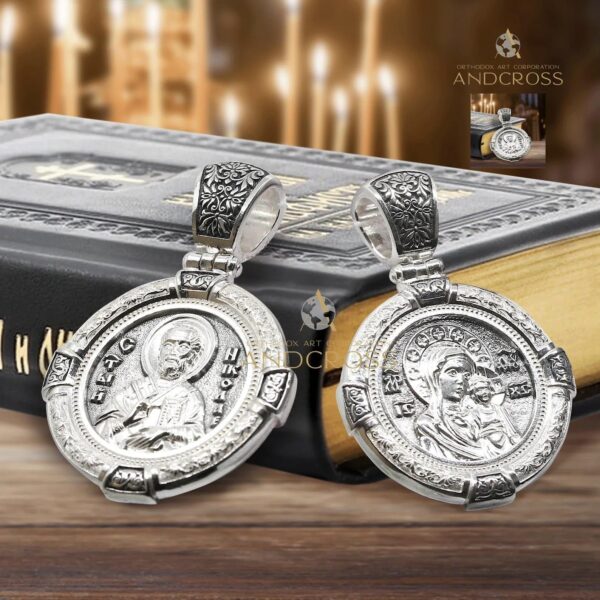
Andcross Orthodox online store offers a wide range of Orthodox products - gift sets, icons, icon cases, books, monastery candles, jewelry and much more. Some of the products of our own production, as well as from other suppliers - monasteries, temples, masters of the entire Orthodox world.
Andcross Orthodox Online Store - Established in 1999
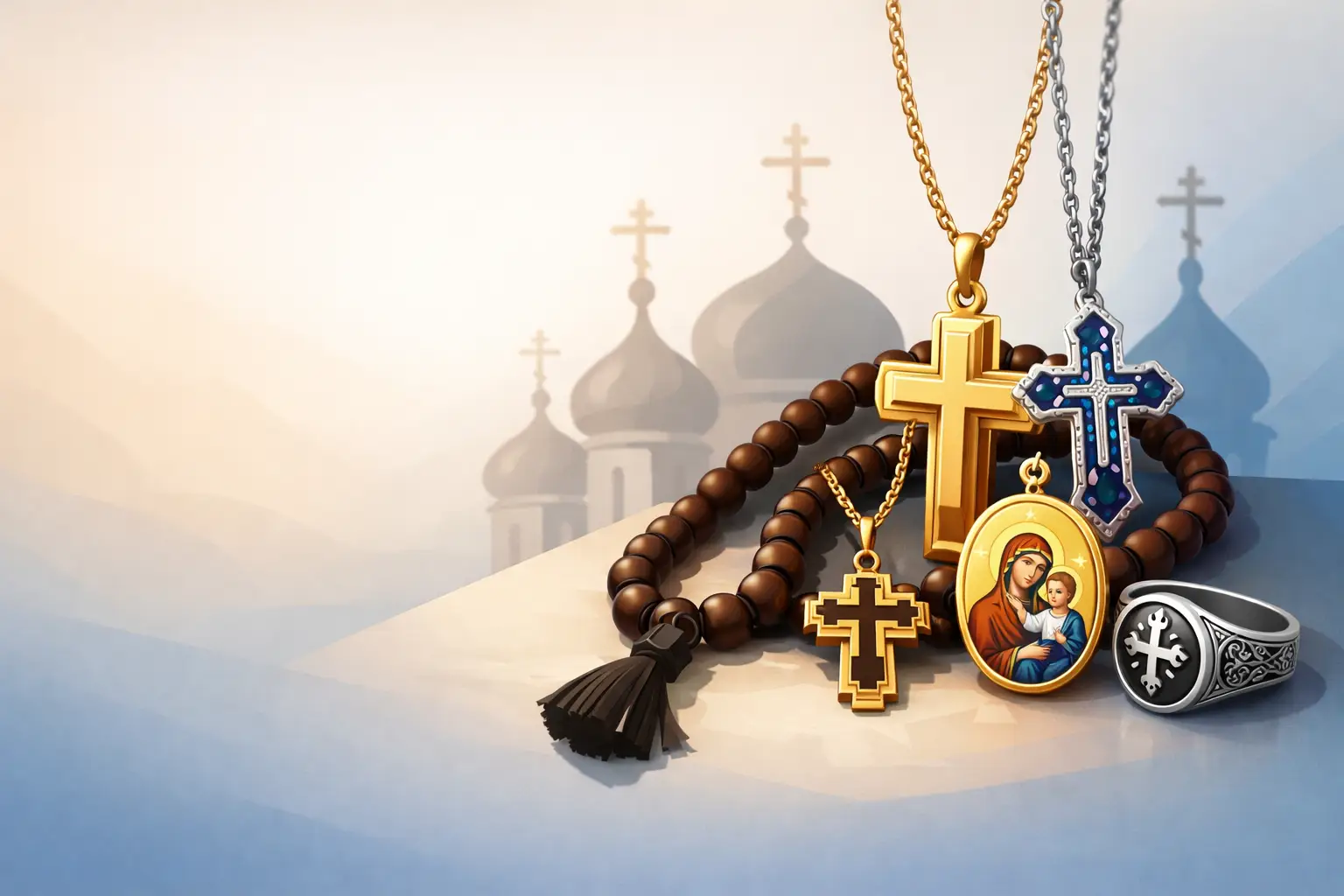
A baptismal cross rests close to the heart. A ring bearing the words of prayer meets the hand throughout ordinary work. A small pendant of Christ or a beloved saint can bring the mind back to God in a crowded day. Orthodox jewelry is valued not merely for its beauty, but for this quiet and personal place it holds in the life of faith.
For Orthodox Christians, selecting such a piece calls for more than choosing a metal or a pleasing design. The image, inscription, workmanship, and intended use all matter. A well-made cross or pendant can become a lifelong companion in prayer, a fitting baptismal gift, or a family keepsake passed on with reverence.
Orthodox jewelry is shaped by the Church’s visual and spiritual tradition. Its forms often draw directly from crosses, icons, sacred inscriptions, and images that have been honored by Orthodox Christians for generations. Rather than treating faith as an ornament or trend, traditional pieces preserve recognizable symbols and place them in forms suitable for personal wear.
The most familiar example is the Orthodox cross. It may be a simple eight-pointed Russian cross, a Byzantine form, or another established design used within an Orthodox tradition. Details are not incidental. The slanted lower bar, the inscription above Christ’s head, and the words engraved on the reverse may carry theological meaning. A cross with the Prayer of the Cross, for example, offers words that can accompany the wearer in moments of temptation, fear, and thanksgiving.
Pendants may bear the image of Christ, the Mother of God, the Guardian Angel, or a named saint. For many people, choosing the saint received at baptism creates a natural connection. Others select an image associated with a family patron, a profession, a feast day, or a particular need for prayer. The piece should be respectful in image and execution, especially when it presents an iconographic face or sacred text.
A ring can also carry a devotional inscription. The words “Save and Protect,” common in Russian Orthodox tradition, are not a promise of automatic protection or a substitute for prayer and repentance. They are a brief confession of dependence on the Lord. Worn faithfully, such a ring can serve as a small reminder to make the sign of the Cross, pray, and live attentively.
The pectoral cross is usually the first and most personal choice. Orthodox Christians commonly receive one at baptism and wear it under their clothing. In that setting, comfort, durability, and spiritual suitability often matter more than size or display.
A cross for daily wear should have smooth edges, a secure bail, and proportions that feel natural against the chest. Small silver crosses are often practical for children, teenagers, and those who prefer a modest piece. A larger gold or gold-plated cross may be chosen for an adult baptism, a wedding, an anniversary, or a significant feast-day gift. There is no single correct size. The right choice depends on the wearer’s age, habits, and the manner in which the cross will be worn.
Material deserves careful thought. Sterling silver has a calm, traditional appearance and can develop a natural patina over time. Many people appreciate this softened finish, while others prefer occasional polishing to retain a bright surface. Gold is durable, warm in color, and especially fitting for heirloom gifts, though its cost is higher. Gold-plated pieces can offer the appearance of gold at a more accessible price, but they require gentler care because the surface layer can wear with friction.
For a child, a lightweight cross with a strong but comfortable chain is usually wiser than an elaborate, heavy design. For an adult who works with their hands or exercises frequently, a sturdy silver cross may be more practical than a delicate openwork piece. Fine details can be beautiful, but an intricate design asks for more careful handling.
Some crosses are sold with a chain, while others are selected separately. The chain should suit the weight and bail of the cross. It should also be strong enough for regular wear without overwhelming the pendant. A cord may be preferred for a child or for someone who finds a metal chain uncomfortable.
Not every devotional piece serves the same purpose. A baptismal cross is ordinarily worn as a personal sign of Christian belonging. A saint pendant, an icon medallion, or a prayer ring can complement that practice, but it does not replace the cross.
An icon pendant is a meaningful gift when the recipient’s patron saint is known. St. Nicholas is often chosen for travelers and those in need. St. George is beloved by many as a witness of courage and steadfastness. The Mother of God is approached with deep love and trust by Orthodox Christians in every circumstance of life. Yet a saint should not be selected only because an image matches a style. Knowing the saint’s name, feast day, and life gives the gift a more enduring meaning.
Rings call for a slightly different decision. A plain silver prayer ring is appropriate for everyday use and can be worn without drawing attention. A more substantial gold ring may suit a milestone gift. Sizing is essential, especially when ordering online. If a ring will be engraved or custom made, confirm the size before production, since resizing can be limited by the design, inscription, or raised icon detail.
Jewelry that contains a tiny icon should be treated with particular care. It should not be casually discarded, left in unsuitable places, or worn simply as a fashion accessory. Respect does not require anxiety, but it does ask for awareness. Sacred images call the heart toward reverence.
Buyers often use the word “canonical” when seeking Orthodox jewelry. In practice, this means looking for imagery and symbols that belong recognizably to Orthodox Christian tradition rather than designs that borrow religious motifs without understanding them.
A canonical approach is especially important for icon pendants. The face of Christ, the Mother of God, or a saint should be presented with dignity, traditional attributes, and proper inscriptions where appropriate. Very small pieces cannot reproduce every detail of a full-sized icon, so simplification is sometimes necessary. Still, the image should remain clear, prayerful, and faithful in character.
Craftsmanship also has a spiritual and practical side. Deeply defined relief, clean engraving, secure settings, and well-finished edges help a piece remain beautiful through years of wear. Handmade work may show slight variations, which are part of its individual character. Machine-made jewelry can offer precision and consistency. Neither method is automatically superior; the meaningful question is whether the piece has been made carefully, honestly described, and suitable for its purpose.
At Andcross, traditional Orthodox symbolism is paired with workshop craftsmanship and items sourced from monasteries, temples, and Orthodox makers. For customers choosing a gift from afar, clear details about metal purity, dimensions, finish, and presentation are not minor matters. They help ensure that a sacred gift arrives as intended.
Orthodox jewelry is often chosen for baptisms, name days, Christmas, Pascha, weddings, graduations, and memorial occasions. The occasion should guide the selection without making the gift feel impersonal.
For baptism, a cross is the natural choice. A patron saint pendant may be added when the child’s baptismal name is known. For a name day, an icon pendant of the saint is especially personal. For a wedding or anniversary, two prayer rings or crosses chosen with matching simplicity can carry more meaning than an overly ornate gift. For a memorial gift, a cross or saint image may be a gentle expression of prayerful remembrance.
Presentation matters because it reflects care for both the recipient and the sacred object. A proper gift box protects precious metal jewelry in transit and makes it ready to give at the appropriate moment. If the item is intended for a baptism or feast day, allowing sufficient time for delivery is wise, particularly for custom work or international orders.
Silver, gold, and gold-plated Orthodox jewelry benefit from ordinary but attentive care. Remove jewelry before swimming, using household chemicals, or applying perfume and lotions directly near the metal. Store each piece separately when possible, since chains and pendants can scratch softer surfaces or become tangled.
A soft polishing cloth is often sufficient for silver. Avoid harsh abrasives on engraved inscriptions, oxidized details, and gold-plated surfaces. If a clasp, bail, or chain shows wear, repair it promptly rather than risking loss. A treasured cross should be worn, not hidden away from fear of damage, but reasonable care allows it to remain close for many years.
The finest Orthodox jewelry does not call attention only to itself. Whether it is a modest silver cross, a gold prayer ring, or a carefully made icon pendant, it can become a faithful reminder: make the sign of the Cross, remember the saint whose image you wear, and turn the heart toward God.



Use this form to find things you need on this site