Andcross Orthodox online store offers a wide range of Orthodox products - gift sets, icons, icon cases, books, monastery candles, jewelry and much more. Some of the products of our own production, as well as from other suppliers - monasteries, temples, masters of the entire Orthodox world.
Andcross Orthodox Online Store - Established in 1999
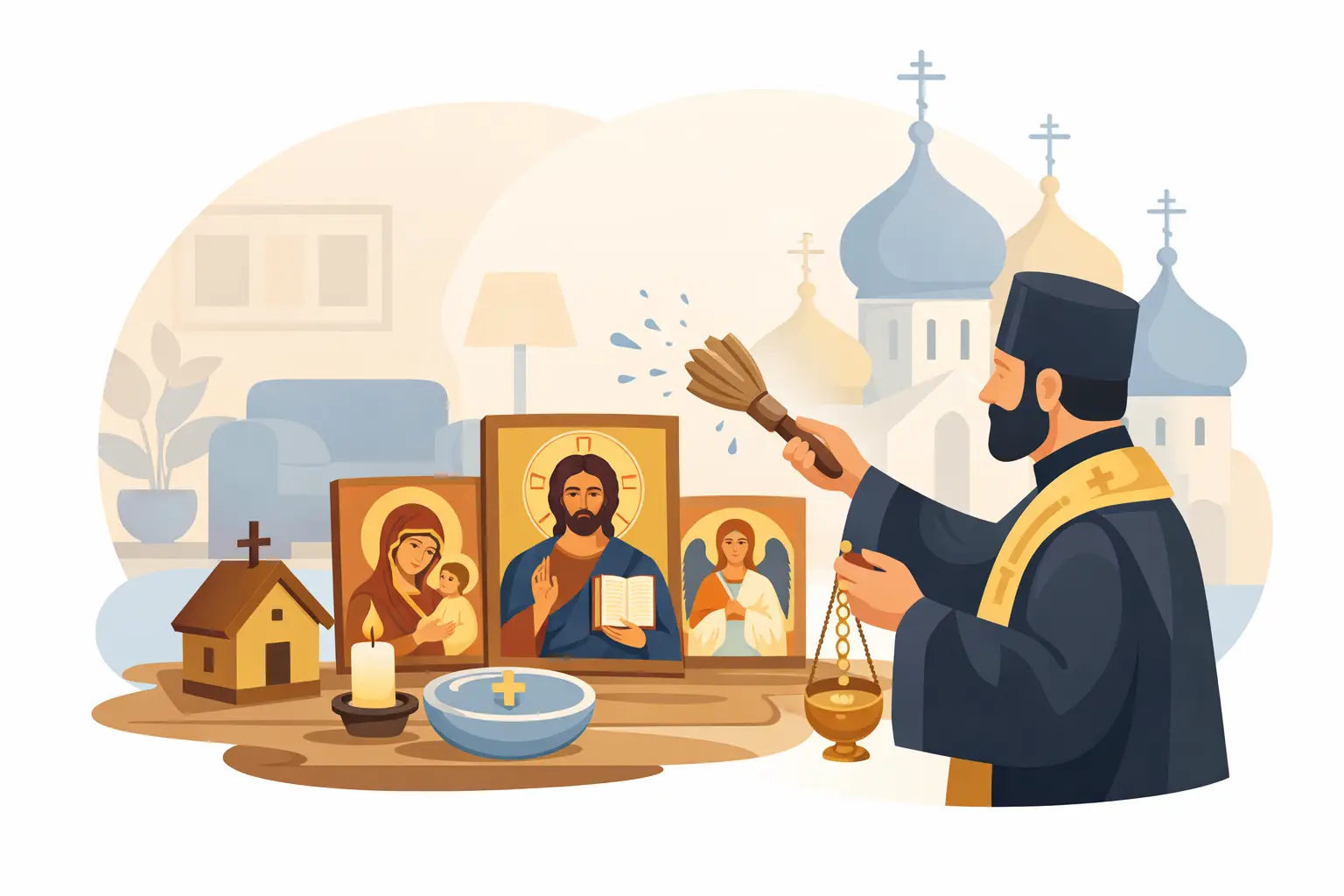
A newly received icon can be beautiful in its craftsmanship, yet its true place is not as decoration. For an Orthodox Christian, learning how to bless home icons begins with a simple distinction: an icon belongs to the life of prayer, and the blessing of sacred objects and homes is entrusted to the priest.
A carefully painted or finely worked icon of Christ, the Mother of God, or a beloved saint invites the faithful person to prayer and remembrance of God. It should be treated with reverence from the moment it enters the home. But reverence is not the same as performing a private rite of consecration. Orthodox practice has an order, and that order protects both the sacredness of the icon and the humility of the Christian household.
In ordinary Orthodox usage, a blessing is given by a bishop or priest through the prayer of the Church. The priest may bless an icon with holy water and prescribed prayers, asking God to sanctify it for the faithful veneration of the person depicted. This is not a magical act, nor does it give power to an object apart from faith, repentance, and prayer.
Practices can differ among Orthodox jurisdictions and local parishes. Some priests bless every newly purchased icon brought to church. Others may explain that a properly made canonical icon, especially one already blessed or received from a monastery, temple, or Orthodox workshop, may be placed in the home with prayer. When in doubt, ask your parish priest. His guidance is more valuable than a general custom because he knows the pastoral practice of your community.
It is also helpful to distinguish blessing an icon from blessing a house. A priest may come to bless the home at Theophany or another suitable time, praying in each room and sprinkling holy water. During this visit, the icon corner and all the people living in the house are included in the prayerful offering of the home to God.
The most fitting way to have an icon blessed is simple: bring it to your parish and ask the priest. Contact the parish office or speak to him after a service, particularly if the icon is large, fragile, framed in metal, or intended as a baptismal, wedding, memorial, or housewarming gift.
Before taking the icon to church, remove any shipping materials and make sure the surface is clean and dry. Do not use harsh cleaners, polishing compounds, or scented household sprays on a painted icon. For silver, gold-plated, or metal-mounted icons, a soft dry cloth is usually sufficient. If the icon comes with a gift case, carry it in the case for protection.
When you ask for the blessing, there is no need for elaborate explanation. You may simply say, “Father, would you please bless this icon for our home?” If it is an icon of a family patron saint, mention that. If it is being given to someone for a baptism, wedding, name day, or memorial, the priest may offer appropriate pastoral counsel.
The priest may bless the icon immediately, ask you to leave it at the church for a time, or bless it during a service according to local practice. Receive his direction peacefully. The point is not to obtain a ritual as quickly as possible, but to place the icon and the household under the prayer of the Church.
Many Orthodox Christians receive icons that have been blessed at a monastery, parish, or workshop connected with church life. A seller may clearly identify an item as consecrated or blessed, while other icons are sold as handmade devotional objects without such a statement. Read the description carefully rather than assuming.
If an icon is already blessed, it does not need to be repeatedly blessed. Still, it is entirely appropriate to bring it to your priest for his guidance, especially if you are establishing an icon corner for the first time. A priest may bless your home and pray with you even when the icons themselves have already been blessed.
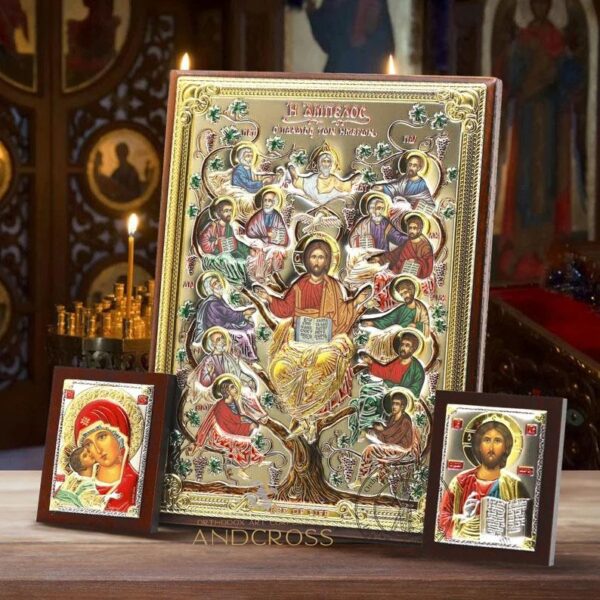
Authenticity matters here. Orthodox sacred art is not merely religious-themed décor. Choose iconography that follows the tradition of the Church, names the saint accurately, and portrays Christ, the Theotokos, angels, and saints with dignity. At Andcross, many customers seek handmade and monastery-sourced icons precisely because workmanship, canonical imagery, and meaningful presentation matter when an icon is intended for prayer or as a Christian gift.
Once the icon has been blessed, or once your priest has advised you to place it in prayer, choose a clean and respectful location. Traditionally, Orthodox homes place icons on an eastern wall when possible, recalling the expectation of Christ’s coming. In a modern apartment or house, however, this may not be practical. A quiet wall or shelf in a bedroom, living room, or dedicated prayer space is suitable.
Avoid placing icons where they are likely to be knocked over, exposed to kitchen grease, dampness, direct sunlight, or smoke. Bathrooms and casual storage areas are not fitting places. If the only available space is limited, even one well-kept icon placed above a small prayer table can establish a faithful center in the home.
The usual foundation of an icon corner is an icon of Christ and an icon of the Theotokos. Families often add their patron saints, the Guardian Angel, St. Nicholas, St. George, St. John the Baptist, or saints especially connected to their heritage. There is no need to fill a wall at once. One or two icons received with faith are better than a crowded arrangement chosen only for appearance.
A prayer book, Psalter, Gospel book, hand cross, censer, and beeswax candles may be kept nearby if the household uses them. Keep candles attended at all times and away from curtains, paper, or wooden frames. A lampada may be used according to family custom, but it also requires careful attention. Devotion should never create a fire risk.
A layperson should not attempt to replace the priest’s blessing with improvised sacramental prayers. Yet every Orthodox Christian may pray when placing an icon in the home. After making the sign of the Cross, light a candle if appropriate, cense the icon if you have been taught to do so, and pray the Trisagion prayers or simply say the Lord’s Prayer.
You may then ask Christ to grant peace to your household, or ask the saint depicted to intercede for those who live and visit there. Speak plainly and with attention. A brief prayer prayed daily is more fruitful than a long ceremony performed once and forgotten.
Orthodox Christians do not worship wood, paint, silver, or enamel. Worship belongs to the Holy Trinity alone. Icons are venerated because honor passes to the prototype – to Christ, His Mother, or the saint shown. When we kiss an icon or stand before it with a candle, we confess that God truly entered human history, that Christ became incarnate, and that His saints remain alive in Him.
This is why an icon should not be treated as a charm for prosperity, travel, or protection from every difficulty. The Cross and holy images call us to trust God, not to control circumstances. A home with icons may still know illness, grief, financial strain, and conflict. The icon corner does not remove the cross from family life. It gives the family a place to bring that cross before Christ.
Keep icons clean, upright, and protected from moisture and extreme temperature changes. Do not attach unrelated objects, notes, or decorations directly to them. If an old icon is damaged, do not discard it casually. Ask your priest how it should be repaired, stored, or disposed of respectfully.
Most of all, let the icon corner be used. Stand before it in the morning, before sleep, before a journey, and when a family member is suffering. Teach children to make the sign of the Cross and greet Christ and His saints with reverence. In a busy home, even a few minutes of sincere prayer can restore the room to its proper purpose: not simply a place where people live, but a place where God is remembered.



Use this form to find things you need on this site