Andcross Orthodox online store offers a wide range of Orthodox products - gift sets, icons, icon cases, books, monastery candles, jewelry and much more. Some of the products of our own production, as well as from other suppliers - monasteries, temples, masters of the entire Orthodox world.
Andcross Orthodox Online Store - Established in 1999
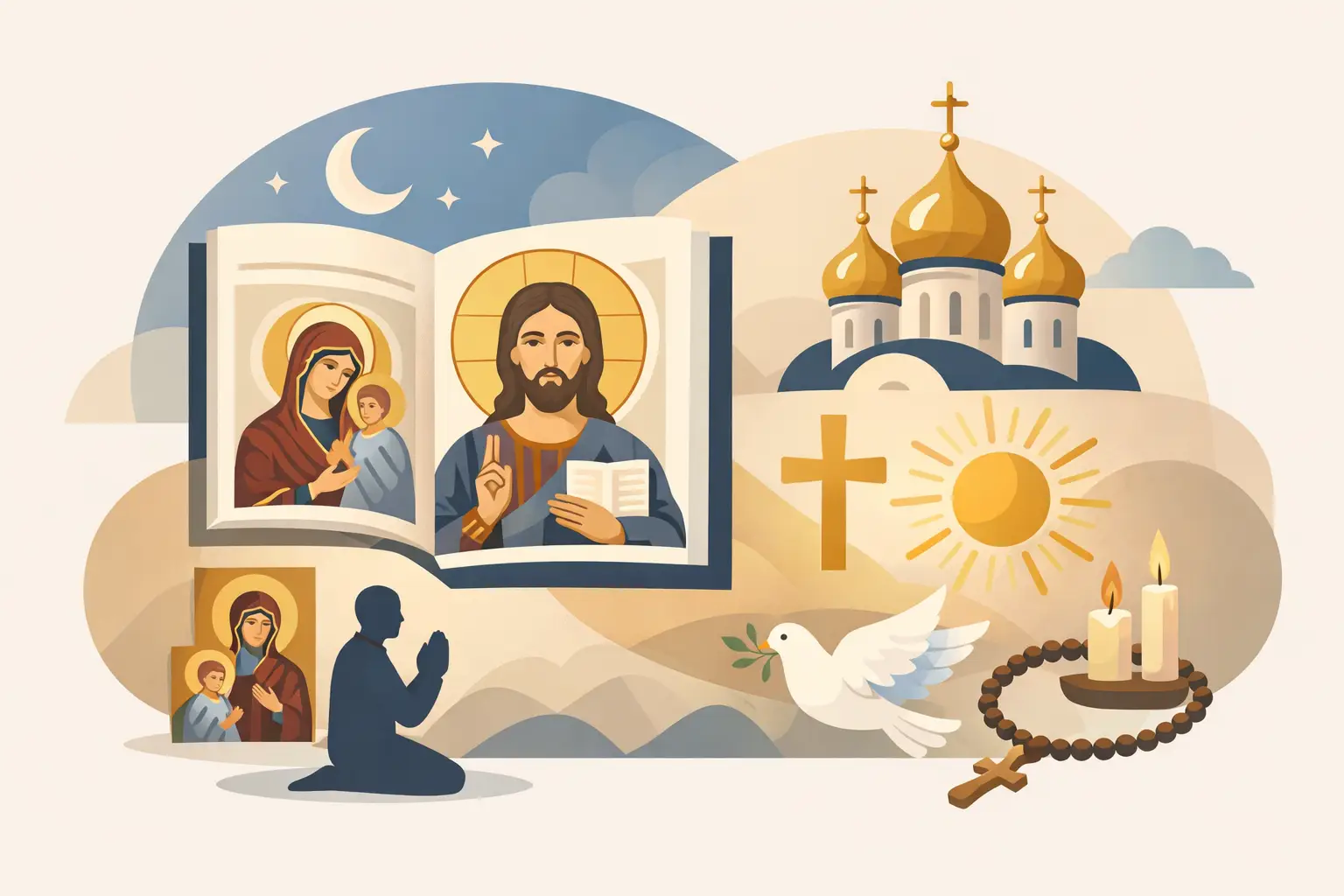
Before an Orthodox Christian lights a candle before an icon, the image has already begun to teach. The gold ground, the saint’s hand, the inscription above a sacred face, and even the direction of a building in the background carry theological meaning. This guide to Russian icon symbolism can help a prayerful viewer read these details with greater attention, whether choosing an icon for a home prayer corner, a baptismal gift, or a feast-day offering.
An icon is not religious decoration in the ordinary sense. It is a sacred image that bears witness to the Incarnation: the eternal Son of God truly took flesh and became visible. Orthodox Christians do not worship wood, paint, silver, or gold. They offer veneration to the person depicted, and that honor passes to the prototype. This is why an icon is approached with reverence, often with a candle, prayer, and a kiss.
Russian icons stand within the wider Orthodox inheritance received from Byzantium, yet they developed distinctive schools, materials, and visual tenderness over many centuries. A Novgorod icon may appear luminous and bold, while a Moscow-school icon may have more refined line and gentler modeling. These differences matter to collectors and art historians, but the central purpose remains unchanged: an icon directs the heart toward Christ, His Most Pure Mother, the angels, and the saints.
For this reason, symbolism should not be treated as a secret code that can be solved at a glance. Some meanings are firmly rooted in Church tradition; others vary according to period, region, workshop, and the individual iconographer. The most faithful way to read an icon is to begin with the person shown and the Gospel, hymn, or saintly life connected with that person.
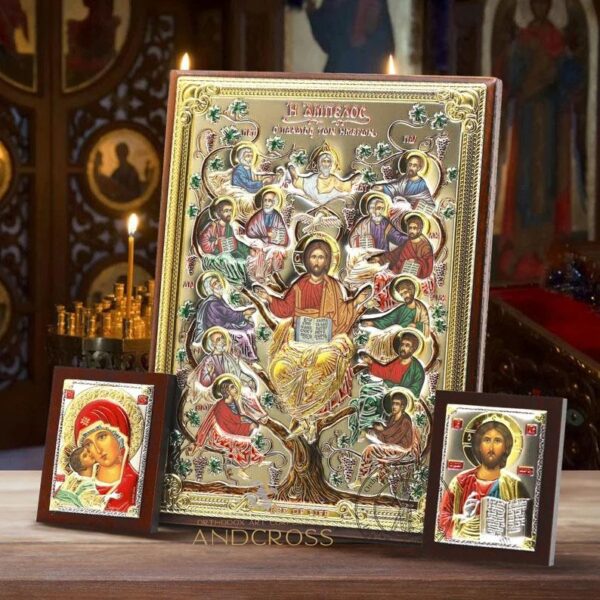
A gold background is not simply an expensive finish or an attempt to make an icon more ornamental. It represents the uncreated light of God’s Kingdom, a reality beyond ordinary time and natural space. In a gold-plated or silver icon, the radiant surface can also recall the honor traditionally given to holy images in churches and Christian homes.
Gold may appear in halos, garments, borders, or small rays. The halo signifies holiness, but it is not merely a sign of moral goodness. In icons of Christ, the halo contains a cross and the Greek letters meaning He Who Is. This identifies Jesus Christ as the eternal Lord revealed to Moses and made flesh for the salvation of the world.
Color in Russian iconography is meaningful, though it is wise not to force every shade into one fixed definition. Blue commonly suggests heaven, mystery, and divine life. Red can express life, sacrifice, royal dignity, and divine energy. Green is associated with renewal, creation, and the Holy Spirit. White speaks of divine light, purity, and the glory of the Resurrection.
The garments of Christ and the Mother of God are especially revealing. Christ is often shown in a red inner garment with a blue outer robe. The image proclaims the One who is eternally divine and who clothed Himself in human nature. The Theotokos commonly wears a deep red or burgundy outer veil over blue, expressing the human woman who was overshadowed by divine grace and became the Mother of God.
Small decorative details should be read with care. A particular workshop may use color for balance or beauty as well as symbolism. The clearest meanings arise from the whole image, not from a single pigment taken alone.
The faces in traditional icons are intentionally unlike portraits or sentimental paintings. The eyes are often large and watchful, the mouth is small, and the features are restrained. The saint does not perform emotion for the viewer. Instead, the face suggests inner stillness, prayer, and a life turned toward God.
The long, fine nose and delicate lips point away from worldly appetite and toward spiritual attention. Ears may be visible and carefully shaped, recalling the saint’s readiness to hear the word of God. These conventions are not meant to deny human personality. They show a person illumined by grace rather than ruled by passing passions.
Hands are equally eloquent. Christ and bishops may bless with the right hand, forming a traditional gesture that confesses the name of Jesus Christ. A saint holding a cross is often a martyr. A Gospel book may identify Christ, an evangelist, bishop, or teacher of the Church. A scroll can indicate preaching, wisdom, prophecy, or a written teaching. Royal garments, military armor, a physician’s box, or a particular tool may identify a saint’s calling and witness.
Western painting often uses linear perspective, in which distant objects become smaller and lines meet at a vanishing point far inside the image. Icons frequently use reverse perspective. Buildings and furniture may seem to open toward the viewer rather than recede away.
This is not a lack of artistic skill. It is a theological way of depicting a world transformed by God. The icon does not ask the faithful person to enter a closed illusion. It opens a spiritual encounter, inviting the viewer to stand prayerfully before the holy person or event.
Mountains, architecture, and trees are also simplified. A mountain may look folded or sharply rising because it is not intended as a landscape study. It tells the viewer that a sacred event occurred in a particular place: the Transfiguration on Tabor, the Nativity in the cave, or the Crucifixion at Golgotha. Buildings may indicate Jerusalem, a temple, a home, or the ordered life of the Church.
Inscriptions are among the most dependable keys to Russian icon symbolism. Christ is often marked with IC XC, an abbreviation of Jesus Christ. The Mother of God bears the Greek abbreviation MP ΘΥ, meaning Mother of God. Her three stars, usually visible on the forehead and shoulders, confess her virginity before, during, and after the birth of Christ.
Saints are usually named in Church Slavonic, Greek, or another traditional liturgical language. When selecting an icon, confirm the full inscription rather than relying only on appearance. Many saints share similar vestments or attributes, and names may have different English forms. Saint Nicholas, Saint George, Saint Seraphim of Sarov, Saint Xenia of Petersburg, and Saint Matrona of Moscow are readily recognized by many faithful, but a proper inscription gives confidence and honors the person depicted.
The lettering itself belongs to the icon. It is not a label added after the image is complete. The name makes clear that this is not a generic holy figure but a particular person known and loved in the communion of saints.
Icons of the Lord’s feasts are read through their central event. In the Nativity, Christ lies in a cave, revealing that the Light has entered a darkened world. In the Baptism of Christ, the Jordan and the descending Spirit reveal the Holy Trinity. In the Resurrection icon, often called the Descent into Hades, Christ breaks the gates of death and raises Adam and Eve, proclaiming victory over sin and the grave.
A feast icon can contain many figures and episodes at once. This does not mean it is confused. It gathers the Church’s hymnography and Scriptural memory into one sacred image. When an icon includes midwives, shepherds, angels, prophets, or grieving women, each figure helps the faithful contemplate the mystery from a different spiritual position.
A beautiful icon should first be chosen for prayer, not simply to match a room. For a home icon corner, many Orthodox families begin with Christ and the Theotokos, then add a patron saint, a baptismal saint, or a feast icon with personal meaning. For a child’s baptism, a named patron saint icon is a lasting and deeply personal gift.
Materials deserve thoughtful consideration. A hand-painted wooden icon carries the warmth of traditional panel iconography. A finely detailed silver or gold-plated icon can be especially fitting for a wedding, memorial, baptism, or significant anniversary, particularly when presented in a protective gift case. In either form, clear identification, careful craftsmanship, and faithfulness to canonical imagery matter more than excessive ornament.
At Andcross, icons and devotional gifts are selected with attention to traditional Orthodox symbolism, artisan workmanship, and meaningful presentation. If an icon is intended for a prayer corner, ask your parish priest about local practice for blessing it. Many faithful also welcome a new icon with a simple prayer and place it respectfully where it can support daily prayer.
Let the icon you choose become familiar through use. Stand before it in gratitude, bring your needs before Christ and His saints, and allow its quiet theological language to remain in the heart long after the candle has gone out.



Use this form to find things you need on this site